. 2022 Aug 26;8(2):veac080.
doi: 10.1093/ve/veac080. eCollection 2022.

The origins and molecular evolution of SARS-CoV-2 lineage B.1.1.7 in the UK

Affiliations

The origins and molecular evolution of SARS-CoV-2 lineage B.1.1.7 in the UK

Verity Hill et al. Virus Evol. .

Erratum in

Abstract

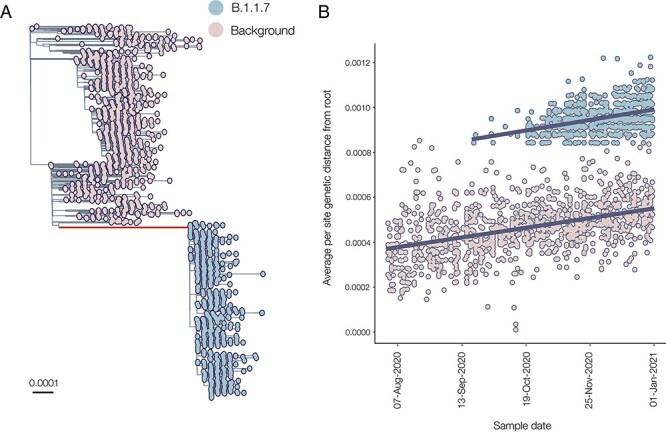
The first SARS-CoV-2 variant of concern (VOC) to be designated was lineage B.1.1.7, later labelled by the World Health Organization as Alpha. Originating in early autumn but discovered in December 2020, it spread rapidly and caused large waves of infections worldwide. The Alpha variant is notable for being defined by a long ancestral phylogenetic branch with an increased evolutionary rate, along which only two sequences have been sampled. Alpha genomes comprise a well-supported monophyletic clade within which the evolutionary rate is typical of SARS-CoV-2. The Alpha epidemic continued to grow despite the continued restrictions on social mixing across the UK and the imposition of new restrictions, in particular, the English national lockdown in November 2020. While these interventions succeeded in reducing the absolute number of cases, the impact of these non-pharmaceutical interventions was predominantly to drive the decline of the SARS-CoV-2 lineages that preceded Alpha. We investigate the only two sampled sequences that fall on the branch ancestral to Alpha. We find that one is likely to be a true intermediate sequence, providing information about the order of mutational events that led to Alpha. We explore alternate hypotheses that can explain how Alpha acquired a large number of mutations yet remained largely unobserved in a region of high genomic surveillance: an under-sampled geographical location, a non-human animal population, or a chronically infected individual. We conclude that the latter provides the best explanation of the observed behaviour and dynamics of the variant, although the individual need not be immunocompromised, as persistently infected immunocompetent hosts also display a higher within-host rate of evolution. Finally, we compare the ancestral branches and mutation profiles of other VOCs and find that Delta appears to be an outlier both in terms of the genomic locations of its defining mutations and a lack of the rapid evolutionary rate on its ancestral branch. As new variants, such as Omicron, continue to evolve (potentially through similar mechanisms), it remains important to investigate the origins of other variants to identify ways to potentially disrupt their evolution and emergence.

Keywords: SARS-COV-2; Virus evolution; Within-host evolution; variants of concern.


Figures

Figure 1.
Figure 1.
(A) Maximum likelihood phylogeny showing the well-supported monophyletic clade that constitutes B.1.1.7. The ancestral branch with the higher rate of evolution is highlighted in red, and branch lengths represent substitutions/sites. (B) Regression of root-to-tip genetic distances against sampling dates, for sequences belonging to lineage B.1.1.7 (blue) and those in its immediate out-group in the global phylogenetic tree (pink). The regression lines are fitted to the two data sets independently. The regression gradient is an estimate of the rate of sequence evolution. These rates are 4.6 × 10−4 and 4.3 × 10−4 nucleotide changes/site/year for the B.1.1.7 and out-group data sets, respectively.
Figure 2.
Figure 2.
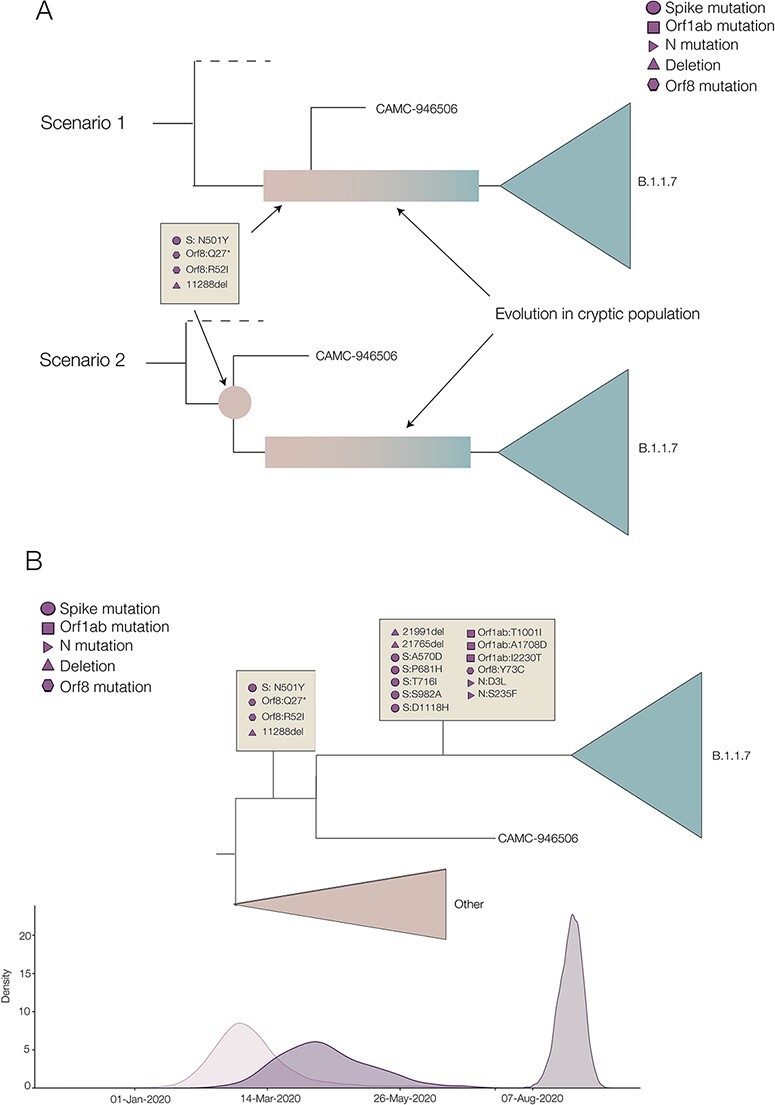
(A) Two different scenarios of how the shared mutations between CAMC-946506 and the B.1.1.7 clade could have arisen. Scenario 1 shows CAMC-946506 as resulting from a transmission chain spilling over from an isolated cryptic population, such as a chronically infected individual, and the mutations arising early in the infection. Scenario 2 shows the mutations as being shared by the common ancestor of CAMC-946506 and a cryptic population. (B) Schematic of the time tree showing possible timings for B.1.1.7 lineage-defining mutations. Densities of the most recent common ancestors for, respectively, the background lineages and all B.1.1.7, the intermediate sequence and B.1.1.7, and all B.1.1.7 are shown along the bottom.
Figure 3.
Figure 3.
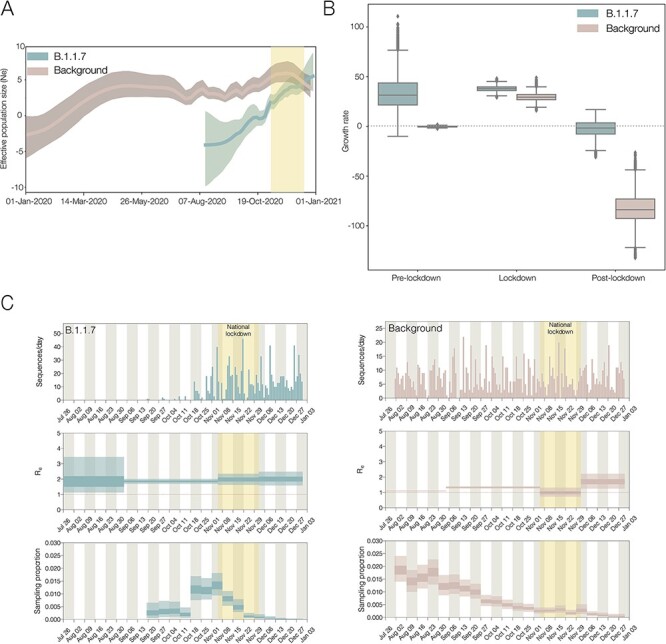
(A) Effective population sizes for the background lineages (pink) and B.1.1.7 (blue), generated from independent BEAST analyses. About 95 % of HPDs are shown as shaded areas. (B) Growth rate estimates with fixed transition times at pre-lockdown, lockdown, and post-lockdown, split by the background lineage and B.1.1.7. (C) Independent birth–death skyline analyses showing the number of sequences per day, the effective reproduction number (Re), and sampling proportion (which is allowed to vary on a weekly basis) for B.1.1.7 and the background. About 95 % of HPDs are shown as light-shaded areas and 50 % HPDs as dark-shaded areas. The English national lockdown in November is highlighted in all plots.
Figure 4.
Figure 4.
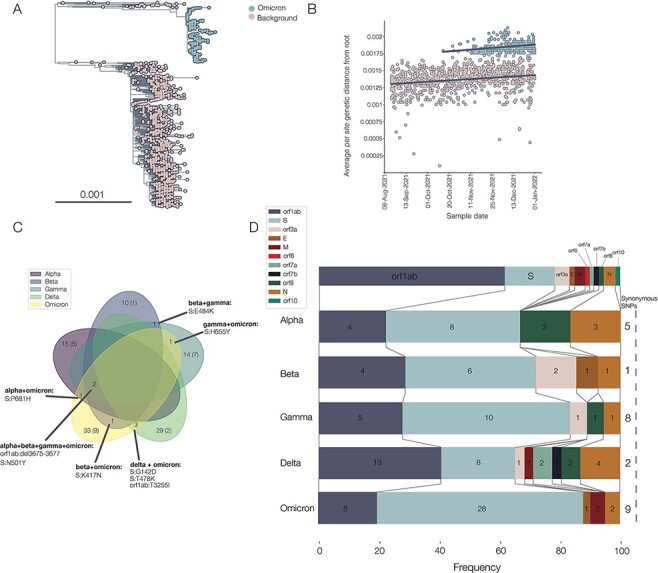
(A) Phylogeny showing Omicron in blue and background sequences in pink. The large background group is the Delta variant, the dominant variant globally in the second half of 2021. (B) Separate regressions of distance from the root against sample time for background sequences and Omicron sequences. Note that the parallel lines indicate similar rates of evolution within each clade (5.03 × 10–4 and 3.88 × 10–4 for the Omicron and background lineages, respectively). (C) Venn diagram showing numbers of mutations shared between different VOCs, with synonymous mutations in brackets. Zeroes, denoting no shared mutations acquired on the ancestral branch, are omitted. (D) Frequency of non-synonymous mutations acquired on the ancestral branch in different parts of the genome between VOCs. A schematic of the genome is shown along the top, numbers on each slice represent the absolute numbers of non-synonymous mutations or deletions in that gene, and numbers of synonymous mutations are shown along the right-hand side.

References

    1. Andreano E. et al. (2020) ‘SARS-CoV-2 Escape in Vitro from a Highly Neutralizing COVID-19 Convalescent Plasma’, bioRxiv.doi: 10.1101/2020.12.28.424451 - DOI - PMC - PubMed
    1. Avanzato V. A. et al. (2020) ‘Case Study: Prolonged Infectious SARS-CoV-2 Shedding from an Asymptomatic Immunocompromised Individual with Cancer’, Cell, 183: 1901. - PMC - PubMed
    1. Benvenuto D. et al. (2020) ‘Evolutionary Analysis of SARS-CoV-2: How Mutation of Non-structural Protein 6 (NSP6) Could Affect Viral Autophagy’, The Journal of Infection, 81: e24–27. - PMC - PubMed
    1. Cele S. et al. (2021) ‘Escape of SARS-CoV-2 501Y.V2 from Neutralization by Convalescent Plasma’, Nature, 593: 7857.doi: 10.1038/s41586-021-03471-w - DOI - PMC - PubMed
    1. ——— et al. (2022) ‘SARS-CoV-2 Prolonged Infection during Advanced HIV Disease Evolves Extensive Immune Escape’, Cell Host & Microbe, 30: 154–62.e5. - PMC - PubMed