. 2023 May;25(4):105082.
doi: 10.1016/j.micinf.2022.105082. Epub 2022 Dec 17.

Heterologous chimpanzee adenovirus vector immunizations for SARS-CoV-2 spike and nucleocapsid protect hamsters against COVID-19

Affiliations

Heterologous chimpanzee adenovirus vector immunizations for SARS-CoV-2 spike and nucleocapsid protect hamsters against COVID-19

Mohadeseh Hasanpourghadi et al. Microbes Infect. 2023 May.

Abstract

Available COVID-19 vaccine only provide protection for a limited time due in part to the rapid emergence of viral variants with spike protein mutations, necessitating the generation of new vaccines to combat SARS-CoV-2. Two serologically distinct replication-defective chimpanzee-origin adenovirus (Ad) vectors (AdC) called AdC6 and AdC7 expressing early SARS-CoV-2 isolate spike (S) or nucleocapsid (N) proteins, the latter expressed as a fusion protein within herpes simplex virus glycoprotein D (gD), were tested individually or as a mixture in a hamster COVID-19 SARS-CoV-2 challenge model. The S protein expressing AdC (AdC-S) vectors induced antibodies including those with neutralizing activity that in part cross-reacted with viral variants. Hamsters vaccinated with the AdC-S vectors were protected against serious disease and showed accelerated recovery upon SARS-CoV-2 challenge. Protection was enhanced if AdC-S vectors were given together with the AdC vaccines that expressed the gD N fusion protein (AdC-gDN). In contrast hamsters that just received the AdC-gDN vaccines showed only marginal lessening of symptoms compared to control animals. These results indicate that immune response to the N protein that is less variable than the S protein may potentiate and prolong protection achieved by the currently used S protein based genetic COVID-19 vaccines.

Keywords: Adenovirus vector vaccines; COVID-19 vaccine; Hamster challenge model; Nucleocapsid protein; Spike protein.


Conflict of interest statement

Declaration of competing interest HCJE holds equity in Virion Therapeutics. She serves as a Consultant to several Gene Therapy companies.

Figures

Fig. 1
Fig. 1
Immune responses to the vaccine vectors. [A] Experimental design. [B-H] Results for female animals are shown as circles, those for males are shown as squares. [B,C] Sera harvested at baseline, 2 weeks after the prime or the boost were tested for antibody responses. [B] Reactivity against SARS-Co-V2 S1/S2 proteins tested for by an ELISA. Data show AUC for dilution curves generated with sera of individual animals. Control animals scored negative with adsorbance values below background and these data are shown as an AUC of 0.1. Lines show geometric means (GM). Significant differences were calculated using two-Way repeated measures ANOVA with Tukey correction for multiple comparisons between time points by group. In this and all subsequent graphs lines with stars above indicated significant differences: (∗) p-value between 0.01 and 0.05, (∗∗) p-value between 0.001 and 0.01., (∗∗∗) p-value between 0.0001 and 0.001, (∗∗∗∗) p-value <0.0001. For the statistical analysis data from males and females were combined. [C] Sera were tested by a neutralization assay using VSV-S vectors pseudotyped with the same S protein as expressed by the vaccines. Data are shown for individual animals. Negatives are shown as a titer of 10. Lines indicate GMs. Lines with stars above show significant differences by two-Way repeated measures ANOVA with Tukey correction for multiple comparisons between time points by group, and between groups by time point. [D] Sera harvested after the boost were tested for inhibition of ACE binding to the RBD of S1 by an ELISA. Data are shown for individual animals as μg of antibody/ml calculated based on an internal standard. Negatives are shown as a titers of 1 μg/ml. Lines indicate GMs. Significant differences were calculated by one-way ANOVA with Tukey's correction. [E,F] Cross-reactivity against SARS-Co-V2 variants was assessed with sera collected after the prime [E] or the boost [F]. They were tested for neutralization of VSV-S vectors pseudotyped with the indicated S protein variants. Group 2 [light grey circles] and group 3 [dark grey squares] are indicated by different symbols. For the statistical analysis by one-way ANOVA with Dunnett's correction data for the two groups were combined. [G] Sera harvested 2 weeks after the boost were tested for N protein-specific antibodies by an ELISA. Results are shown as AUC for individual sera from female and male hamsters. Lines show GMs. Significant differences were calculated by Kruskal Wallis test with Dunn's multiple comparisons test. [H] Frequencies of CD8+ T cells in blood producing IFN-γ in response to N protein-derived peptides. Graph shows sum of responses to the 3 peptide pools. Lines show median responses. Lines with stars above show significant differences between animals that received the COVID vaccine and control animals by Kruskal Wallis test with Dunn's multiple comparisons test. [I] Proportions of N-specific CD8+ T cell responses to the 3 peptide pools.
Fig. 2
Fig. 2
Disease score and weight loss after challenge. [A] Experimental design. [B] Disease score over time after challenge in female (top) and male (bottom) animals of groups 1 to 4 (left to right). Data are shown for individual animals with bars indicating means. [C] Weight loss after challenge is shown as % weigh reduction over the weight on the day of challenge. Data are shown as means ± SEM. Significant differences were compared by One-Way ANOVA with Tukey correction for day 4 and 14 data separately, which are indicated by connecting lines next to the legend. Day 4 comparisons are shown first followed by/and then day 14 comparisons. [D] Median days with maximum weight loss. Significant differences were calculated using one-Way ANOVA with Tukey correction.
Fig. 3
Fig. 3
Viral loads and lung pathology. [A] Experimental design. [B,C] Viral RNA [B] and sgRNA [C] loads in oral swabs collected after challenge on days 2 and 4 for all animals and on days 7 and 14 for the day 14 euthanasia group animals. Significant difference between groups for each time point were calculated by two-Way repeated measures ANOVA with Tukey correction; they are indicated with lines and stars above as in legend to Fig. 1. [D,E] Lung viral RNA [D] and sgRNA [E] titers are shown for individual hamsters of the day 4 and day 14 euthanasia groups. Differences were calculated by two-Way ANOVA with Tukey correction, with lines and stars showing significant differences as in legend to Fig. 1. [F,G] SARS-CoV-2 TCID50 titers in nares [F] and lungs [G] were determine on day 4 after challenge. Data were analyzed by an uncorrected Kruskal–Wallis test. [H] Sum of lung lesions for the day 4 and day 14 euthanasia group. Differences were calculated by two-Way ANOVA with Tukey correction, with lines and stars above as in legend to Fig. 1. [I] Severity of the different types of lesions according to gender of the animals.
Fig. 4
Fig. 4
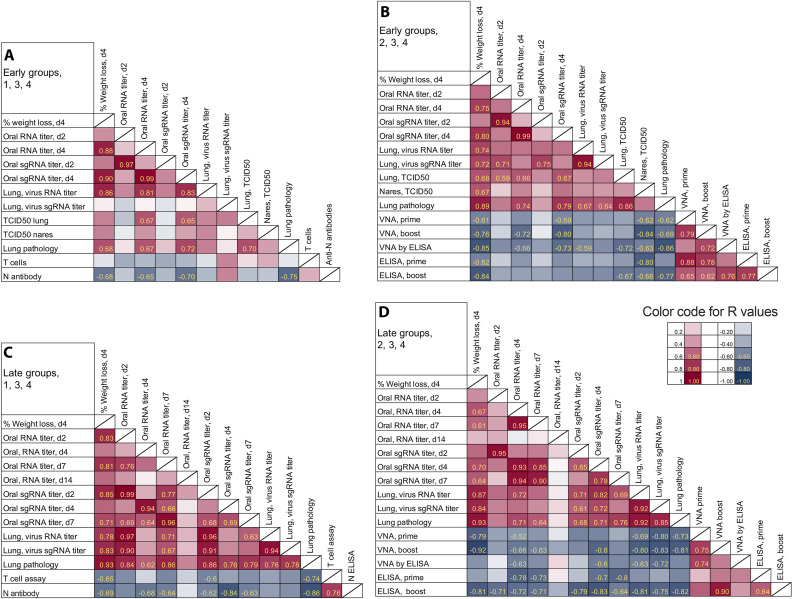
Correlations between antibodies to N proteins and disease parameters and T cell responses. The graphs show as heatmaps the R-values of correlations by Spearman between the indicated parameters. Red squares show positive R values, blue squares show negative R values as indicated in the legend. Yellow numbers of R within colored squares are only shown for R values with p-values ≤0.05. [A] Analysis for the early euthanasia animals of groups 1, 3, and 4. [B] Analysis for the early euthanasia animals of groups 2, 3, and 4. [C] Analysis for the late euthanasia animals of groups 1, 3, and 4. [D] Analysis for the late euthanasia animals of groups 2, 3, and 4.

References

    1. Liu L., Iketani S., Guo Y., Chan J.F.-W., Wang M., Liu L., et al. Striking antibody evasion manifested by the Omicron variant of SARS-CoV-2. Nature. 2022;602:676–681. doi: 10.1038/s41586-021-04388-0. - DOI - PubMed
    1. Baden L.R., El Sahly H.M., Essink B., Kotloff K., Frey S., Novak R., et al. Efficacy and safety of the mRNA-1273 SARS-CoV-2 vaccine. N Engl J Med. 2021;384:403–416. doi: 10.1056/NEJMoa2035389. - DOI - PMC - PubMed
    1. Polack F.P., Thomas S.J., Kitchin N., Absalon J., Gurtman A., Lockhart S., et al. Safety and efficacy of the BNT162b2 mRNA Covid-19 vaccine. N Engl J Med. 2020;383:2603–2615. doi: 10.1056/NEJMoa2034577. - DOI - PMC - PubMed
    1. Sadoff J., Gray G., Vandebosch A., Cárdenas V., Shukarev G., Grinsztejn B., et al. Safety and efficacy of single-dose Ad26.COV2.S vaccine against Covid-19. N Engl J Med. 2021 doi: 10.1056/NEJMoa2101544. NEJMoa2101544. - DOI - PMC - PubMed
    1. Emary K.R.W., Golubchik T., Aley P.K., Ariani C.V., Angus B., Bibi S., et al. Efficacy of ChAdOx1 nCoV-19 (AZD1222) vaccine against SARS-CoV-2 variant of concern 202012/01 (B.1.1.7): an exploratory analysis of a randomised controlled trial. Lancet. 2021;397:1351–1362. doi: 10.1016/S0140-6736(21)00628-0. - DOI - PMC - PubMed

Publication types