. 2022 Dec 20;23(1):263.
doi: 10.1186/s13059-022-02833-5.

Canalization of genome-wide transcriptional activity in Arabidopsis thaliana accessions by MET1-dependent CG methylation

Affiliations

Canalization of genome-wide transcriptional activity in Arabidopsis thaliana accessions by MET1-dependent CG methylation

Thanvi Srikant et al. Genome Biol. .

Abstract

Background: Despite its conserved role on gene expression and transposable element (TE) silencing, genome-wide CG methylation differs substantially between wild Arabidopsis thaliana accessions.

Results: To test our hypothesis that global reduction of CG methylation would reduce epigenomic, transcriptomic, and phenotypic diversity in A. thaliana accessions, we knock out MET1, which is required for CG methylation, in 18 early-flowering accessions. Homozygous met1 mutants in all accessions suffer from common developmental defects such as dwarfism and delayed flowering, in addition to accession-specific abnormalities in rosette leaf architecture, silique morphology, and fertility. Integrated analysis of genome-wide methylation, chromatin accessibility, and transcriptomes confirms that MET1 inactivation greatly reduces CG methylation and alters chromatin accessibility at thousands of loci. While the effects on TE activation are similarly drastic in all accessions, the quantitative effects on non-TE genes vary greatly. The global expression profiles of accessions become considerably more divergent from each other after genome-wide removal of CG methylation, although a few genes with diverse expression profiles across wild-type accessions tend to become more similar in mutants. Most differentially expressed genes do not exhibit altered chromatin accessibility or CG methylation in cis, suggesting that absence of MET1 can have profound indirect effects on gene expression and that these effects vary substantially between accessions.

Conclusions: Systematic analysis of MET1 requirement in different A. thaliana accessions reveals a dual role for CG methylation: for many genes, CG methylation appears to canalize expression levels, with methylation masking regulatory divergence. However, for a smaller subset of genes, CG methylation increases expression diversity beyond genetically encoded differences.

Keywords: Arabidopsis; DNA methylation; Epigenetics; Methyltransferase; Natural variation.


Conflict of interest statement

D.W. holds equity in Computomics, which advises plant breeders. D.W. consults for KWS SE, a plant breeder and seed producer. All other authors declare that they have no competing interests.

Figures

Fig. 1.
Fig. 1.
Transcriptomic variation among accessions in met1 mutants and wildtypes. a UMAP projections of transformed RNA-seq read counts in 19,473 genes similarly compared for wildtypes (left) and met1 mutants (right). These genes were further analyzed to identify DEGs across accessions, separately for WTs and met1 mutants. b UMAP representation of transformed RNA-seq counts from 158 samples (104 hetero- or homozygous met1 mutants and 54 wild-type plants) across 21,657 genes. Colors indicate accessions, and shapes indicate genotype. WT, wild-type; Mut Het, heterozygous met1 mutants; Mut Homo G1, first-generation homozygous met1 mutants; Mut Homo G2, second-generation homozygous met1 mutants. c Volcano plot of 3479 DEGs identified in a contrast between all met1 mutant samples and all wild-type samples. TE-associated DEGs (TE-DEGs) are colored purple, and Non-TE-DEGs yellow. d Chromosomal distribution of 3479 DEGs from the all-met1-against-all-wild-type contrast, and their log2(fold change) in mutants relative to the corresponding wildtypes. Upregulated DEGs are colored orange and downregulated DEGs green. e DEGs in the 18 accession-specific contrasts, compared to the all-met1-against-all-wild-type contrast (denoted by “A,” third column from the left). f Variation in numbers of upregulated and downregulated Non-TE-DEGs and TE-DEGs across different contrasts, bars colored similarly to d. For e and f, colors below bars indicate accession-specific contrasts. g Boxplots showing distribution of the coefficient of variation (CV) for expression level (measured in transformed read counts) across accessions, compared between 104 met1 mutant and 54 wild-type samples at 10,151 Non-TE-DEGs, 1,524 TE-DEGs, and 291 Universal DEGs. *** indicates Wilcoxon-test p-value <0.0001
Fig. 2
Fig. 2
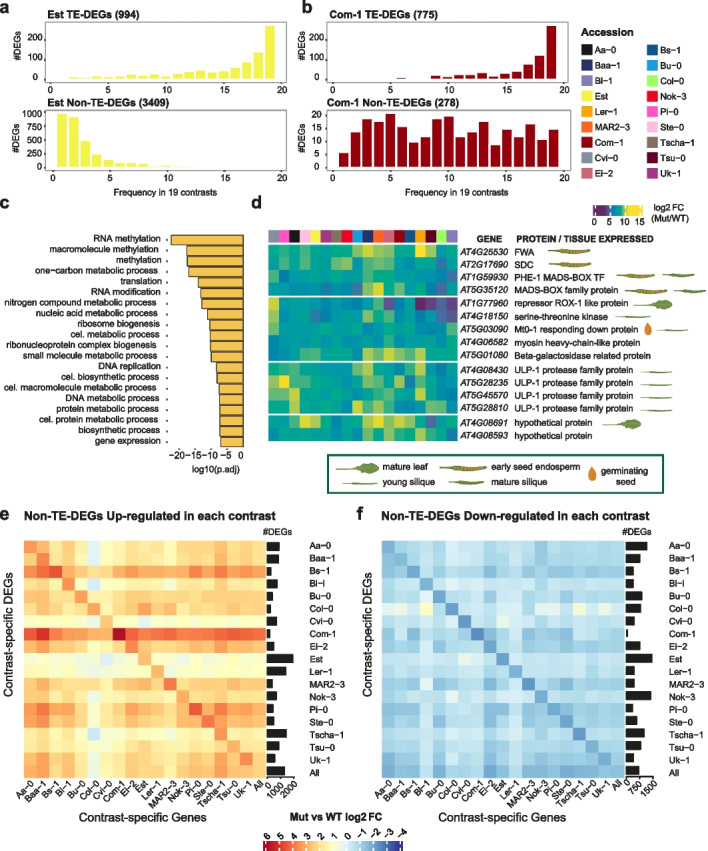
Qualitative and quantitative comparisons of accession-specific DEGs. a, b Frequency spectrum of Est and Com-1 TE-DEGs and Non-TE-DEGs across all other accessions. c The top 20 GO terms enriched for 983 DEGs unique to Est. d Heatmap of log2(fold change) of 15 universal Non-TE-DEGs across all accessions, grouped by protein function categories. TAIR10 gene names, encoded proteins and their preferential tissues of expression in wild-type (where known) are shown. e, f Heatmaps of average log2(fold change) for all Non-TE-DEGs from one accession in each of the other accessions. Barplots on the right indicate the absolute frequency of Non-TE-DEGs in each accession
Fig. 3
Fig. 3
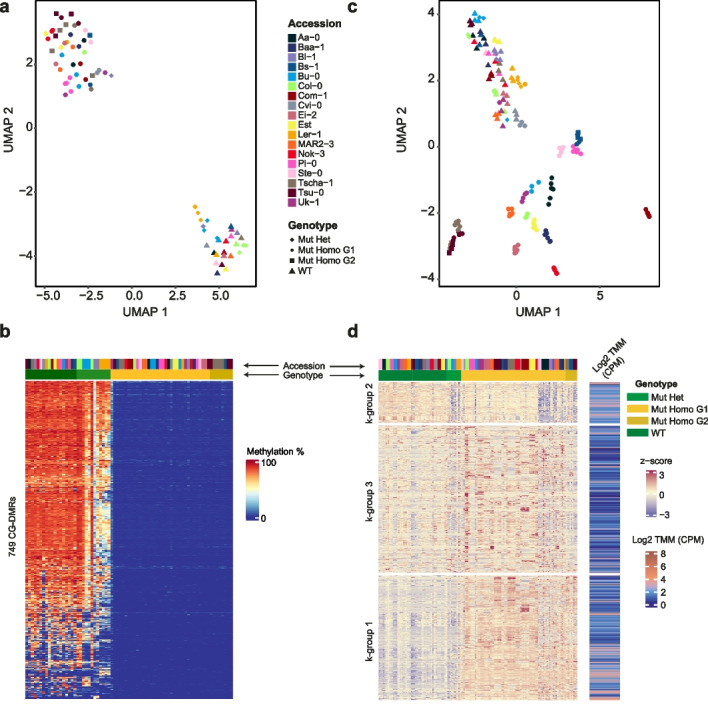
Reduced CG methylation and increased chromatin accessibility in met1 mutants. a, b UMAP representation and heatmap of CG methylation levels in wild-type plants and met1 mutants across 749 CG-DMRs (from a total of 2388 CG-DMRs). c UMAP representation of chromatin accessibility in log2(CPM) of 9505 highly variable dACRs (HV-dACRs) across wild-type plants and met1 mutants. d Heatmap of z-scaled values of 9505 HV-dACRs grouped by k-means clustering, with mean accessibility for each dACR indicated on the right. TMM, trimmed mean of M-values. CPM, counts per million
Fig. 4
Fig. 4
CG-DMRs in gene bodies of Non-TE-DEGs and TE-DEGs. Differences in CG methylation between met1 mutants and wild-type plants plotted against differences in gene expression. Dots are colored by wild-type expression quintiles (a,b,e,f) and wild-type methylation quintiles (c,d,g,h) with density distributions shown on top and left. Expression levels are represented as transformed read counts (tr. counts) and methylation levels as % CG methylation in CG-DMRs
Fig. 5
Fig. 5
Non-TE-DEGs in met1 mutants can have different epigenetic states in different accessions. a Heatmap of expression changes across 5731 Non-TE-DEGs in 17 accessions, with an adjacent heatmap showing variance expressed as standard deviation (SD) across accessions, and scatterplots of changes in expression and accessibility in representative genes, AT1G60190 and PR1, from two different DEG categories (based on overlap with cis CG-DMRs and HV-dACRs). A genome browser screenshot of ATAC-seq, RNA-seq, and BS-seq data in three accessions is shown for a third example gene locus, ROS1, harboring both cis DMRs and cis dACRs. b Scatterplot of changes in chromatin accessibility and methylation in Non-TE-DEGs across 17 accessions. Colors and density distributions represent custom bins of expression changes. A closeup of a selected region is shown below. c Scatterplots similar to b for Non-TE genes. d Boxplots showing MET1-dependent changes in chromatin accessibility, gene expression, and CG methylation of genes that are weakly (“LOW”) or highly (“HIGH”) methylated in wild-type Cvi-0. The same genes are compared for Cvi-0 (dark green) and 16 other accessions (gray). e Scatterplot of changes in methylation and expression in Non-TE-DEGs with gene body CG-DMRs, colored by DEGs specific to Col-0 (black) against the same genes in other accessions (yellow). f Scatterplot of changes in chromatin accessibility and expression in Non-TE-DEGs carrying cis dACRs, colored by DEGs specific to Col-0 (black) against the same genes in other accessions (yellow). Expression levels are represented as transformed read counts (tr. counts); chromatin accessibility levels as TMM (trimmed mean of M-values) normalized values in counts per million (CPM), and methylation levels as % CG methylation
Fig. 6
Fig. 6
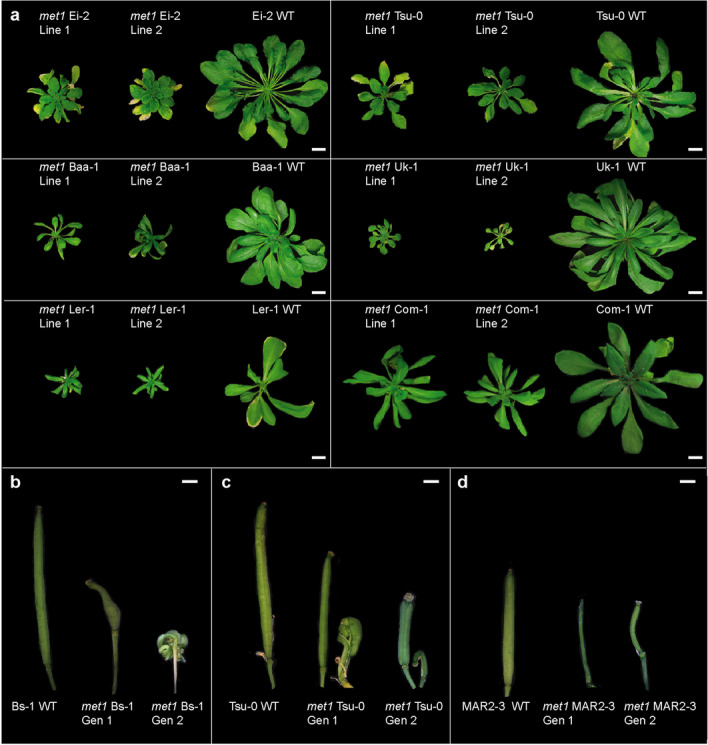
Rosette and silique morphology of met1 mutants. a Representative images of two independently derived mutants and the corresponding wild-type (WT) for six accessions at 6 weeks post germination; scale bars represent 1 cm. bd Silique morphology in three accessions. Scale bars represent 1 mm. Gen1, first-generation homozygous mutants; Gen 2, second-generation homozygous mutants
Fig. 7
Fig. 7
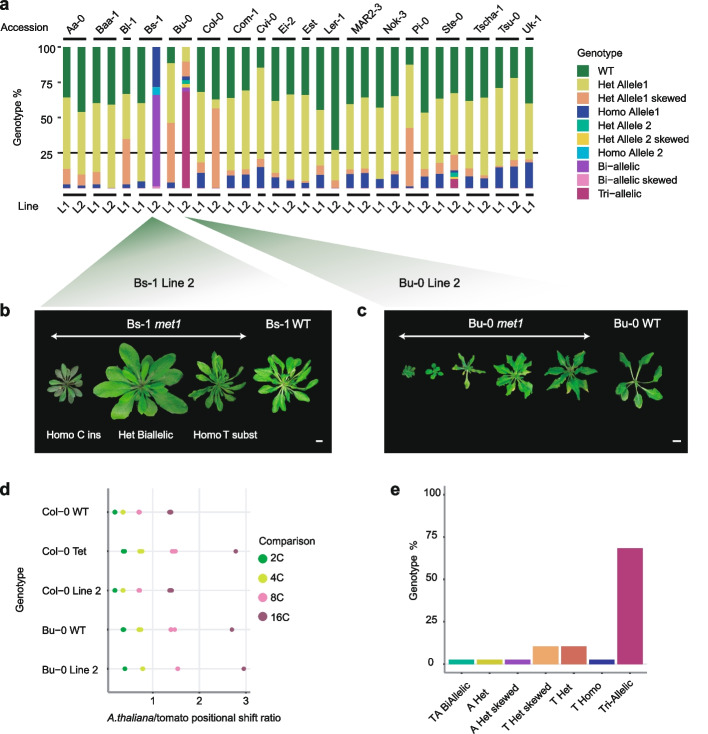
Segregation distortion in met1 mutants. a Proportions of wild-type and met1 mutant genotypes in progeny of heterozygous individuals. L1, L2, Line 1, Line 2. b Different phenotypes in met1 Bs-1 Line 2. “Ins” refers to “insertion” and “subst” refers to “substitution.” c Phenotypic diversity in Bu-0 Line 2. d Endopolyploidy peak position ratios (from flow cytometry profiles) in Bu-0 and Col-0 lines relative to tomato internal standard. “Col-Tet,” Col-0 tetraploid line. e Fractions of segregating genotypes in met1 Bu-0 Line 2 progeny. Scale bars in b and c = 1 cm

References

    1. Law JA, Jacobsen SE. Establishing, maintaining and modifying DNA methylation patterns in plants and animals. Nat Rev Genet. 2010;11:204. doi: 10.1038/nrg2719. - DOI - PMC - PubMed
    1. Zhang H, Lang Z, Zhu J-K. Dynamics and function of DNA methylation in plants. Nat Rev Mol Cell Biol. 2018;19:489–506. doi: 10.1038/s41580-018-0016-z. - DOI - PubMed
    1. Finnegan EJ, Peacock WJ, Dennis ES. Reduced DNA methylation in Arabidopsis thaliana results in abnormal plant development. Proc Natl Acad Sci U S A. 1996;93:8449–8454. doi: 10.1073/pnas.93.16.8449. - DOI - PMC - PubMed
    1. Jacobsen SE, Sakai H, Finnegan EJ, Cao X, Meyerowitz EM. Ectopic hypermethylation of flower-specific genes in Arabidopsis. Curr Biol. 2000;10:179–186. doi: 10.1016/S0960-9822(00)00324-9. - DOI - PubMed
    1. Kankel MW, Ramsey DE, Stokes TL, Flowers SK, Haag JR, Jeddeloh JA, et al. Arabidopsis MET1 cytosine methyltransferase mutants. Genetics. 2003;163:1109–1122. doi: 10.1093/genetics/163.3.1109. - DOI - PMC - PubMed

Publication types

MeSH terms

LinkOut - more resources