


The impact of mortality salience on quantified self behavior during the COVID-19 pandemic
- PMID: 36540323
- PMCID: PMC9756974
- DOI: 10.1016/j.paid.2021.110972
The impact of mortality salience on quantified self behavior during the COVID-19 pandemic
Abstract
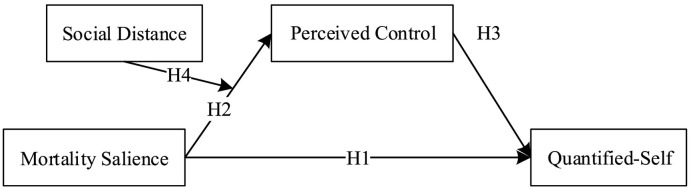
Quantified self refers to the process consumers collect, analyze to reflect, control, and optimize their behaviors, thus obtaining self-knowledge. Since the COVID-19 pandemic has changed our lives dramatically, this research aims to explore how mortality salience caused by COVID-19 affects people's quantified self behavior. The current study used an online survey and the experimental method to test multiple research hypotheses. The results indicated that mortality salience has a positive impact on quantified self; perceived control mediates the relationship between mortality salience and the quantified self, and social distance plays a moderating role between mortality salience and perceived control. The conclusions provide a new way to help people deal with anxiety and fear brought by the COVID-19, and enhance public health and well-being.
Keywords: COVID-19; Mortality salience; Perceived control; Quantified self; Social distance; Terror management theory.
© 2021 Elsevier Ltd. All rights reserved.
Figures
References
-
- Arndt J., Solomon S., Sheldon K.K.M. The urge to splurge: A terror management account of materialism and consumer behavior. Journal of Consumer Psychology. 2004;14(3):198–212. doi: 10.1207/s15327663jcp1403_2. - DOI
-
- Beck E. Free Press; New York: 2004. The denial of death.
-
- Belk R.W. You are what you can access: Sharing and collaborative consumption online. Journal of Business Research. 2014;67(8):1595–1600. doi: 10.1016/j.jbusres.2013.10.001. - DOI
LinkOut - more resources
Full Text Sources