Sensitivity and complications of thoracentesis and thoracoscopy: a meta-analysis
- PMID: 36543349
- PMCID: PMC9879342
- DOI: 10.1183/16000617.0053-2022
Sensitivity and complications of thoracentesis and thoracoscopy: a meta-analysis
Abstract
Background: Thoracentesis and thoracoscopy are used to diagnose malignant pleural effusions (MPE). Data on how sensitivity varies with tumour type is limited.
Methods: Systematic review using PubMed was performed through August 2020 to determine the sensitivity of thoracentesis and thoracoscopy for MPE secondary to malignancy, by cancer type, and complication rates. Tests to identify sources of heterogeneity were performed. Study quality was assessed using Quality Assessment of Diagnostic Accuracy Studies (QUADAS)-2 and National Institutes of Health quality assessment tools. Publication bias was tested using funnel plots.
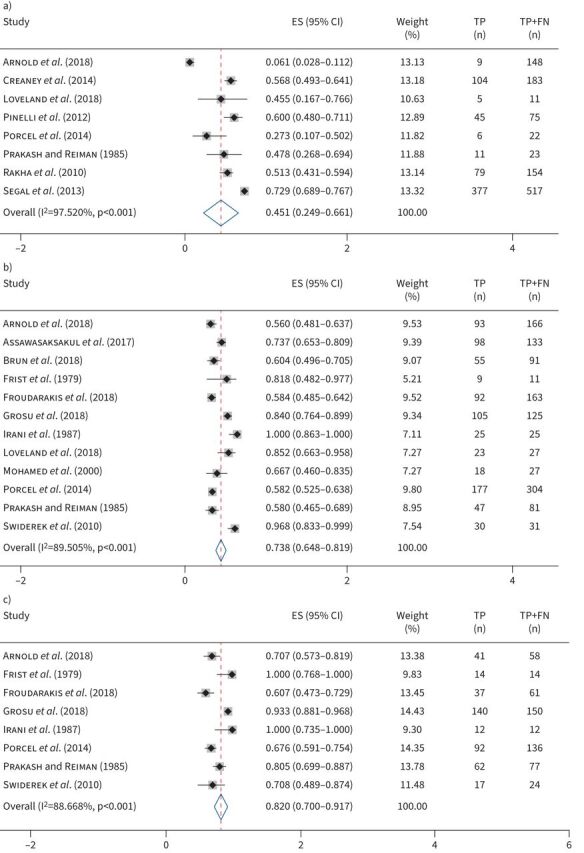
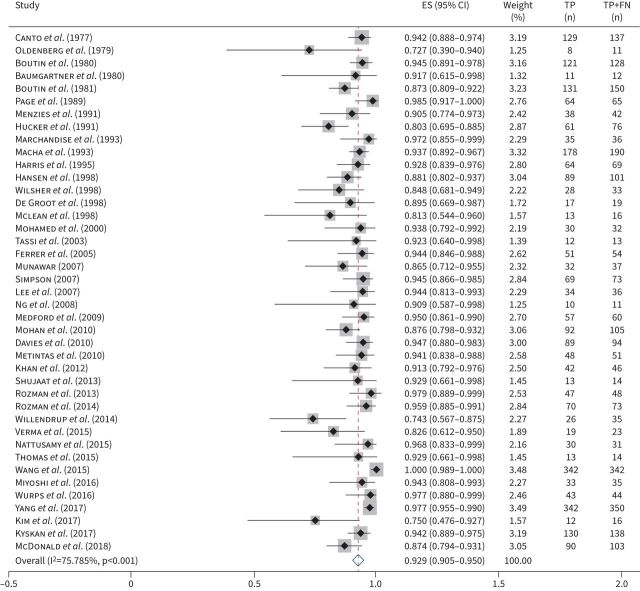
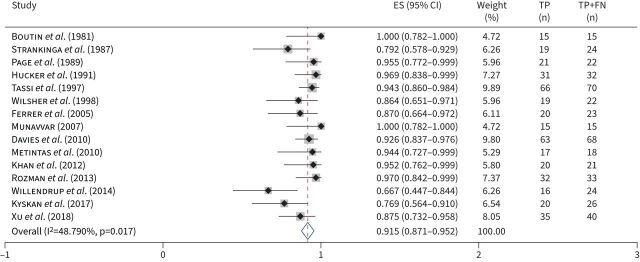
Results: Meta-analyses for sensitivity of thoracentesis for MPE secondary to malignancy, mesothelioma and lung and breast cancer included 29, eight, 12 and nine studies, respectively. Pooled sensitivities were 0.643 (95% CI 0.592-0.692), 0.451 (95% CI 0.249-0.661), 0.738 (95% CI 0.659-0.836) and 0.820 (95% CI 0.700-0.917), respectively. For sensitivity of thoracoscopy for MPE secondary to malignancy and mesothelioma, 41 and 15 studies were included, respectively. Pooled sensitivities were 0.929 (95% CI 0.905-0.95) and 0.915 (95% CI 0.871-0.952), respectively. Pooled complication rates of thoracentesis and thoracoscopy were 0.041 (95% CI 0.025-0.051) and 0.040 (95% CI 0.029-0.052), respectively. Heterogeneity was significant for all meta-analyses. Funnel plots were asymmetric.
Interpretation: Sensitivity of thoracentesis varied significantly per cancer type. Pooled complication rates were low. Awareness of how sensitivity of thoracentesis changes across cancers can improve decision-making when MPE is suspected.
Copyright ©The authors 2022.
Conflict of interest statement
Conflicts of interest: G. Martinez-Zayas, S. Molina and D.E. Ost have no conflicts of interest to disclose and take full responsibility for this paper.
Figures


References
Publication types
MeSH terms
LinkOut - more resources
Full Text Sources
Medical