


The potential of multistress tolerant yeast, Saccharomycodes ludwigii, for second-generation bioethanol production
- PMID: 36543886
- PMCID: PMC9772304
- DOI: 10.1038/s41598-022-26686-x
The potential of multistress tolerant yeast, Saccharomycodes ludwigii, for second-generation bioethanol production
Abstract
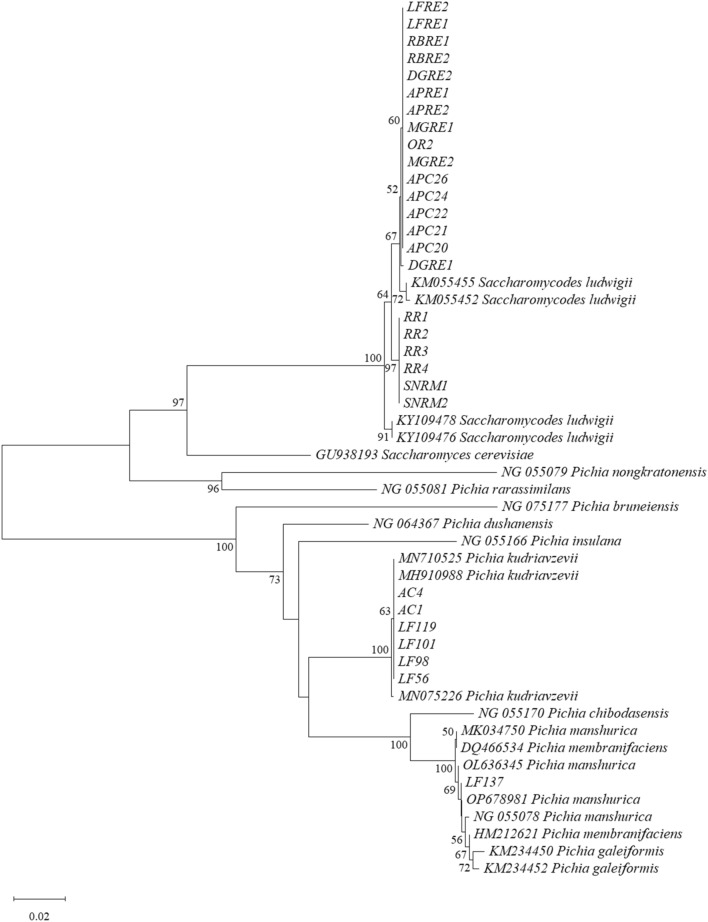
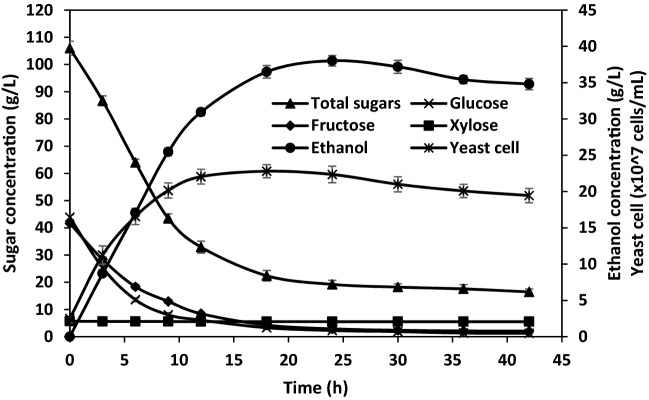
Ethanol production at high temperatures using lignocellulosic biomass as feedstock requires a highly efficient thermo and lignocellulosic inhibitor-tolerant ethanologenic yeast. In this study, sixty-three yeast isolates were obtained from tropical acidic fruits using a selective acidified medium containing 80 mM glacial acetic acid. Twenty-nine of the yeast isolates exhibited significant thermo and acetic acid-tolerant fermentative abilities. All these isolates were classified into three major yeast species, namely Saccharomycodes ludwigii, Pichia kudriavzevii, and P. manshurica, based on molecular identification. Saccharomycodes ludwigii APRE2 displayed an ability to grow at high temperatures of up to 43 °C and exhibited significant multistress tolerance toward acetic acid, furfural, 5-hydroxymethyl furfural (5-HMF), and ethanol among the isolated yeast species. It can produce a maximum ethanol concentration of 63.07 g/L and productivity of 1.31 g/L.h in yeast extract malt extract (YM) medium containing 160 g/L glucose and supplemented with 80 mM acetic acid and 15 mM furfural as a cocktail inhibitor. When an acid-pretreated pineapple waste hydrolysate (PWH) containing approximately 106 g/L total sugars, 131 mM acetic acid, and 3.95 mM furfural was used as a feedstock, 38.02 g/L and 1.58 g/L.h of ethanol concentration and productivity, respectively, were achieved. Based on the results of the current study, the new thermo and acetic acid-tolerant yeast S. ludwigii APRE2 exhibited excellent potential for second-generation bioethanol production at high temperatures.
© 2022. The Author(s).
Conflict of interest statement
The authors declare no competing interests.
Figures
References
-
- Brown M, Trautmann ST, Vlahu R. Understanding bank-run contagion. Manage. Sci. 2017;63:2272–2282. doi: 10.1287/mnsc.2015.2416. - DOI
-
- Giwa A, Adeyemi I, Dindi A, Lopez CGB, Lopresto CG, Curcio S, Chakraborty S. Techno-economic assessment of the sustainability of an integrated biorefinery from microalgae and Jatropha: A review and case study. Renew. Sustain. Energy. Rev. 2018;88:239–257. doi: 10.1016/j.rser.2018.02.032. - DOI
-
- Quilcaille Y, Gasser T, Ciais P, Lecocq F, Janssens-Maenhout G, Mohr S. Uncertainty in projected climate change arising from uncertain fossil-fuel emission factors. Environ. Res. Lett. 2018;13:044017. doi: 10.1088/1748-9326/aab304. - DOI
-
- Mandley SJ, Daioglou V, Junginger HM, van Vuuren DP, Wicke B. EU bioenergy development to 2050. Renew. Sustain. Energy Rev. 2020;127:109858. doi: 10.1016/j.rser.2020.109858. - DOI
-
- Patel SKS, Das D, Kim SC, Cho BK, Kalia VC, Lee JK. Integrating strategies for sustainable conversion of waste biomass into dark-fermentative hydrogen and value-added products. Renew. Sustain. Energy Rev. 2021;150:111491. doi: 10.1016/j.rser.2021.111491. - DOI
Publication types
MeSH terms
Substances
Supplementary concepts
LinkOut - more resources
Full Text Sources
