


Partial trisomy 21 with or without highly restricted Down syndrome critical region (HR-DSCR): report of two new cases and reanalysis of the genotype-phenotype association
- PMID: 36544206
- PMCID: PMC9768891
- DOI: 10.1186/s12920-022-01422-6
Partial trisomy 21 with or without highly restricted Down syndrome critical region (HR-DSCR): report of two new cases and reanalysis of the genotype-phenotype association
Abstract
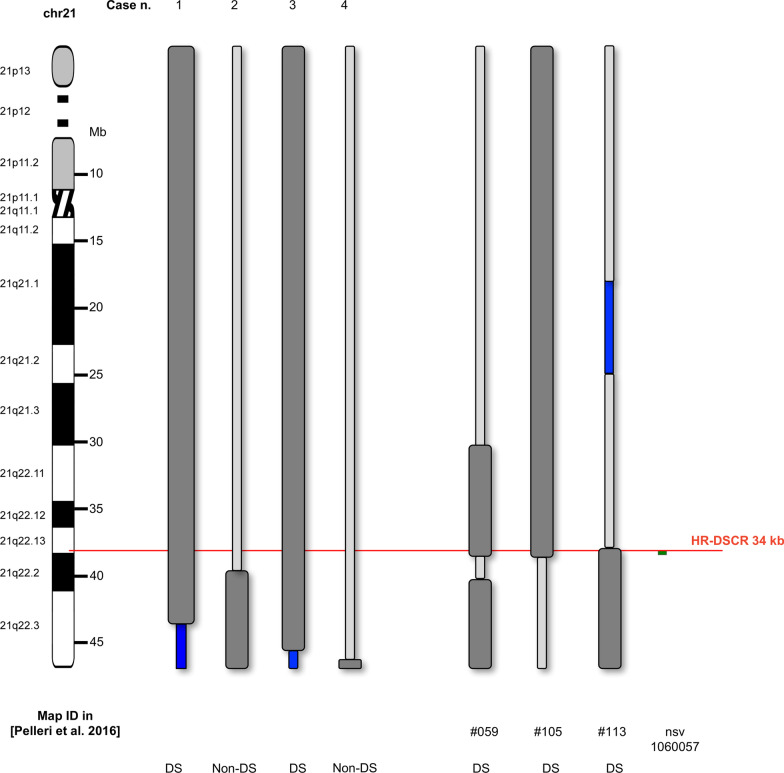
Background: Down syndrome (DS) is caused by the presence of an extra copy of full or partial human chromosome 21 (Hsa21). Partial (segmental) trisomy 21 (PT21) is the duplication of only a delimited region of Hsa21 and can be associated or not to DS: the study of PT21 cases is an invaluable model for addressing genotype-phenotype correlation in DS. Previous works reported systematic reanalyses of 132 subjects with PT21 and allowed the identification of a 34-kb highly restricted DS critical region (HR-DSCR) as the minimal region whose duplication is shared by all PT21 subjects diagnosed with DS.
Methods: We report clinical data and cytogenetic analysis of two children with PT21, one with DS and the other without DS. Moreover, we performed a systematic bibliographic search for any new PT21 report.
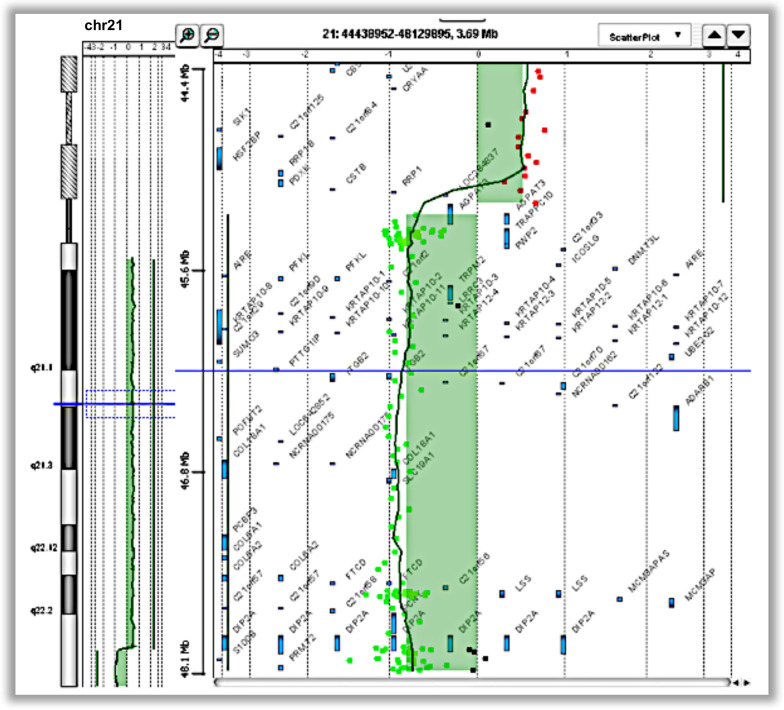
Results: Clinical and cytogenetic analyses of the two PT21 children have been reported: in Case 1 the duplication involves the whole long arm of Hsa21, except for the last 2.7 Mb, which are deleted as a consequence of an isodicentric 21: the HR-DSCR is within the duplicated regions and the child is diagnosed with DS. In Case 2 the duplication involves 7.1 Mb of distal 21q22, with a deletion of 2.1 Mb of proximal 20p, as a consequence of an unbalanced translocation: the HR-DSCR is not duplicated and the child presents with psychomotor development delay but no clinical signs of DS. Furthermore, two PT21 reports recently published (named Case 3 and 4) have been discussed: Case 3 has DS diagnosis, nearly full trisomy for Hsa21 and a monosomy for the 21q22.3 region. Case 4 is a baby without DS and a 0.56-Mb duplication of 21q22.3. Genotype-phenotype correlation confirmed the presence of three copies of the HR-DSCR in all DS subjects and two copies in all non-DS individuals.
Conclusions: The results presented here are fully consistent with the hypothesis that the HR-DSCR is critically associated with DS diagnosis. No exception to this pathogenetic model was found. Further studies are needed to detect genetic determinants likely located in the HR-DSCR and possibly responsible for core DS features, in particular intellectual disability.
Keywords: Down syndrome; Highly restricted Down syndrome critical region; Partial trisomy 21.
© 2022. The Author(s).
Conflict of interest statement
The authors declare that they have no competing interests.
Figures


References
-
- Lejeune J, Gauthier M, Turpin R. Human chromosomes in tissue cultures. C R Hebd Seances Acad Sci. 1959;248:602–603. - PubMed
Publication types
MeSH terms
Supplementary concepts
LinkOut - more resources
Full Text Sources
Medical
Miscellaneous
