Clinical practice guidelines and real-life practice in hepatocellular carcinoma: A Chinese perspective
- PMID: 36545708
- PMCID: PMC10121293
- DOI: 10.3350/cmh.2022.0402
Clinical practice guidelines and real-life practice in hepatocellular carcinoma: A Chinese perspective
Abstract
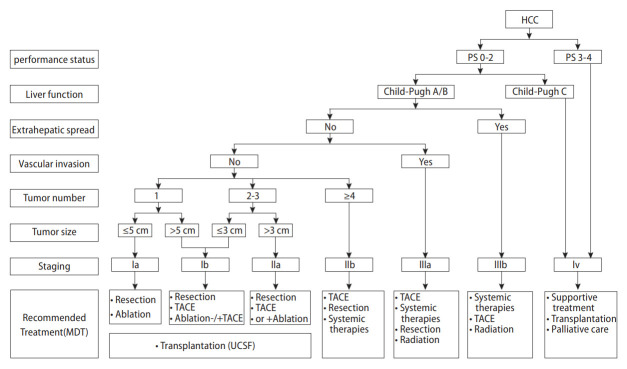
Liver cancer is the fourth most prevalent and the second most lethal cancer in China. Hepatitis B virus (HBV) infection represents a major risk factor for hepatocellular carcinoma (HCC). Liver ultrasonography plus alpha-fetoprotein every 6 months continues to be the predominant surveillance modality. The age-Male-ALBI-Platelets score was recommended in the recent 2022 Chinese guidelines to predict HCC occurrence. The Chinese liver cancer (CNLC) staging system proposed in the 2017 guidelines continues to be the standard model for staging with modifications in the treatment allocations. Considering the aggressive nature of HBV-associated HCC, multimodal and high-intensity strategies like the addition of immunotherapy-based systemic treatment to local therapies, including resection, ablation, and intra-arterial therapies, have been adopted in real-life practices in China. The latest Chinese guidelines recommend atezolizumab plus bevacizumab, suntilimab plus a bevacizumab analog, lenvatinib, sorafenib, donafenib, and FOLFOX (folinic acid, fluorouracil, and oxaliplatin) chemotherapy as first-line treatment without priority. Regorafenib, apatinib, camrelizumab, and tislelizumab have been added as second-line systemic therapies for patients who progressed on sorafenib. Systemic therapies adopted in real-life practice are sophisticated with various combination modalities and different sequences.
Keywords: Diagnosis; Guideline; Hepatocellular carcinoma; Treatment.
Conflict of interest statement
The authors have no conflicts to disclose.
Figures
Comment in
-
The clinical management of hepatocellular carcinoma in China: Progress and challenges.Clin Mol Hepatol. 2023 Apr;29(2):339-341. doi: 10.3350/cmh.2023.0077. Epub 2023 Mar 16. Clin Mol Hepatol. 2023. PMID: 36924120 Free PMC article. No abstract available.
-
Management of hepatocellular carcinoma in China: Seeking common grounds while reserving differences.Clin Mol Hepatol. 2023 Apr;29(2):342-344. doi: 10.3350/cmh.2023.0106. Epub 2023 Mar 16. Clin Mol Hepatol. 2023. PMID: 36924123 Free PMC article. No abstract available.
References
-
- Sung H, Ferlay J, Siegel RL, Laversanne M, Soerjomataram I, Jemal A, et al. Global cancer statistics 2020: GLOBOCAN Estimates of incidence and mortality worldwide for 36 cancers in 185 countries. CA Cancer J Clin. 2021;71:209–249. - PubMed
-
- Liang X, Bi S, Yang W, Wang L, Cui G, Cui F, et al. Epidemiological serosurvey of hepatitis B in China--declining HBV prevalence due to hepatitis B vaccination. Vaccine. 2009;27:6550–6557. - PubMed
Publication types
MeSH terms
Substances
Grants and funding
- 82130077/National Natural Science Foundation of China
- 82090053/National Natural Science Foundation of China
- 81961128025/National Natural Science Foundation of China
- 21JC1410100/Science and Technology Commission of Shanghai Municipality
- 21JC1401200/Science and Technology Commission of Shanghai Municipality
LinkOut - more resources
Full Text Sources
Medical