Early migration in unicompartmental knee arthroplasty: a radiostereometric study of 26 patients with 24 months of follow-up
- PMID: 36545925
- PMCID: PMC9772924
- DOI: 10.2340/17453674.2022.5672
Early migration in unicompartmental knee arthroplasty: a radiostereometric study of 26 patients with 24 months of follow-up
Abstract
Background and purpose: Aseptic loosening, mainly caused by migration, is one of the most common indications for revisions in unicompartmental knee arthroplasty (UKA). In this study, we investigated the early migration of the Persona Partial Knee (PPK, Zimmer Biomet, Warsaw, IN), a cemented medial fixed-bearing unicompartmental knee prosthesis, and evaluated the clinical results.
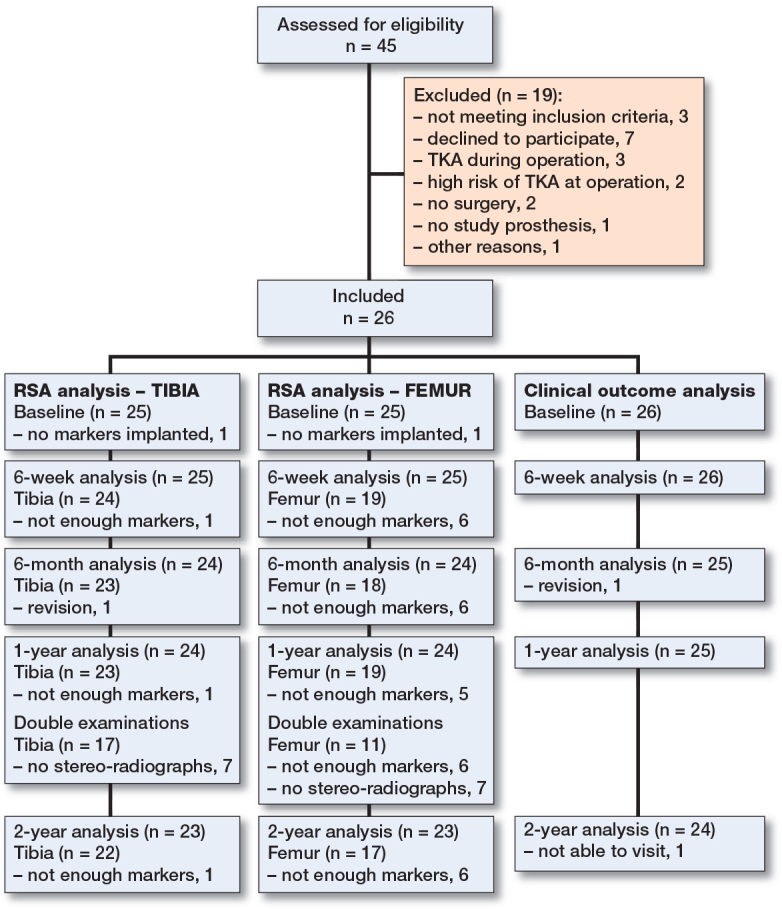
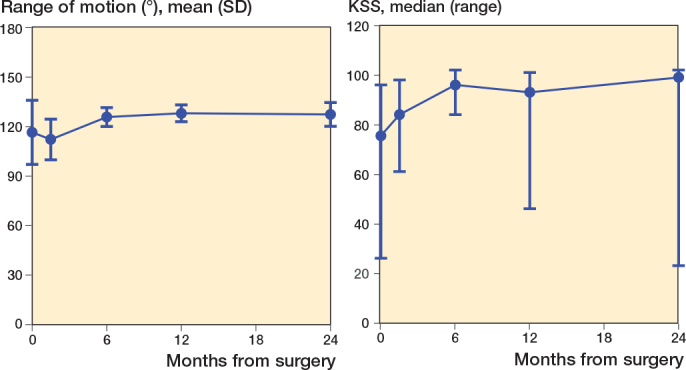
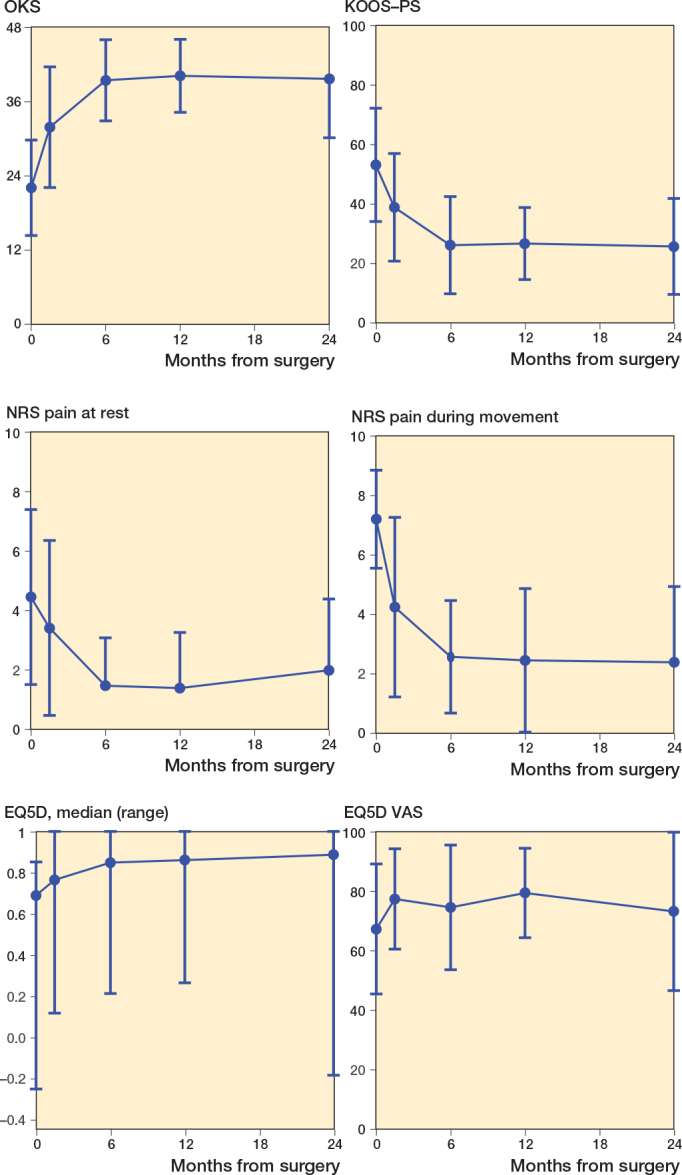
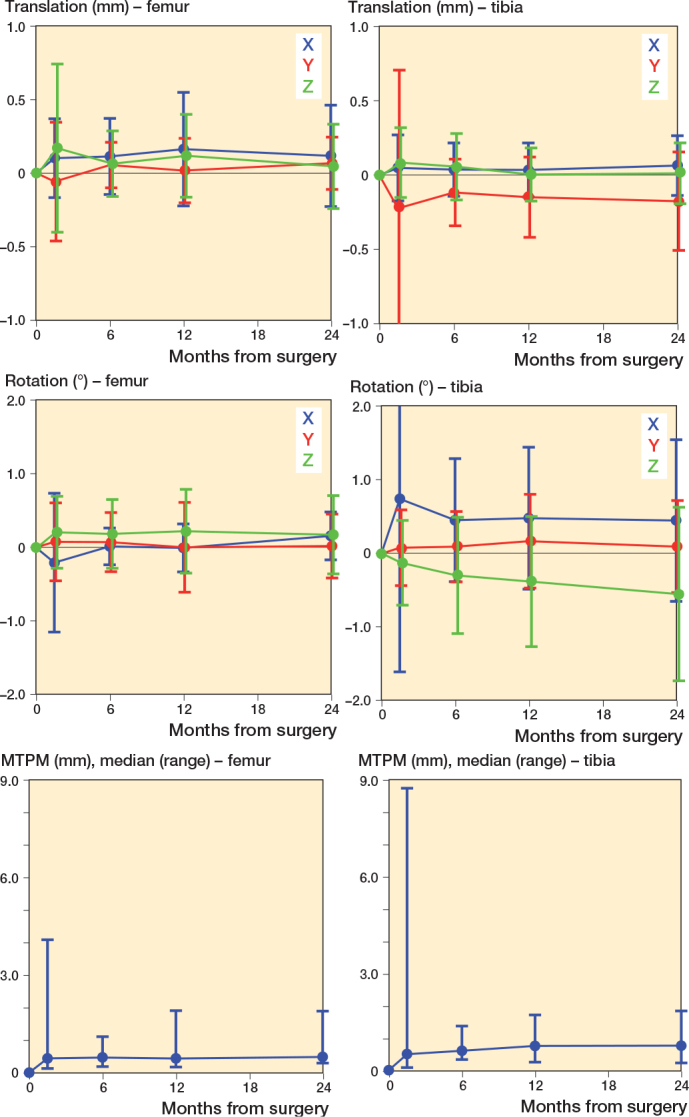
Patients and methods: 26 primary PPKs were implanted. Radiographs were obtained direct postoperatively, at 6 weeks, 6, 12 and 24 months postoperatively. Migration of the femoral and tibial component was calculated using model-based radiostereophotogrammetric analysis (mRSA) in terms of translations and rotations. Patient-reported outcome measures (PROMs) were also registered.
Results: At 24 months postoperatively, we found low migration of both the femoral and tibial component in the first 6 months, after which both components stabilized. Only the rotation of the tibial component about the z-axis did not stabilize. All PROMs improved after 24 months compared with preoperative PROMs.
Conclusion: The Persona Partial Knee shows low migration of both the femoral and tibial component and PROMs were improved at 24 months follow-up. Long-term follow-up is needed to investigate the performance of the prosthesis compared with other prostheses.
Figures
References
-
- Bruni D, Bragonzoni L, Gagliardi M, Bontempi M, Akkawi I, Raspugli G F, et al. . Roentgen stereophotogrammetric analysis: an effective tool to predict implant survival after an all-poly unicompartmental knee arthroplasty: a 10 year follow-up study. Knee Surg Sports Traumatol Arthrosc 2015; 23(11): 3273-80. doi: 10.1007/s00167-014-3106-2. - DOI - PubMed
MeSH terms
LinkOut - more resources
Full Text Sources
Medical