


Autoimmune diseases and new-onset atrial fibrillation: a UK Biobank study
- PMID: 36546587
- PMCID: PMC10062304
- DOI: 10.1093/europace/euac244
Autoimmune diseases and new-onset atrial fibrillation: a UK Biobank study
Abstract
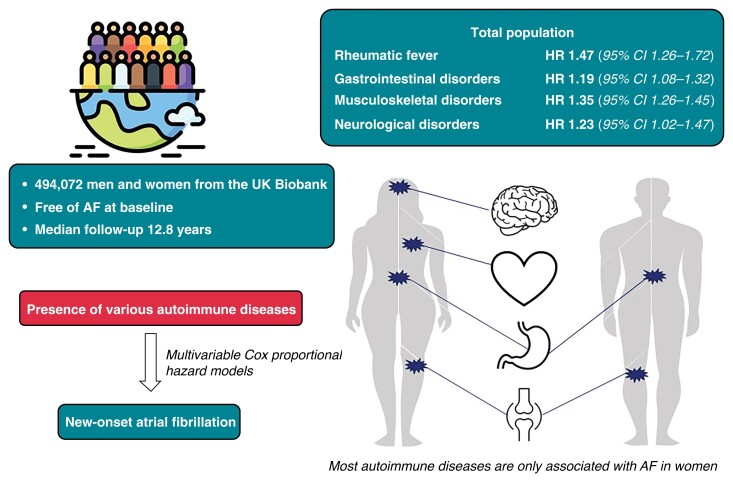
Aims: The underlying mechanisms of atrial fibrillation (AF) are largely unknown. Inflammation may underlie atrial remodelling. Autoimmune diseases, related to increased systemic inflammation, may therefore be associated with new-onset AF.
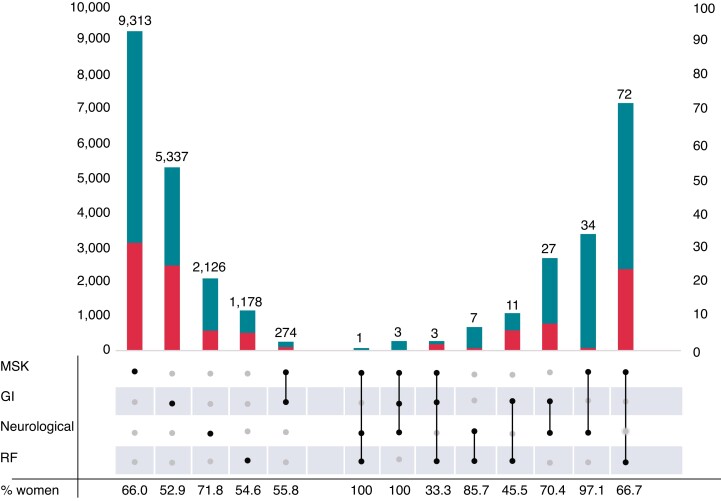
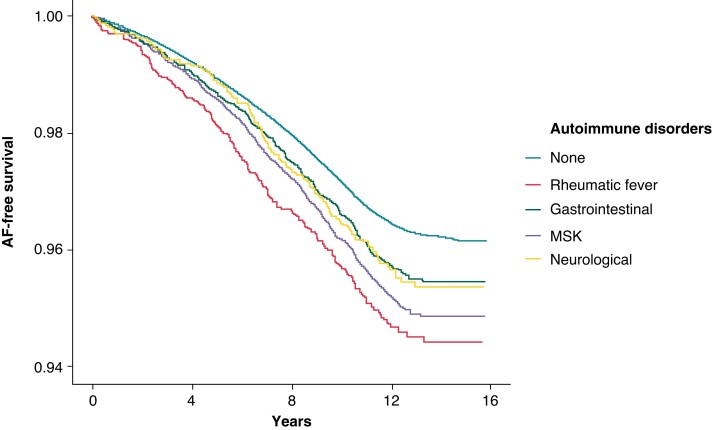
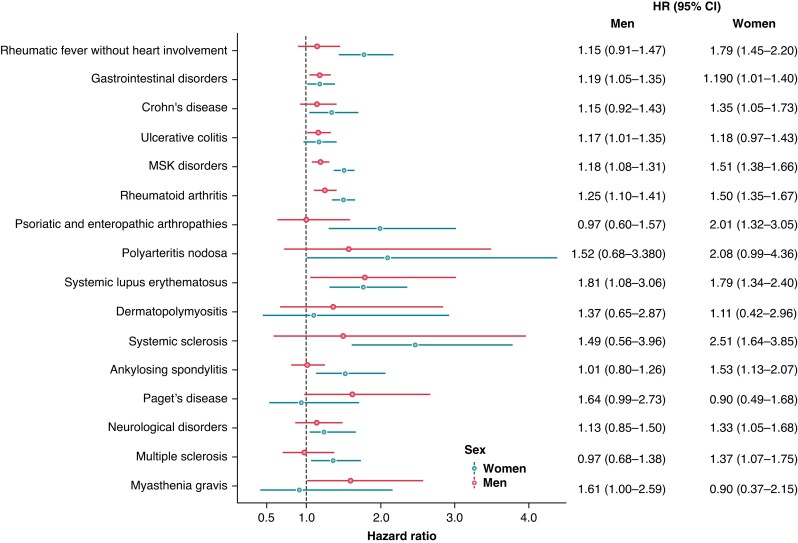
Methods and results: Participants from the population-based UK Biobank were screened for rheumatic fever, gastrointestinal autoimmune diseases, autoimmune diseases targeting the musculoskeletal system and connective tissues, and neurological autoimmune diseases. Between 2006 and 2022, participants were followed for incident AF. Cox proportional hazards regression analyses were performed to calculate hazard ratios (HRs) and 95% confidence intervals (CIs) to quantify associations. 494 072 participants free from AF were included (median age 58.0 years, 54.8% women). After a median of 12.8 years, 27 194 (5.5%) participants were diagnosed with new-onset AF. Rheumatic fever without heart involvement (HR, 95% CI: 1.47, 1.26-1.72), Crohn's disease (1.23, 1.05-1.45), ulcerative colitis (1.17, 1.06-1.31), rheumatoid arthritis (1.39, 1.28-1.51), polyarteritis nodosa (1.82, 1.04-3.09), systemic lupus erythematosus (1.82, 1.41-2.35), and systemic sclerosis (2.32, 1.57-3.44) were associated with a larger AF risk. In sex-stratified analyses, rheumatic fever without heart involvement, multiple sclerosis, Crohn's disease, seropositive rheumatoid arthritis, psoriatic and enteropathic arthropathies, systemic sclerosis and ankylosing spondylitis were associated with larger AF risk in women, whereas only men showed a larger AF risk associated with ulcerative colitis.
Conclusions: Various autoimmune diseases are associated with new-onset AF, more distinct in women. Our findings elaborate on the pathophysiological differences in autoimmunity and AF risk between men and women.
Keywords: Atrial fibrillation; Autoimmune disease; Inflammation; Risk factors; Sex differences.
© The Author(s) 2022. Published by Oxford University Press on behalf of the European Society of Cardiology.
Conflict of interest statement
Conflict of interest: None declared.
Figures
Comment in
-
Autoimmunity-related atrial fibrillation incidence: an emerging conundrum meriting further investigation: authors' reply.Europace. 2023 May 19;25(5):euad081. doi: 10.1093/europace/euad081. Europace. 2023. PMID: 36967234 Free PMC article. No abstract available.
-
Autoimmunity-related atrial fibrillation incidence: an emerging conundrum meriting further investigation.Europace. 2023 May 19;25(5):euad076. doi: 10.1093/europace/euad076. Europace. 2023. PMID: 36967235 Free PMC article. No abstract available.
References
-
- Hindricks G, Potpara T, Dagres N, Arbelo E, Bax JJ, Blomstrom-Lundqvist Cet al. 2020 ESC guidelines for the diagnosis and management of atrial fibrillation developed in collaboration with the European Association for Cardio-Thoracic Surgery (EACTS): the Task Force for the diagnosis and management of atrial fibrillation of the European Society of Cardiology (ESC) developed with the special contribution of the European Heart Rhythm Association (EHRA) of the ESC. Eur Heart J 2021;42:373–498. - PubMed
-
- Engelmann MD, Svendsen JH. Inflammation in the genesis and perpetuation of atrial fibrillation. Eur Heart J 2005;26:2083–92. - PubMed
MeSH terms
Grants and funding
LinkOut - more resources
Full Text Sources
Medical
Research Materials
