. 2023 Jan 20;12(1):95-107.
doi: 10.1021/acssynbio.2c00392. Epub 2022 Dec 22.

A Low-Cost, Thermostable, Cell-Free Protein Synthesis Platform for On-Demand Production of Conjugate Vaccines

Affiliations

A Low-Cost, Thermostable, Cell-Free Protein Synthesis Platform for On-Demand Production of Conjugate Vaccines

Katherine F Warfel et al. ACS Synth Biol. .

Abstract

Cell-free protein synthesis systems that can be lyophilized for long-term, non-refrigerated storage and transportation have the potential to enable decentralized biomanufacturing. However, increased thermostability and decreased reaction cost are necessary for further technology adoption. Here, we identify maltodextrin as an additive to cell-free reactions that can act as both a lyoprotectant to increase thermostability and a low-cost energy substrate. As a model, we apply optimized formulations to produce conjugate vaccines for ∼$0.50 per dose after storage at room temperature (∼22 °C) or 37 °C for up to 4 weeks, and ∼$1.00 per dose after storage at 50 °C for up to 4 weeks, with costs based on raw materials purchased at the laboratory scale. We show that these conjugate vaccines generate bactericidal antibodies against enterotoxigenic Escherichia coli (ETEC) O78 O-polysaccharide, a pathogen responsible for diarrheal disease, in immunized mice. We anticipate that our low-cost, thermostable cell-free glycoprotein synthesis system will enable new models of medicine biosynthesis and distribution that bypass cold-chain requirements.

Keywords: cell-free protein synthesis; conjugate vaccine; decentralized biomanufacturing; glycosylation; lyophilization; lyoprotectant.


Conflict of interest statement

The authors declare the following competing financial interest(s): M.P.D. has a financial interest in Gauntlet, Inc., Glycobia, Inc., SwiftScale Biologics, Inc., Versatope, Inc., Gauntlet Bio, and UbiquiTx, Inc. M.C.J. has a financial interest in SwiftScale Biologics, Gauntlet Bio, Pearl Bio, Inc., Design Pharmaceutics, and Stemloop Inc. M.P.D.s and M.C.J.s interests are reviewed and managed by Cornell University and Northwestern University, respectively, in accordance with their competing interest policies. All other authors declare no competing interests.

Figures
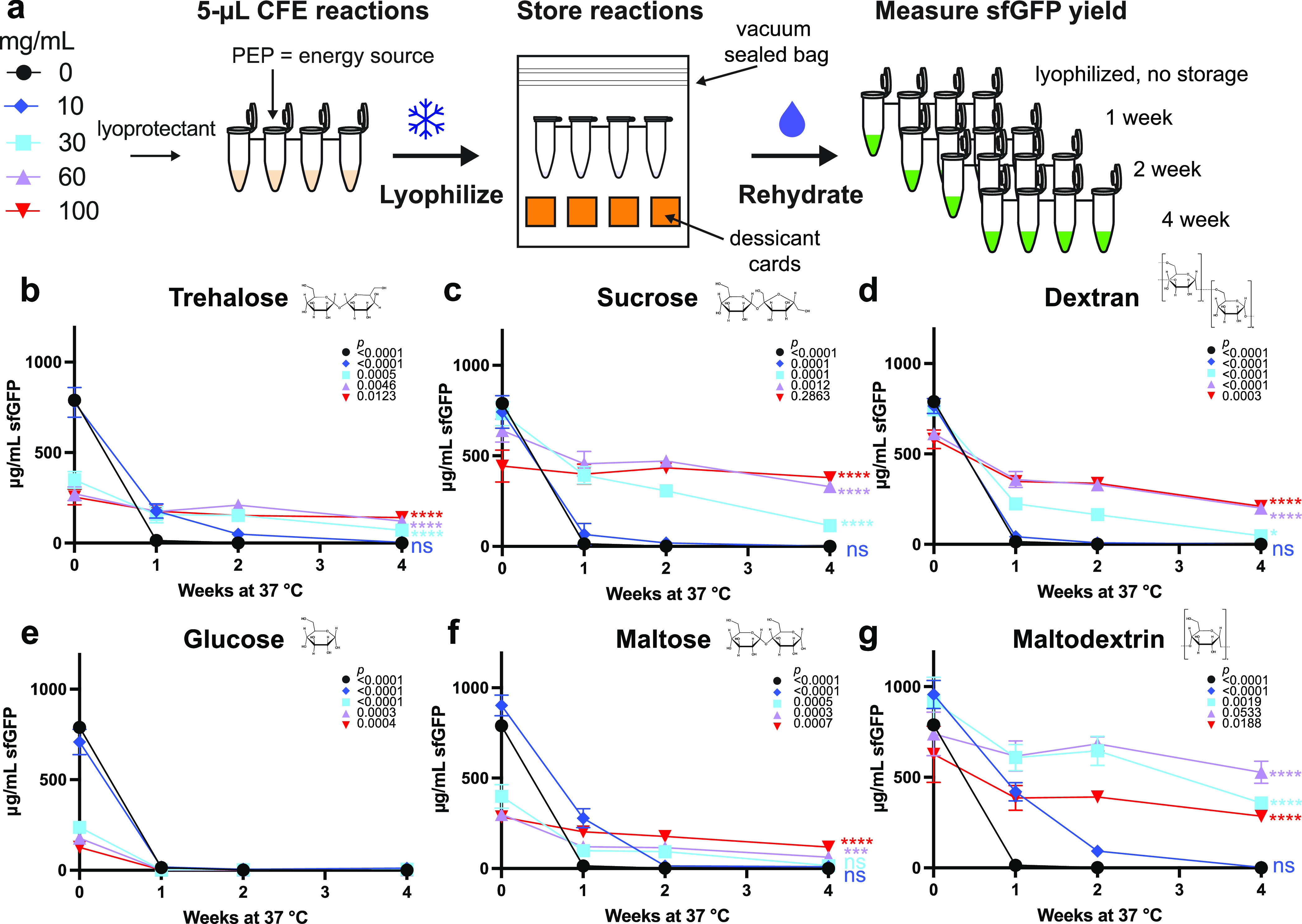
Figure 1
Figure 1
Maltodextrin enhances the stability of cell-free gene expression (CFE) reactions stored at 37 °C. (A) Schematic of CFE reaction setup and lyophilization for the screening of lyoprotectants. The impact of (B) trehalose, (C) sucrose, (D) dextran, (E) glucose, (F) maltose, and (G) maltodextrin at concentrations of 0 mg/mL in black circles, 10 mg/mL in blue diamonds, 30 mg/mL in light blue squares, 60 mg/mL in purple triangles, and 100 mg/mL in inverted red triangles on the amount of sfGFP produced by lyophilized CFE reactions after storage was measured. Reactions were rehydrated with 5 μL of water and incubated at 30 °C for 20 h after 1, 2, and 4 weeks of storage at 37 °C. Error bars represent the standard deviation of three CFE reactions (n = 3). Unpaired two-tailed t-tests were used to compare the 0- and 4-week timepoint for each condition. P values showing the significance of the change in sfGFP yield for each condition between 0 and 4 weeks of storage at 37 °C are inset on the top right of each graph with the corresponding shape for each condition. An ordinary one-way ANOVA (95% confidence interval) with Dunnett’s multiple comparisons test was performed to determine the significance of the yields after 4 weeks of storage for each condition compared to the no lyoprotectant control. Significance (adjusted p value <0.0001 is denoted by ****, 0.0001 to 0.001 by ***, 0.001 to 0.01 by **, 0.01 to 0.05 by *, and ≥0.05 by ns) is reported to the right of the 4-week timepoint marker for each condition.
Figure 2
Figure 2
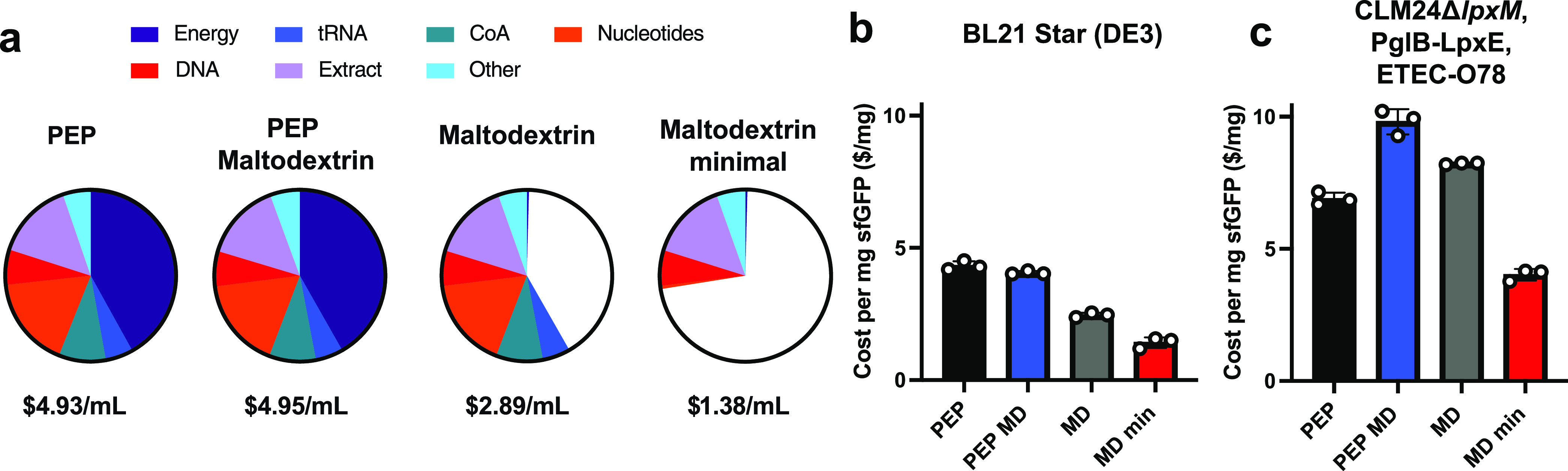
Maltodextrin can be effectively used as both an energy source and lyoprotectant for low-cost CFE. (A) Cost per mL CFE reaction was calculated for each formulation: PEP with no lyoprotectant, PEP with maltodextrin supplemented as a lyoprotectant (PEP MD), maltodextrin as an both energy source and a lyoprotectant (MD), and maltodextrin without CoA, tRNA, and replacing NTPs with NMPs (MD min). Costs are based only on raw materials included in the reaction purchased at laboratory scale using calculations in Supporting Tables S1–S3. (B) Cost per milligram sfGFP in CFE reactions using BL21 Star (DE3) extract in all four formulations. (C) Cost per milligram sfGFP in CFE reactions using CLM24 ΔlpxM extract in all four formulations. Error bars represent the standard deviation of three CFE reactions (n = 3).
Figure 3
Figure 3
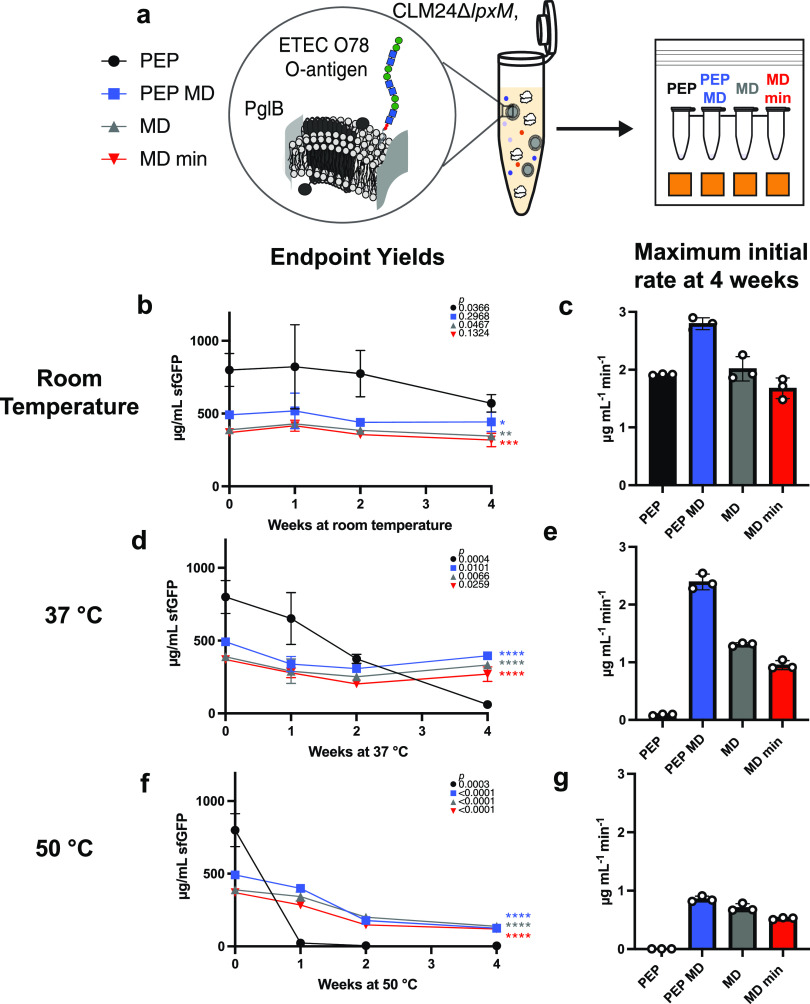
Low-cost formulations preserve CFE reactions with iVAX extract when stored at up to 50 °C. (A) Schematic of CFE reaction storage conditions. After 4 weeks of storage at room temperature (∼22 °C) (B, C), 37 °C (D, E), and 50 °C (F, G), lyophilized CFE reactions were rehydrated with 5 μL of water and incubated at 30 °C for 20 h and endpoint sfGFP yields and maximum initial protein synthesis rates were measured. Error bars represent the standard deviation of three CFE reactions. Unpaired two-tailed t-tests were used to compare the 0-week and 4-week timepoint for each condition. P values showing the significance of the change in sfGFP yield for each condition between 0 and 4 weeks of storage are inset on the top right of each graph with the corresponding shape for each condition. An ordinary one-way ANOVA (95% confidence interval) with Dunnett’s multiple comparisons test was performed to determine the significance of the yields after 4 weeks of storage for each condition compared to the PEP formulation. Significance (adjusted p value <0.0001 is denoted by ****, 0.0001 to 0.001 by ***, 0.001 to 0.01 by **, 0.01 to 0.05 by *, and ≥0.05 by ns) is reported to the right of the 4-week timepoint marker for each condition.
Figure 4
Figure 4
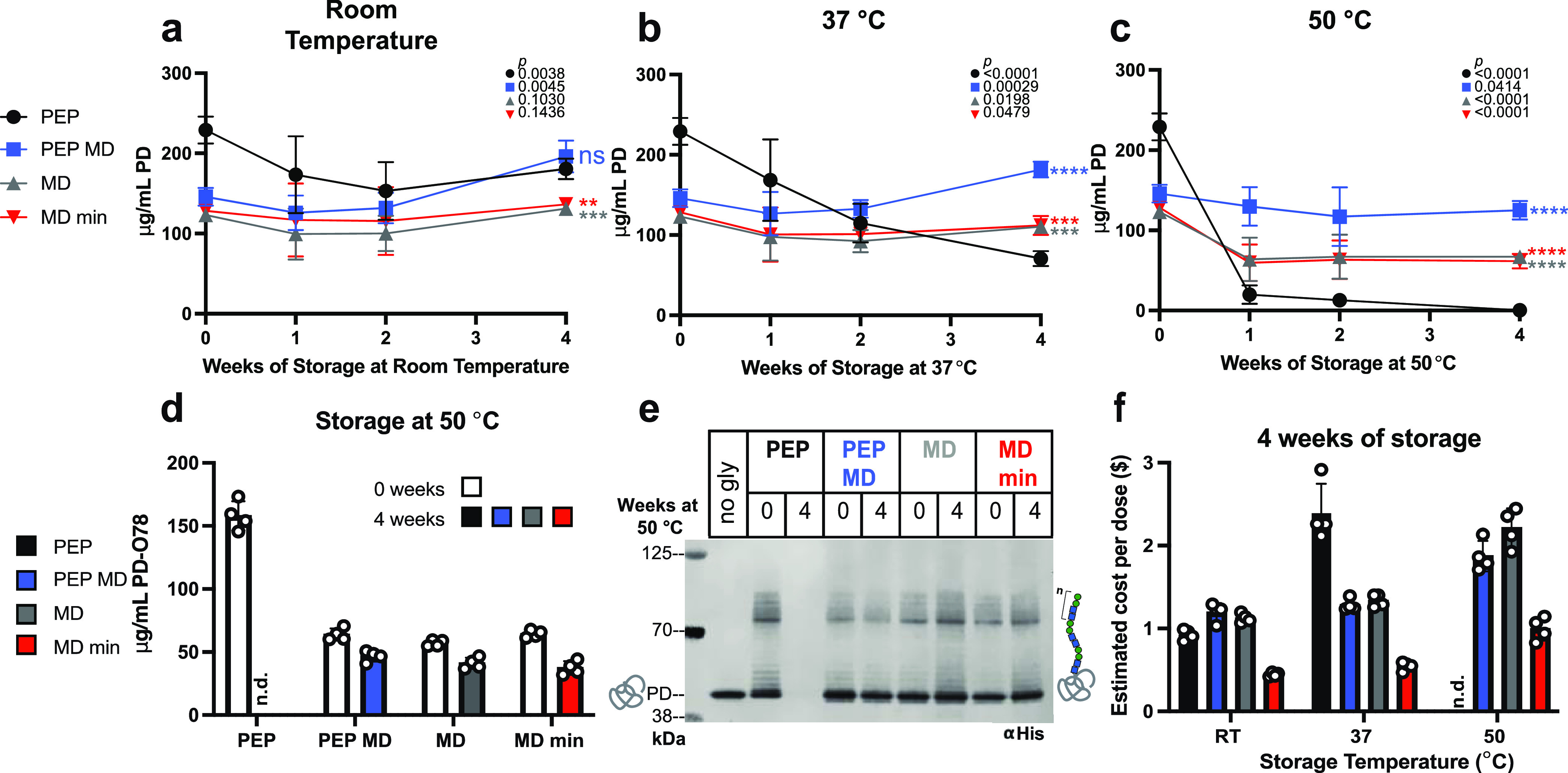
Maltodextrin-based formulations with iVAX extract enable production of conjugate vaccine molecules at low cost after high-temperature storage. Yields of carrier protein (PD) were measured from lyophilized 15 μL of reactions stored for up to 4 weeks at (A) room temperature (∼22 °C), (B) 37 °C, and (C) 50 °C. Unpaired two-tailed t-tests were used to compare the 0-week and 4-week timepoint for each condition in (A)–(C). P values showing the significance of the change in sfGFP yield for each condition between 0 and 4 weeks of storage are inset on the top right of each graph with the corresponding shape for each condition. An ordinary one-way ANOVA (95% confidence interval) with Dunnett’s multiple comparisons test was performed to determine the significance of the yields after 4 weeks of storage for each condition compared to the PEP formulation. Significance (adjusted p value <0.0001 is denoted by ****, 0.0001 to 0.001 by ***, 0.001 to 0.01 by **, 0.01 to 0.05 by *, and ≥0.05 by ns) is reported to the right of the 4-week timepoint marker for each condition in (A)–(C). CFE reactions were rehydrated with 15 μL of water and incubated at 30 °C for 4 h, then glycosylation was initiated, and samples were incubated for an additional 16 h at 30 °C. Yields of glycosylated carrier protein (PD) with a C-terminal glycosylation tag followed by a 6x-His tag were measured (D) and observed via anti-His Western blot (E) for reactions that were stored at 50 °C. (F) Estimated cost per dose of conjugate vaccines produced by CFE reactions stored for 4 weeks at each tested temperature. Error bars represent the standard deviation of four CFE reactions (n = 4).
Figure 5
Figure 5
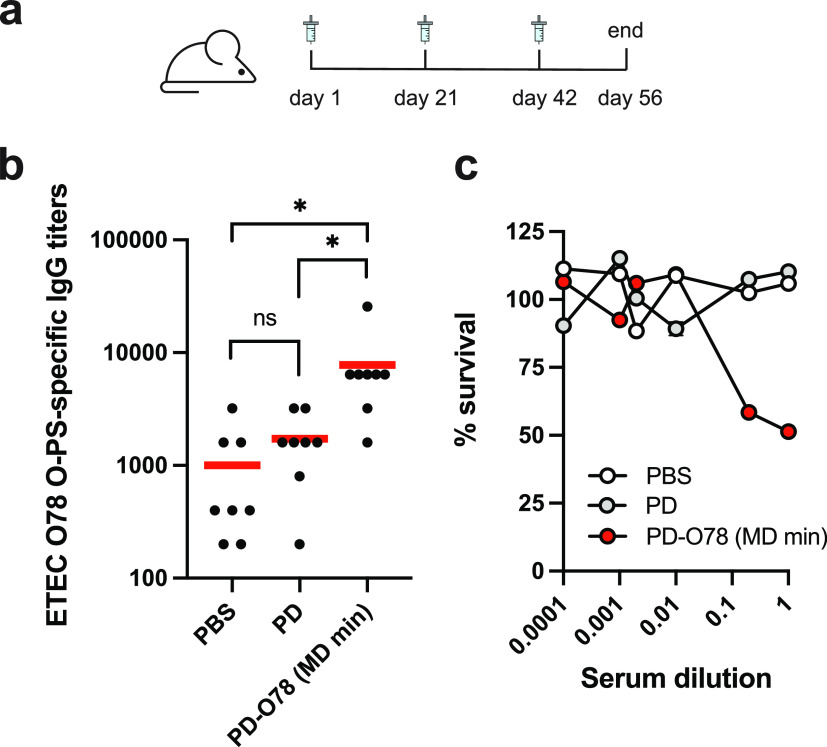
Conjugate vaccines produced using the MD min CFE formulation elicit antibodies that are bactericidal. (A) Lyophilized MD min CFE reactions using iVAX extracts were used to synthesize anti-ETEC O78 conjugate vaccines for immunization studies. Groups of BALB/c mice were immunized subcutaneously with a 1:1 mixture of adjuvant and PBS or ∼24 μg of the following cell-free-derived immunogens: unconjugated protein D (PD), or PD modified with O78 O-PS from a minimal iVAX reaction (PD-O78 (MD min)). Each group was composed of eight mice. Mice were boosted on days 21 and 42 with identical doses of antigen. (B) ETEC O78 O-PS-specific IgG titers were measured by enzyme-linked immunosorbent assay (ELISA) in endpoint (day 56) serum of individual mice (black dots) with recombinant O-PS immobilized as antigen. Mean titers of each group are also shown (red lines). Statistical significance was calculated by unpaired two-tailed t-test with a single asterisk (*) indicating p-value <0.05 and ns indicating not significant. (C) Bacterial killing activity of serum antibodies corresponding to the same groups as in (B). Survival data were derived from a standard serum bactericidal assay (SBA) where dilutions of pooled sera from immunized mice were tested against ETEC O78 strain H10407 in the presence of human complement. Values for % survival were determined from the colony forming units (CFUs) counted at each individual serum dilution. Data in (C) represent average error bars for two independent samples (n = 2).

References

    1. Scown C. D.; Keasling J. D. Sustainable Manufacturing with Synthetic Biology. Nat. Biotechnol. 2022, 40, 304–307. 10.1038/s41587-022-01248-8. - DOI - PubMed
    1. Khalil A. S.; Collins J. J. Synthetic Biology: Applications Come of Age. Nat. Rev. Genet. 2010, 11, 367–379. 10.1038/nrg2775. - DOI - PMC - PubMed
    1. Clomburg J. M.; Crumbley A. M.; Gonzalez R. Industrial Biomanufacturing: The Future of Chemical Production. Science 2017, 355, aag0804 10.1126/science.aag0804. - DOI - PubMed
    1. Acharya K. P.; Ghimire T. R.; Subramanya S. H. Access to and Equitable Distribution of COVID-19 Vaccine in Low-Income Countries. npj Vaccines 2021, 6, 54 10.1038/s41541-021-00323-6. - DOI - PMC - PubMed
    1. Tinafar A.; Jaenes K.; Pardee K. Synthetic Biology Goes Cell-Free. BMC Biol. 2019, 17, 64 10.1186/s12915-019-0685-x. - DOI - PMC - PubMed

Publication types

Substances