Review
. 2022 Dec 10;14(12):868.
doi: 10.3390/toxins14120868.

Anatomical Proposal for Botulinum Neurotoxin Injection Targeting the Platysma Muscle for Treating Platysmal Band and Jawline Lifting: A Review

Affiliations
Review

Anatomical Proposal for Botulinum Neurotoxin Injection Targeting the Platysma Muscle for Treating Platysmal Band and Jawline Lifting: A Review

Kyu-Ho Yi et al. Toxins (Basel). .

Abstract

The platysma muscle is a thin superficial muscle that covers the entire neck and lower part of the face. The platysma muscle is the primary target muscle for botulinum neurotoxin injection therapy aimed at treating platysmal band and lower facial lifting. In the procedure of botulinum neurotoxin injection therapy, a lack of knowledge of the anatomy of the platysma muscle and the properties of botulinum neurotoxin can lead to side effects such as dysphagia, dysphonia, and weakness of the neck muscles. Anatomically safe injection sites have been proposed for the platysma muscle, and the appropriate injection technique has been reviewed. We proposed optimal injection sites based on the external anatomical features of the mandible. The aim of these proposal was to standardize the procedure for the effective use of botulinum neurotoxin injections by minimizing the dose unit and injection points and thereby preventing adverse events.

Keywords: botulinum neurotoxin; dermotoxin; face lifting; injection point; platysma band; platysma muscle.


Conflict of interest statement

The authors declare no conflict of interest.

Figures
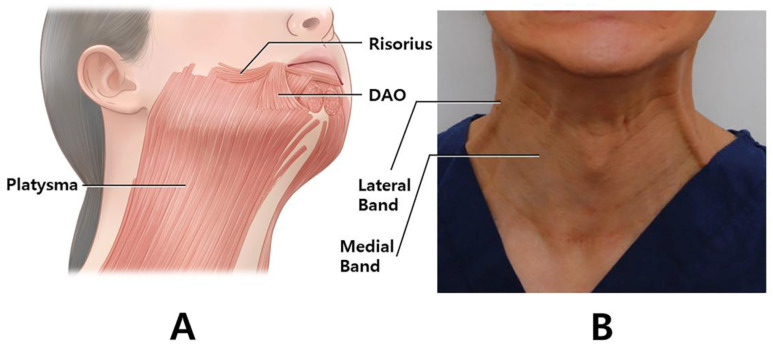
Figure 1
Figure 1
The image of the playsmal bands. The posterior and anterior platysmal bands are targeted for botulinum neurotoxin (A). Schematic image of the platysma muscle in oblique view. The muscle intermingles with the depressor anguli oris, depressor labii inferioris, mentalis, risorius, and orbicularis oris muscles (B). (DAO; depressor anguli oris).
Figure 2
Figure 2
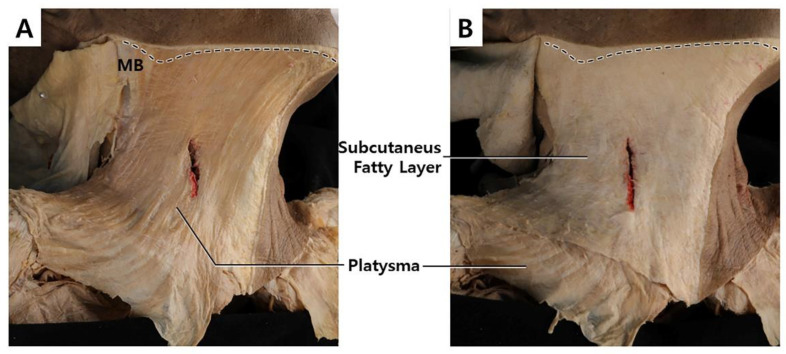
The dissected image of the platysma muscle in a cadaver (A) and revealing platysma muscle by removing subcutaneous tissue (B).
Figure 3
Figure 3
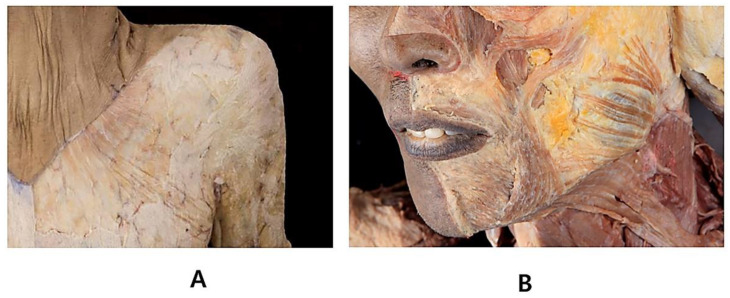
Platysma muscle continuously extends to the fascial structure of pectoralis major and anterior deltoid (A). The platysma also extends to mid-face region (B).
Figure 4
Figure 4
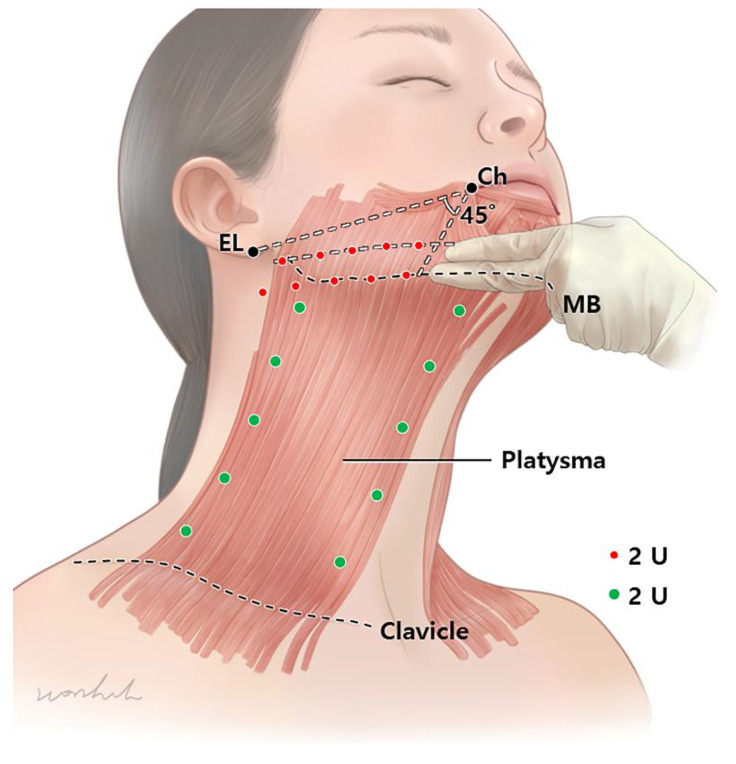
The jawline lifting, 2 U is injected per point. A total of 20 U of botulinum neurotoxin per side is injected. The injection should be in two lines (distance of two finger width), one right above the mandibular lower border and one below the line connecting the cheilion and ear lobule. For the platysmal bands, 2 U is injected per point (green dots). For injection, 5 points are placed for each band approximately 2 cm from each other along the muscular band. A total of 40 units are used for both sides of medial and lateral bands. (EL, ear lobe; Ch, Cheilion; MB, Mandibular border.).
Figure 5
Figure 5
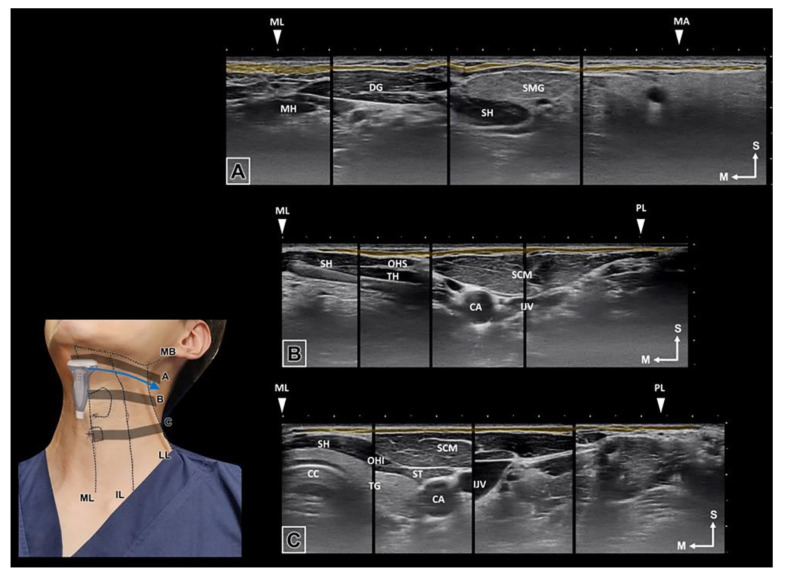
The ultrasonographic image of the platysma muscle was observed in blue arrow direction. The muscle lies from the midline to the vertical line from the mandibular angle and has been presented in the ultrasonographic image of three transverse planes: below the mandibular border (A), superior notch of the thyroid cartilage (B), and cricoid cartilage (C). (ML, midline; MH, Mylohyoid muscle; DG, Digastric muscle; SH, Sternohyoid muscle; SMG, Submandibular gland; MA, mandibular angle; CA, carotid artery; OHS, Omohyoid superior belly; OHI, Omohyoid inferior belly; IJV, Internal jugular vein; TH; Thyrohyiod muscle; TG; Thyroid gland; CC, Cricoid cartilage; IL, intermediate line; LL, lateral border of the lateral band).

References

    1. Dessy L.A., Mazzocchi M., Rubino C., Mazzarello V., Spissu N., Scuderi N. An objective assessment of botulinum toxin A effect on superficial skin texture. Ann. Plast. Surg. 2007;58:469–473. doi: 10.1097/01.sap.0000244968.16977.1f. - DOI - PubMed
    1. Childers M.K. Targeting the neuromuscular junction in skeletal muscles. Am. J. Phys. Med. Rehabil. 2004;83:S38–S44. doi: 10.1097/01.PHM.0000141129.23219.42. - DOI - PubMed
    1. Sugrue C.M., Kelly J.L., McInerney N. Botulinum Toxin Treatment for Mild to Moderate Platysma Bands: A Systematic Review of Efficacy, Safety, and Injection Technique. Aesthetic Surg. J. 2019;39:201–206. doi: 10.1093/asj/sjy179. - DOI - PubMed
    1. Lorenc Z.P., Corduff N., van Loghem J., Yoelin S. Creating Lift in the Lower Face With Botulinum Toxin A Treatment: An Anatomical Overview With Videos and Case Studies Illustrating Patient Evaluation and Treatment. Aesthetic Surg. J. Open Forum. 2022;4:ojac034. doi: 10.1093/asjof/ojac034. - DOI - PMC - PubMed
    1. Witmanowski H., Blochowiak K. The whole truth about botulinum toxin—A review. Postepy Dermatol. Alergol. 2020;37:853–861. doi: 10.5114/ada.2019.82795. - DOI - PMC - PubMed

Publication types

Substances