


Cardiovascular Risk and Diseases in Patients With and Without Leptin-Melanocortin Pathway Variants
- PMID: 36549983
- PMCID: PMC10079551
- DOI: 10.1016/j.mayocp.2022.10.028
Cardiovascular Risk and Diseases in Patients With and Without Leptin-Melanocortin Pathway Variants
Abstract
Objective: To study differences in cardiovascular risk factors and diseases between patients with and without genetic variants in the leptin-melanocortin pathway.
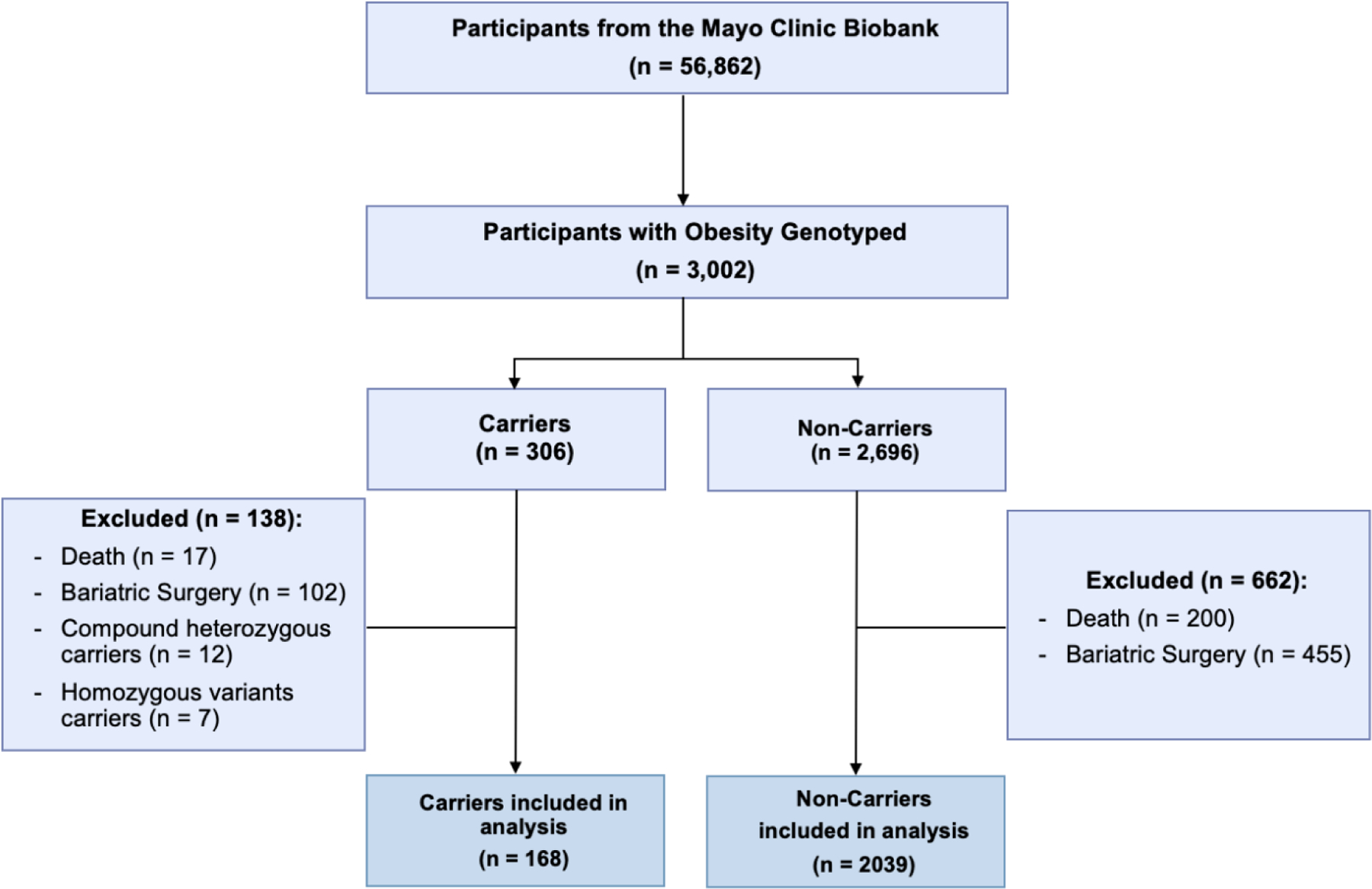
Methods: A cross-sectional study of patients with a history of severe obesity genotyped in June 2019 as participants of the Mayo Clinic Biobank was conducted in March 2022 to assess differences in cardiovascular risk and diseases between carriers of a heterozygous variant in the leptin-melanocortin pathway and noncarriers. Cardiovascular risk factors included hypertension, diabetes, dyslipidemia, and smoking. Cardiovascular disease includes coronary artery disease, peripheral artery disease, and cerebrovascular accidents. Patients with a history of bariatric surgery were excluded. We used logistic regression models to estimate the odds ratio and 95% CI, adjusting for age, body mass index (BMI), and sex.
Results: Among a total of 168 carriers (8%; 121 [72%] female; mean [SD] age, 65.1 [14.9] years; BMI, 44.0 [7.4] kg/m2) and 2039 noncarriers (92%; 1446 [71%] female; mean [SD] age, 64.9 [14.4] years; BMI, 42.9 [6.6] kg/m2), carriers had higher prevalence odds of hypertension (odds ratio, 3.26; 95% CI, 2.31 to 4.61; P<.001) and reported higher number of cardiovascular risk factors compared with noncarriers (2.4 [1.1] vs 2.0 [1.1]; P<.001). There were no significant differences in the adjusted odds associated with diabetes, dyslipidemia, smoking, or cardiovascular disease.
Conclusion: Despite having similar body weight and BMI, carriers of heterozygous variants in the leptin-melanocortin pathway had higher rates of hypertension than noncarriers. These findings point to an association between hypertension and leptin-melanocortin pathway variants.
Copyright © 2022 Mayo Foundation for Medical Education and Research. Published by Elsevier Inc. All rights reserved.
References
-
- Heymsfield SB, Wadden TA. Mechanisms, pathophysiology, and management of obesity. New England Journal of Medicine 2017; 376(3): 254–66. - PubMed
-
- Abarca-Gómez L, Abdeen ZA, Hamid ZA, et al. Worldwide trends in body-mass index, underweight, overweight, and obesity from 1975 to 2016: a pooled analysis of 2416 population-based measurement studies in 128· 9 million children, adolescents, and adults. The lancet 2017; 390(10113): 2627–42. - PMC - PubMed
-
- Van Gaal LF, Mertens IL, Christophe E. Mechanisms linking obesity with cardiovascular disease. Nature 2006; 444(7121): 875–80. - PubMed
-
- Eckel RH, Kahn R, Robertson RM, Rizza RA. Preventing cardiovascular disease and diabetes: a call to action from the American Diabetes Association and the American Heart Association. Circulation 2006; 113(25): 2943–6. - PubMed
Publication types
MeSH terms
Substances
Grants and funding
LinkOut - more resources
Full Text Sources
Medical
