


Development and Application of an SPR Nanobiosensor Based on AuNPs for the Detection of SARS-CoV-2 on Food Surfaces
- PMID: 36551068
- PMCID: PMC9776341
- DOI: 10.3390/bios12121101
Development and Application of an SPR Nanobiosensor Based on AuNPs for the Detection of SARS-CoV-2 on Food Surfaces
Abstract
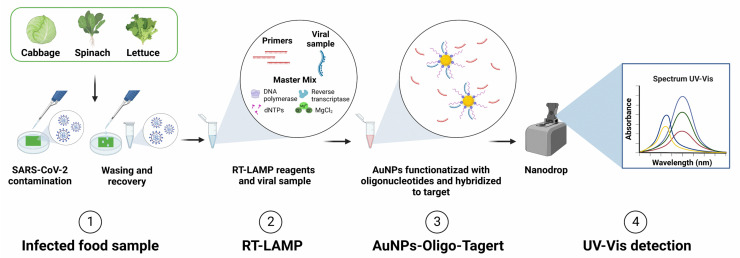
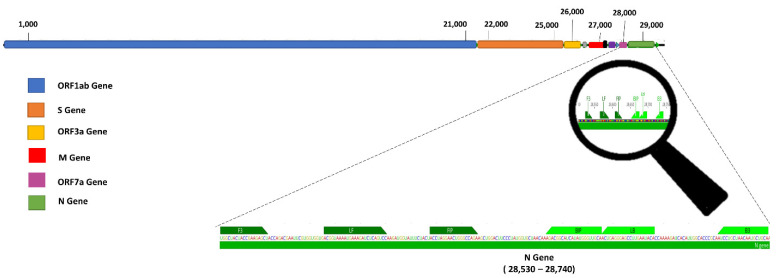
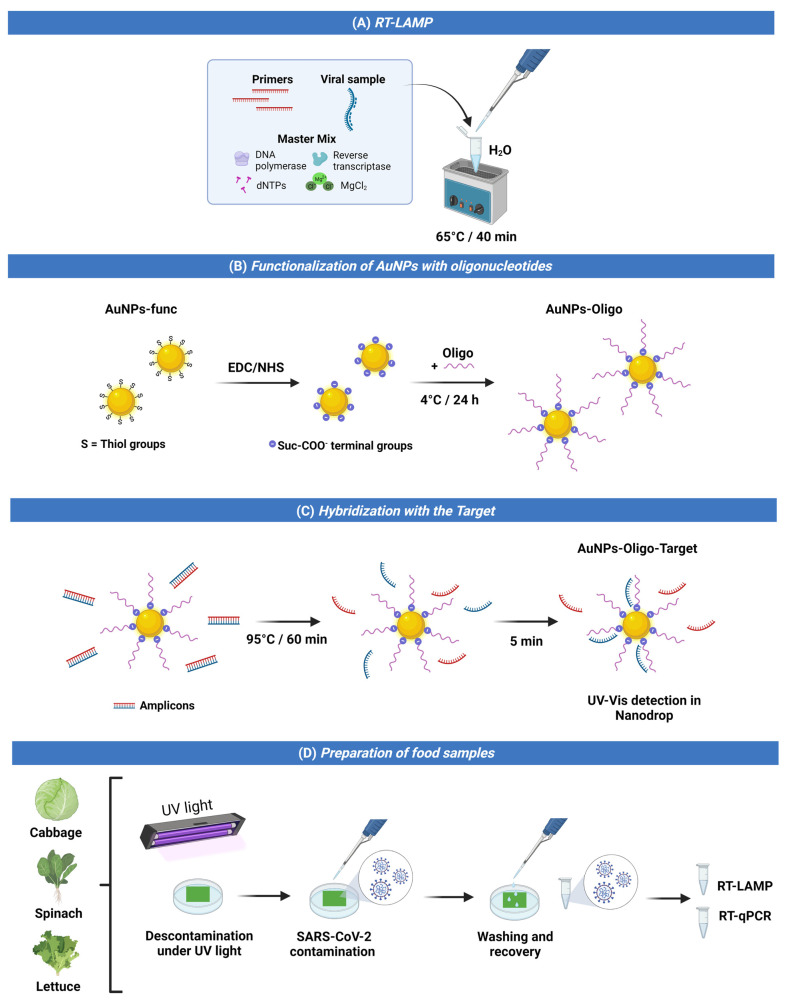
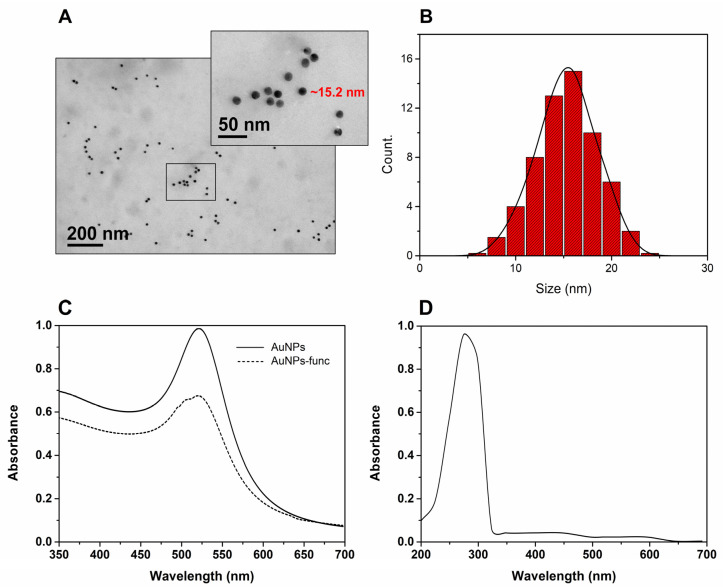
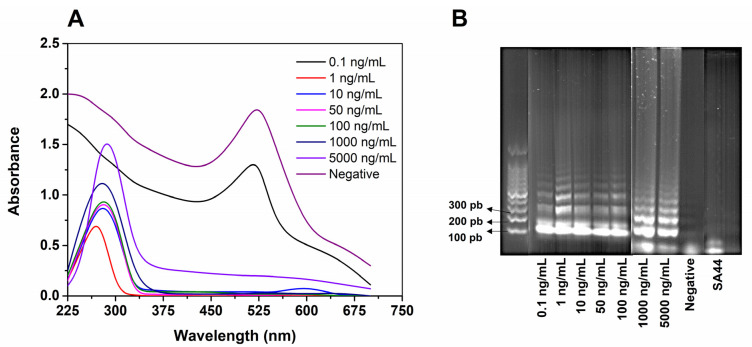
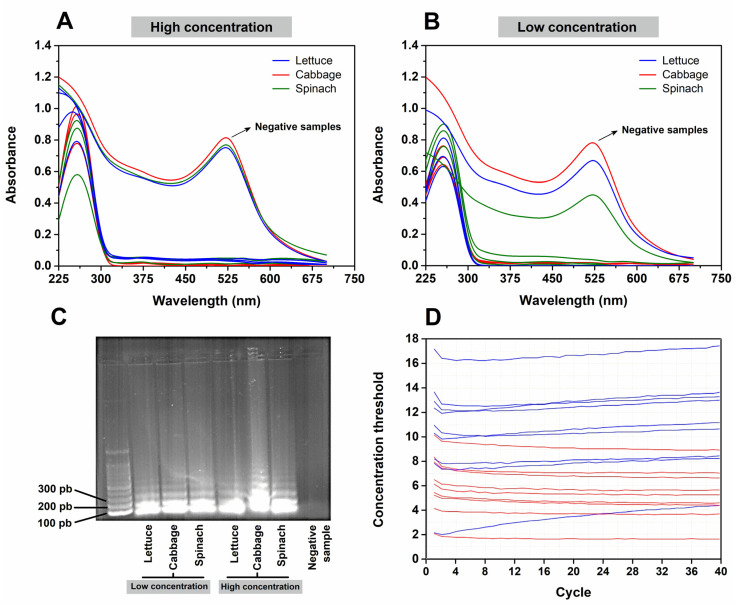
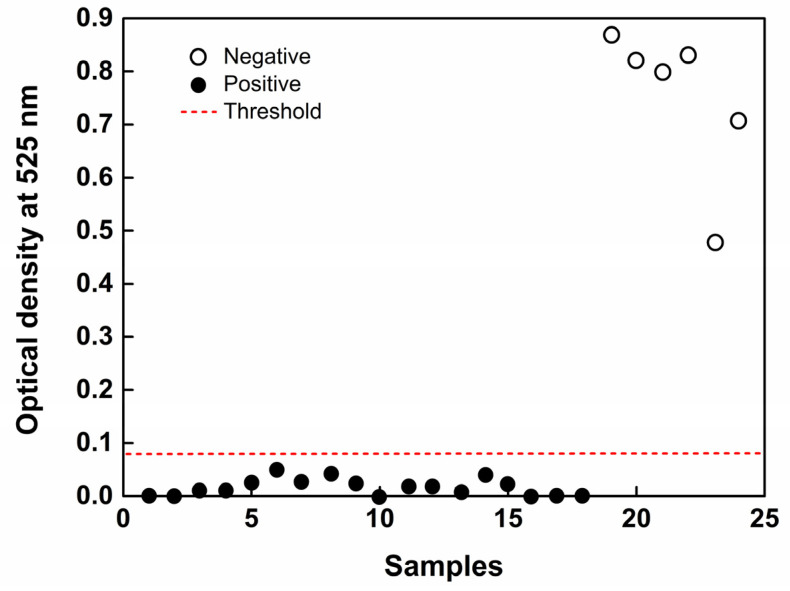
A new transmission route of SARS-CoV-2 through food was recently considered by the World Health Organization (WHO), and, given the pandemic scenario, the search for fast, sensitive, and low-cost methods is necessary. Biosensors have become a viable alternative for large-scale testing because they overcome the limitations of standard techniques. Herein, we investigated the ability of gold spherical nanoparticles (AuNPs) functionalized with oligonucleotides to detect SARS-CoV-2 and demonstrated their potential to be used as plasmonic nanobiosensors. The loop-mediated isothermal amplification (LAMP) technique was used to amplify the viral genetic material from the raw virus-containing solution without any preparation. The detection of virus presence or absence was performed by ultraviolet-visible (UV-Vis) absorption spectroscopy, by monitoring the absorption band of the surface plasmonic resonance (SPR) of the AuNPs. The displacement of the peak by 525 nm from the functionalized AuNPs indicated the absence of the virus (particular region of gold). On the other hand, the region ~300 nm indicated the presence of the virus when RNA bound to the functionalized AuNPs. The nanobiosensor system was designed to detect a region of the N gene in a dynamic concentration range from 0.1 to 50 × 103 ng·mL-1 with a limit of detection (LOD) of 1 ng·mL-1 (2.7 × 10³ copy per µL), indicating excellent sensitivity. The nanobiosensor was applied to detect the SARS-CoV-2 virus on the surfaces of vegetables and showed 100% accuracy compared to the standard quantitative reverse transcription polymerase chain reaction (RT-qPCR) technique. Therefore, the nanobiosensor is sensitive, selective, and simple, providing a viable alternative for the rapid detection of SARS-CoV-2 in ready-to-eat vegetables.
Keywords: COVID-19; LAMP; SPR; UV–Vis; optical biosensor.
Conflict of interest statement
The authors declare no conflict of interest.
Figures
References
-
- WHO WHO Coronavirus (COVID-19) Dashboard 2022. [(accessed on 30 September 2022)]. Available online: https://covid19.who.int/
-
- Erkoc P., Ulucan-Karnak F. Nanotechnology-Based Antimicrobial and Antiviral Surface Coating Strategies. Prosthesis. 2021;3:25–52. doi: 10.3390/prosthesis3010005. - DOI
MeSH terms
Substances
Grants and funding
- E-26/200.691/2021/Fundação Carlos Chagas Filho de Amparo à Pesquisa do Estado do Rio de Janeiro
- E-26/202.000/2021/Fundação Carlos Chagas Filho de Amparo à Pesquisa do Estado do Rio de Janeiro
- E-26/201.813/2022/Fundação Carlos Chagas Filho de Amparo à Pesquisa do Estado do Rio de Janeiro
- ; E-26/204.254/2021/Fundação Carlos Chagas Filho de Amparo à Pesquisa do Estado do Rio de Janeiro
- 313119/2020-1/National Council for Scientific and Technological Development
- 152275/2022-3/National Council for Scientific and Technological Development
- [88887.518753/2020-00/Coordenação de Aperfeicoamento de Pessoal de Nível Superior
- FinanceCode001/Coordenação de Aperfeicoamento de Pessoal de Nível Superior
- 164569/2020-0/National Council for Scientific and Technological Development
- 151200/2020-0/National Council for Scientific and Technological Development
- 423952/2018-8/National Council for Scientific and Technological Development
LinkOut - more resources
Full Text Sources
Medical
Miscellaneous
