


Recent Advances in the Immunoassays Based on Nanozymes
- PMID: 36551085
- PMCID: PMC9776222
- DOI: 10.3390/bios12121119
Recent Advances in the Immunoassays Based on Nanozymes
Abstract
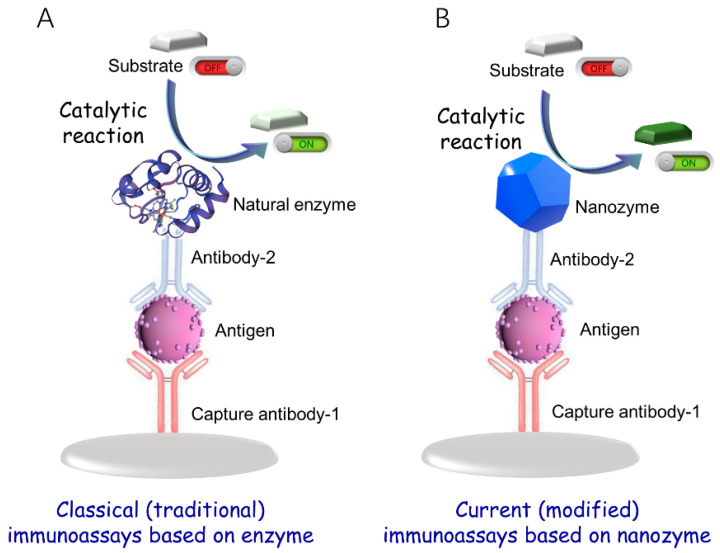
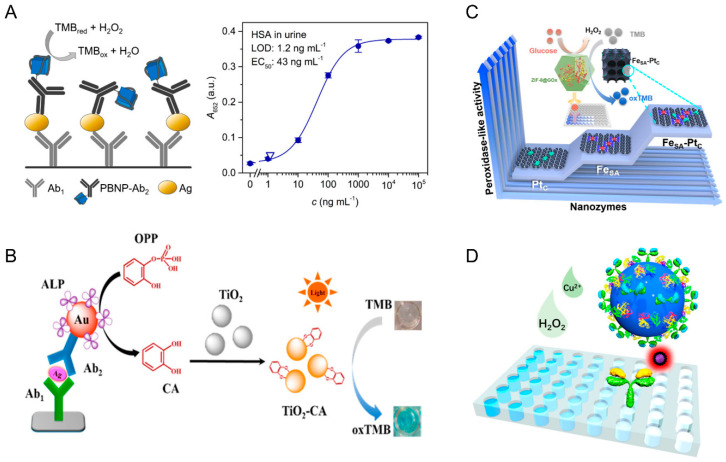
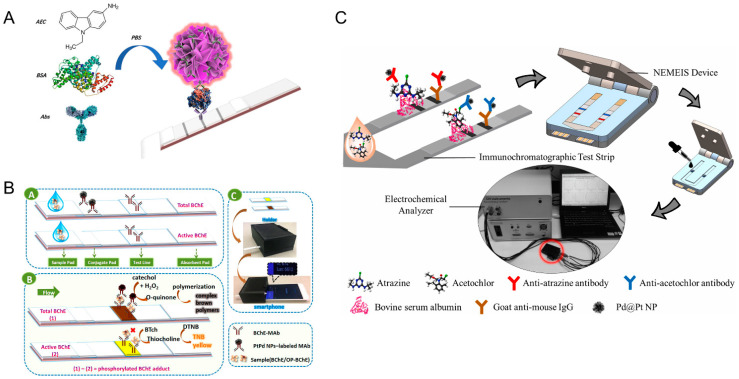
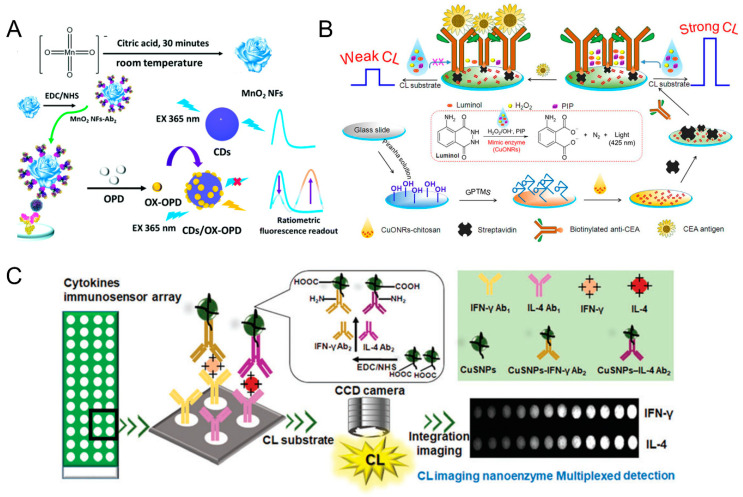
As a rapid and simple method for the detection of multiple targets, immunoassay has attracted extensive attention due to the merits of high specificity and sensitivity. Notably, enzyme-linked immunosorbent assay (ELISA) is a widely used immunoassay, which can provide high detection sensitivity since the enzyme labels can promote the generation of catalytically amplified readouts. However, the natural enzyme labels usually suffer from low stability, high cost, and difficult storage. Inspired by the advantages of superior and tunable catalytic activities, easy preparation, low cost, and high stability, nanozymes have arisen to replace the natural enzymes in immunoassay; they also possess equivalent sensitivity and selectivity, as well as robustness. Up to now, various kinds of nanozymes, including mimic peroxidase, oxidase, and phosphatase, have been incorporated to construct immunosensors. Herein, the development of immunoassays based on nanozymes with various types of detection signals are highlighted and discussed in detail. Furthermore, the challenges and perspectives of the design of novel nanozymes for widespread applications are discussed.
Keywords: immunoassays; nanozymes; signal amplification; target detection.
Conflict of interest statement
The authors declare no conflict of interest.
Figures
References
-
- Yang M.H., Chen S.C., Chen K.C., You H.P., Wu H.Y., Arthur Chen Y.M., Huang Y.F., Huang M.Y., Yuan C.H., Lin P.C., et al. Quantitative analysis of progesterone using isotope dilution-matrix-assisted laser desorption ionization-time of flight mass spectrometry as a reference procedure for radioimmunoassay. Clin. Chim. Acta. 2021;512:106–111. doi: 10.1016/j.cca.2019.11.020. - DOI - PubMed
Publication types
MeSH terms
Substances
Grants and funding
LinkOut - more resources
Full Text Sources
Research Materials
