


Protective Effects of Combined Utilization of Quercetin and Florfenicol on Acute Hepatopancreatic Necrosis Syndrome Infected Litopenaeus vannamei
- PMID: 36551441
- PMCID: PMC9774288
- DOI: 10.3390/antibiotics11121784
Protective Effects of Combined Utilization of Quercetin and Florfenicol on Acute Hepatopancreatic Necrosis Syndrome Infected Litopenaeus vannamei
Abstract
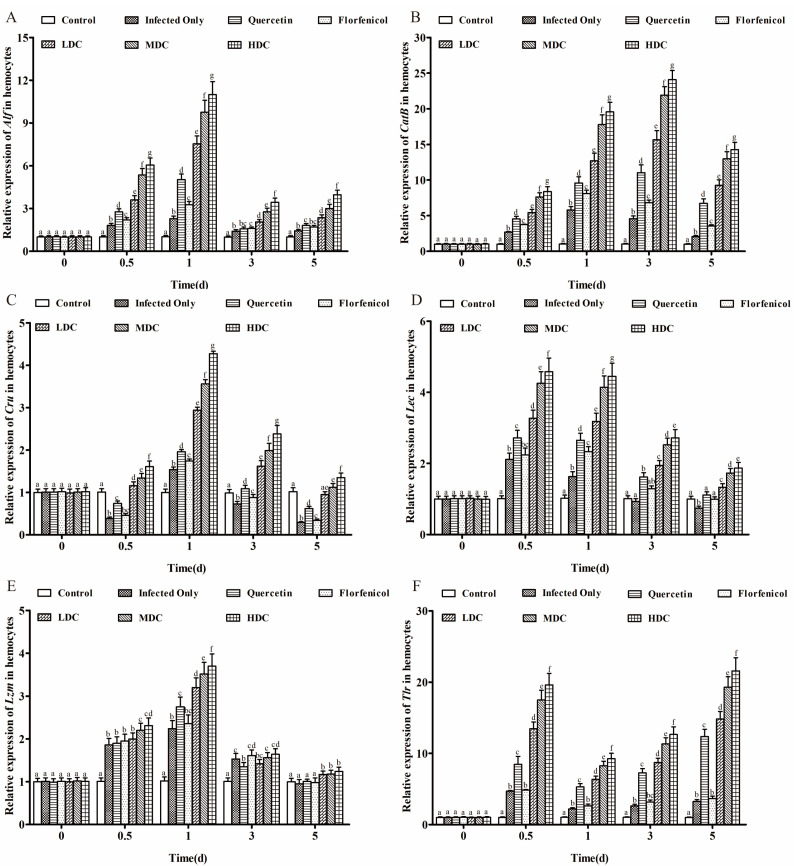
This study aimed to determine the immunity, survival rate, and disease resistance of Litopenaeus vannamei treated using quercetin and florfenicol alone or in combination, after infection with acute hepatopancreatic necrosis syndrome caused by Vibrio parahaemolyticus (VPAHPND). After infection with VPAHPND, different types of feed were given to the shrimp for 5 days, including a control diet (drug-free), florfenicol only diet (15 mg/kg), quercetin only diet (400 mg/kg), a low-dose florfenicol/quercetin combined diet (200 mg/kg quercetin + 7.0 mg/kg florfenicol), a moderate-dose florfenicol/quercetin combined diet (400 mg/kg quercetin + 15 mg/kg florfenicol), and a high-dose florfenicol/quercetin combined diet (800 mg/kg quercetin + 30 mg/kg florfenicol). The cumulative mortality of shrimp was significantly reduced in the drug combination groups compared with either drug used alone (p < 0.05). The density of Vibrio was significantly lower and the immune parameters were significantly increased in the drug combination groups compared with either drug used alone (p < 0.05). Moreover, in the drug combination groups, the hepatopancreas tubules showed better integrity and structure compared with those when either drug was used alone. Therefore, compared with single drug treatment, the florfenicol and quercetin combination enhanced disease resistance, survival, and immune activity of VPAHPND-infected shrimp. When the combination treatment is used, the dosage of florfenicol can be reduced and a better therapeutic effect is obtained.
Keywords: Litopenaeus vannamei; VPAHPND; florfenicol; immunomodulation; quercetin.
Conflict of interest statement
The authors declare no conflict of interest.
Figures



References
-
- MOA (Fisheries Bureau, Ministry of Agriculture) China Fishery Statistics Yearbook 2021. China Agriculture Press; Beijing, China: 2021. pp. 21–36.
-
- Rico A., Phu T.M., Satapornvanit K., Min J., Shahabuddin A.M., Henriksson P.J.G., Murray F.J., Little D.C., Dalsgaard A., Van den Brink P.J. Use of veterinary medicines, feed additives and probiotics in four major internationally traded aquaculture species farmed in Asia. Aquaculture. 2013;412–413:231–243. doi: 10.1016/j.aquaculture.2013.07.028. - DOI
Grants and funding
- 32102845/National Natural Science Foundation of China
- 2019YFD0900403/National Key R&D Program of China
- ZR2019QC015/Natural Science Foundation of Shandong Province, P. R. China
- CARS-48/China Agriculture Research System of MOF and MARA
- 2020TD46/Central Public-interest Scientific Institution Basal Research Fund, CAFS
LinkOut - more resources
Full Text Sources
