


Experimental Studies of the Attention Processing Model in Multiple Object Tracking Task
- PMID: 36552146
- PMCID: PMC9775580
- DOI: 10.3390/brainsci12121686
Experimental Studies of the Attention Processing Model in Multiple Object Tracking Task
Abstract
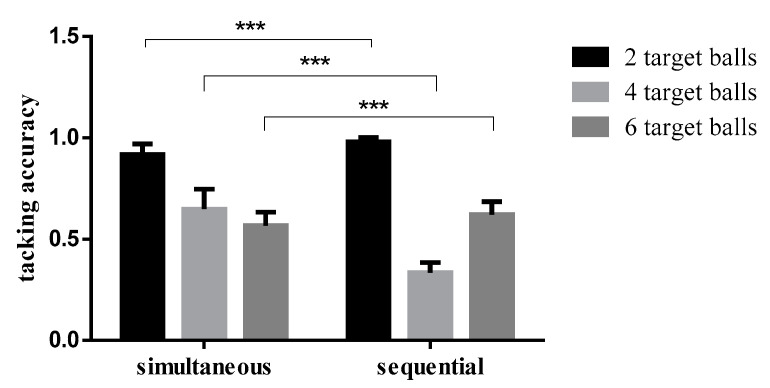
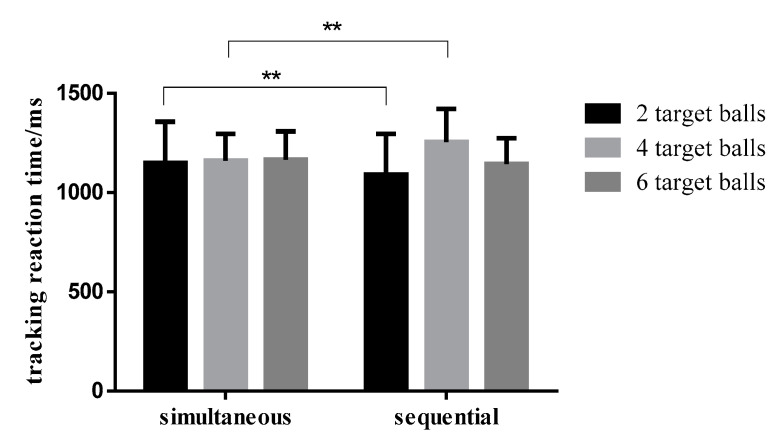
(1) Background: Attention is an important cognitive process in daily life. However, limited cognitive resources have been allocated to attention, especially for multiple objects and its mechanism is still unclear. Most of the previous studies have been based on the static attention paradigms with relatively lower ecological validity. Thus, we aimed to explore the attention processing mechanism in a multiple object tracking (MOT) task by using a dynamic attention paradigm. Two experiments were conducted to assess whether there was a multi-focus attention processing model, and whether the processing model changes with the number of target balls. (2) Methods: During the experiments, 33 university students completed MOT combined with the simultaneous-sequential paradigm, with tracking accuracy and reaction time of correct reaction as indicators. (3) Results: (i) When there were two target balls, an obvious bilateral field advantage was apparent. (ii) When there were four target balls, participants' performance was significantly better when stimuli were presented simultaneously than when they were presented sequentially, showing a multi-focus attention processing model. (4) Conclusion: Attention processing is characterized by flexibility, providing strong evidence to support the multi-focus theory.
Keywords: attention; multi-focus theory; multiple object tracking (MOT) task; simultaneous–sequential paradigm.
Conflict of interest statement
The authors declare no conflicts of interest.
Figures


References
-
- Peng D.L. General Psychology. 5th ed. Beijing Normal University Press; Beijing, China: 2019. pp. 198–204.
Grants and funding
LinkOut - more resources
Full Text Sources
