


Phloroglucinol Attenuates DNA Damage and Apoptosis Induced by Oxidative Stress in Human Retinal Pigment Epithelium ARPE-19 Cells by Blocking the Production of Mitochondrial ROS
- PMID: 36552561
- PMCID: PMC9774705
- DOI: 10.3390/antiox11122353
Phloroglucinol Attenuates DNA Damage and Apoptosis Induced by Oxidative Stress in Human Retinal Pigment Epithelium ARPE-19 Cells by Blocking the Production of Mitochondrial ROS
Abstract
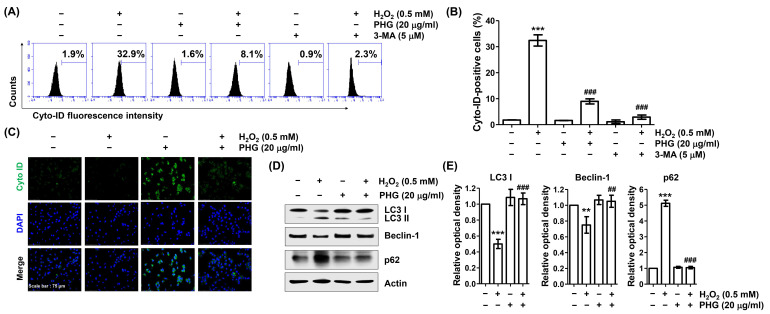
Phloroglucinol, a phenolic compound, is known to possess a potent antioxidant ability. However, its role in retinal cells susceptible to oxidative stress has not been well elucidated yet. Thus, the objective of this study was to evaluate whether phloroglucinol could protect against oxidative damage in cultured human retinal pigment epithelium ARPE-19 cells. For this purpose, ARPE-19 cells were stimula ted with hydrogen peroxide (H2O2) to mimic oxidative stress. Cell viability, cytotoxicity, apoptosis, reactive oxygen species (ROS) generation, mitochondrial function, DNA damage, and autophagy were then assessed. Our results revealed that phloroglucinol ameliorated cell viability, cytotoxicity, and DNA damage in H2O2-exposued ARPE-19 cells and blocked production of ROS. Phloroglucinol also counteracted H2O2-induced apoptosis by reducing Bax/Bcl-2 ratio, blocking activation of caspase-3, and inhibiting degradation of poly (ADP-ribose) polymerase. H2O2 caused mitochondrial impairment and increased expression levels of mitophagy markers such as PINK1and PARKIN known to be associated with mitochondrial ROS (mtROS) generation and cytosolic release of cytochrome c. However, these changes were significantly attenuated by phloroglucinol. Mito-TEMPO, a selective mitochondrial antioxidant, further enhanced the protective effect of phloroglucinol against dysfunctional mitochondria. Furthermore, H2O2 induced autophagy, but not when ARPE-19 cells were pretreated with phloroglucinol, meaning that autophagy by H2O2 contributed to the pro-survival mechanism and that phloroglucinol protected ARPE-19 cells from apoptosis by blocking autophagy. Taken together, these results suggest that phloroglucinol can inhibit oxidative stress-induced ARPE-19 cell damage and dysfunction by protecting DNA damage, autophagy, and subsequent apoptosis through mitigation of mtROS generation. Thus, phloroglucinol might have therapeutic potential to prevent oxidative stress-mediated damage in RPE cells.
Keywords: DNA damage; apoptosis; autophagy; mitochondrial ROS; phloroglucinol.
Conflict of interest statement
The authors declare no conflict of interest.
Figures



References
-
- Kaarniranta K., Uusitalo H., Blasiak J., Felszeghy S., Kannan R., Kauppinen A., Salminen A., Sinha D., Ferrington D. Mechanisms of mitochondrial dysfunction and their impact on age-related macular degeneration. Prog. Retin. Eye Res. 2020;79:100858. doi: 10.1016/j.preteyeres.2020.100858. - DOI - PMC - PubMed
Grants and funding
- 2021R1A2C200954911/Basic Science Research Program through the National Research Foundation of Korea (NRF) grant funded by the Korea government
- 2022R1I1A1A01070768/Basic Science Research Program through the National Research Foundation of Korea (NRF) grant funded by the Korea government
- 20220488/Korea Institute of Marine Science & Technology Promotion (KIMST) funded by the Ministry of Oceans and Fisheries
LinkOut - more resources
Full Text Sources
Research Materials
