


Learning to Cycle: Is Velocity a Control Parameter for Children's Cycle Patterns on the Balance Bike?
- PMID: 36553380
- PMCID: PMC9776492
- DOI: 10.3390/children9121937
Learning to Cycle: Is Velocity a Control Parameter for Children's Cycle Patterns on the Balance Bike?
Abstract
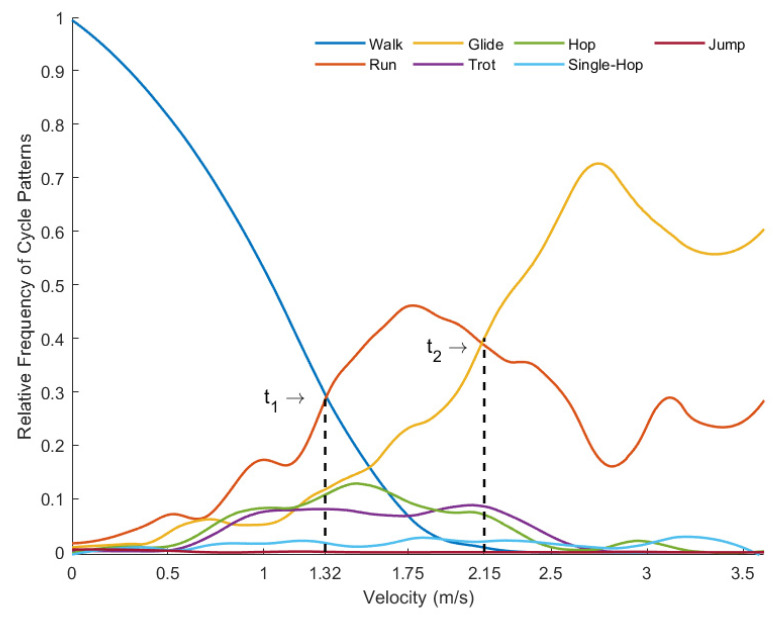
The balance bike (BB) has been pointed out as being the most efficient learning bicycle due to its inherent stimulation of balance. However, the process of acquiring the control of balance on the BB has not been explored. This study aimed to: (i) categorize the cycle patterns of children on the BB, (ii) compare the cycle patterns in different stages of learning (before and after six sessions of a BB practice program), and (iii) verify whether velocity is a control parameter leading to transitions between different cycle patterns on a BB. The data were collected during the Learning to Cycle program from 12 children aged 6.06 ± 1.25 years. The velocity was measured using an inertial sensor. Seven different movement patterns were captured and categorized through video analysis. After practice, there was an increase in the mean number of different patterns and in the global mean and maximum velocity. These were interpreted as an improvement of the motor competence in the use of the BB. The results obtained support the hypothesis that velocity is a control parameter which leads to the emergence of diverse patterns of behavior. As the speed increased, the amount of foot contact with the ground became less frequent and the locomotor modes that imply that longer flight phases began to emerge.
Keywords: IMU; L2Cycle program; balance bike; children; control parameter; cycle patterns.
Conflict of interest statement
The authors declare no conflict of interest.
Figures
References
-
- Ramírez-Vélez R., García-Hermoso A., Agostinis-Sobrinho C., Mota J., Santos R., Correa-Bautista J.E., Amaya-Tambo D.C., Villa-González E. Cycling to School and Body Composition, Physical Fitness, and Metabolic Syndrome in Children and Adolescents. J. Pediatr. 2017;188:57–63. doi: 10.1016/j.jpeds.2017.05.065. - DOI - PubMed
-
- Kelso S. Coordination Dynamics. In: Meyers R.A., editor. Encyclopedia of Complexity and Systems Science. Springer; New York, NY, USA: 2009. pp. 1537–1564.
-
- Kelso J.A.S. Dynamic Patterns: The Self-Organization of Brain and Behavior. MIT Press; Cambridge, MA, USA: 1995.
LinkOut - more resources
Full Text Sources
Research Materials
