


Early Regressive Development of the Subcommissural Organ of Two Human Fetuses with Non-Communicating Hydrocephalus
- PMID: 36553409
- PMCID: PMC9776597
- DOI: 10.3390/children9121966
Early Regressive Development of the Subcommissural Organ of Two Human Fetuses with Non-Communicating Hydrocephalus
Abstract
Hydrocephalus is a central nervous system condition characterized by CSF buildup and ventricular hypertrophy. It is divided into two types: communicative and non-communicating hydrocephalus. Congenital hydrocephalus has been linked to several changes in the subcommissural organ (SCO). However, it is unclear whether these changes occur before or as a result of the hydrocephalic illness. This report presents three cases of human fetuses with hydrocephalus: one non-communicating case, two communicating cases, and two controls. Hematoxylin-Eosin (H&E) or cresyl violet and immunohistochemistry with anti-transthyretin were used to analyze SCO morphological and secretory changes. We conclude that in the cases presented here, there could be an early regression in the SCO of the communicating cases that is not present in the non-communicating case.
Keywords: human congenital hydrocephalus; subcommissural organ; transthyretin.
Conflict of interest statement
The authors declare no conflict of interest.
Figures
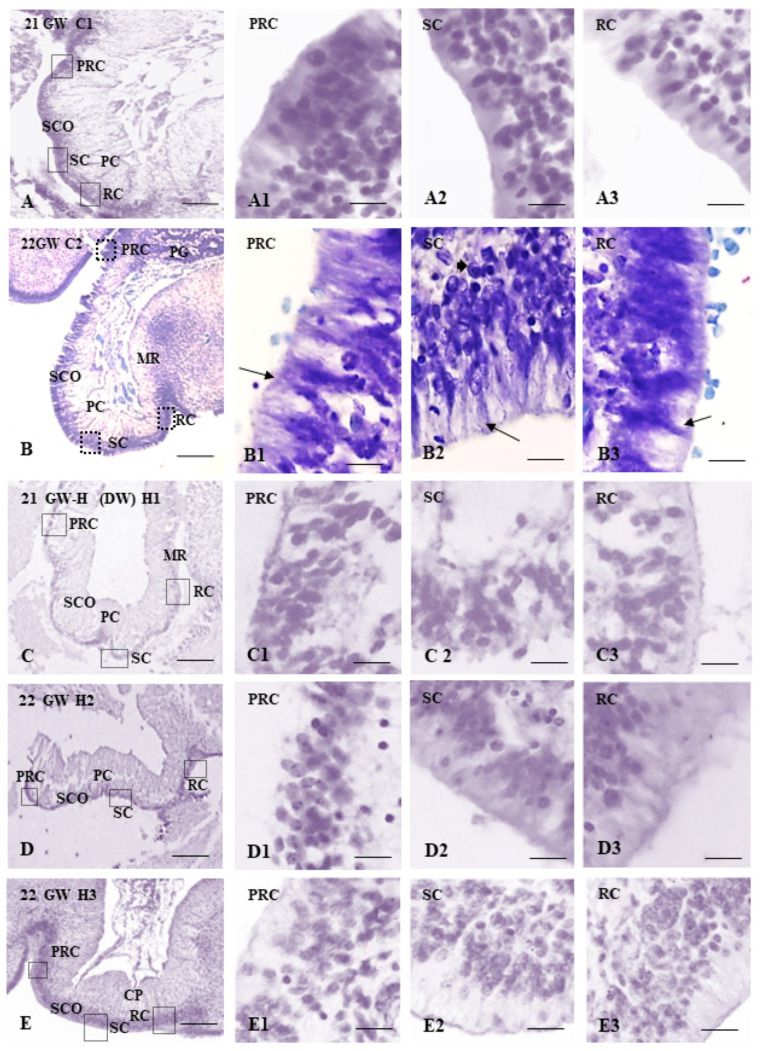
 ependymal cells,
  hypendymal cells.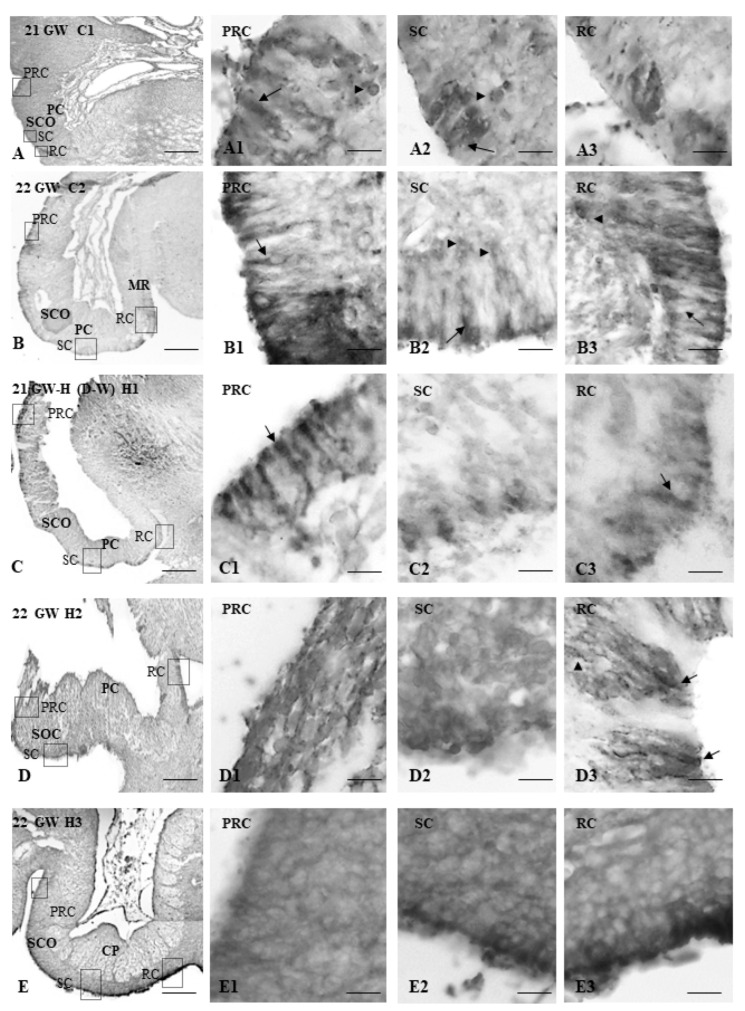
 ependymal cells, (▲) hypendymal cells. In the case of non-communicating hydrocephalus, TTR-ir can be observed in the rostral and caudal parts of the SCO. However, in the H2 case of communicating hydrocephalus, the TTR-ir can mainly be observed in the sub and retrocomisural parts of the SCO and located in the ependymal cells. In the H3 case of communicating the TTR-ir is in the ependymal cells of the retro-commissural parts, mainly in its apical pole.
References
-
- Höfer H. Zur Morphologie der circumventriculären Organe des Zwischenhirnes der Säugetiere. Zool Anz Suppl. 1959;22:202–251.
-
- Oksche A. Funktionelle histologische Untersuchungen über die Organe des Zwischenhirndaches der Chordaten. Anat. Anz. 1956;102:404–419. - PubMed
-
- Oksche A. Phylogenetic and conceptual aspects of the subcommissural organ. In: Oksche A., Rodríguez E.M., Fernández-Llébrez P., editors. The Subcommissural Organ, an Ependymal Brain Gland. Springer; Berlin/Heidelberg, Germany: 1993. pp. 23–32.
LinkOut - more resources
Full Text Sources
Research Materials
