


High Resistance to Antibiotics Recommended in Standard Treatment Guidelines in Ghana: A Cross-Sectional Study of Antimicrobial Resistance Patterns in Patients with Urinary Tract Infections between 2017-2021
- PMID: 36554436
- PMCID: PMC9779193
- DOI: 10.3390/ijerph192416556
High Resistance to Antibiotics Recommended in Standard Treatment Guidelines in Ghana: A Cross-Sectional Study of Antimicrobial Resistance Patterns in Patients with Urinary Tract Infections between 2017-2021
Abstract
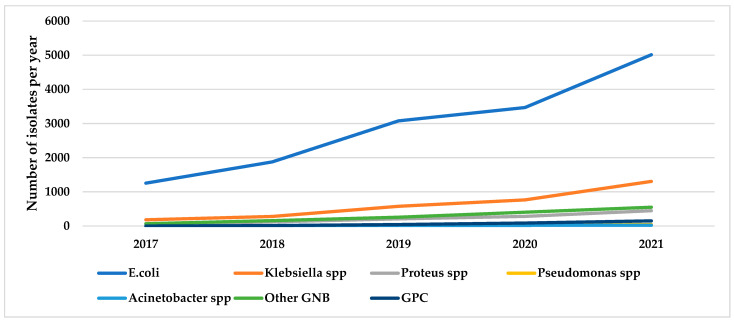
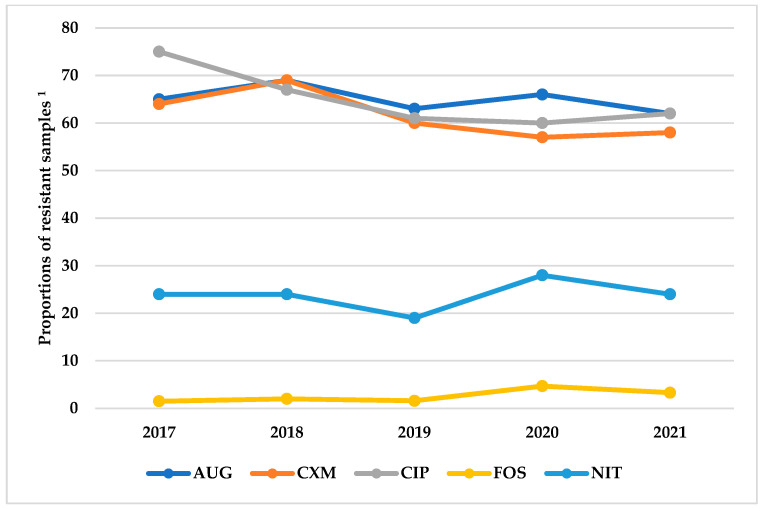
Management of urinary tract infections is challenged by increasing antimicrobial resistance (AMR) worldwide. In this study, we describe the trends in antimicrobial resistance of uropathogens isolated from the largest private sector laboratory in Ghana over a five-year period. We reviewed positive urine cultures at the MDS Lancet Laboratories from 2017 to 2021. The proportions of uropathogens with antimicrobial resistance to oral and parenteral antimicrobials recommended by the Ghana standard treatment guidelines were determined. The proportion of multi-drug resistant isolates, ESBL and carbapenemase-producing phenotypes were determined. Of 94,134 urine specimens submitted for culture, 20,010 (22.1%) were culture positive. Enterobacterales was the most common group of organisms, E. coli (70.6%) being the most common isolate and Enterococcus spp. the most common gram-positive (1.3%) organisms. Among oral antimicrobials, the highest resistance was observed to ciprofloxacin (62.3%) and cefuroxime (60.2%) and the least resistance to fosfomycin (1.9%). The least resistance among parenteral antimicrobials was to meropenem (0.3%). The highest multi-drug resistance levels were observed among Klebsiella spp. (68.6%) and E. coli (64.0%). Extended-spectrum beta-lactamase (ESBL) positivity was highest in Klebsiella spp. (58.6%) and E. coli (50.0%). There may be a need to review the Ghana standard treatment guidelines to reflect increased resistance among uropathogens to recommended antimicrobials.
Keywords: Access, Watch and Reserve (AWaRE) classification; Ghana; MDS Lancet Laboratories; antimicrobial resistance (AMR); multi-drug resistance (MDR); urinary tract infection; uropathogens.
Conflict of interest statement
The authors declare that this study received funding from the National Institute of Health Research, Department of Health & Social Care of the United Kingdom and supported by implementing partners. The funder was not involved in the study design, collection, analysis, interpretation of data, the writing of this article or the decision to submit it for publication.
Figures
References
-
- World Health Organization (WHO) Factsheet. World Health Organization (WHO); Geneva, Switzerland: 2020. Antimicrobial resistance.
-
- Joshua M., Raymond M. Virulence factors and antibiotic resistance patterns of uropathogenic Escherichia coli. Afr. J. Microbiol. Res. 2014;8:3678–3686. doi: 10.5897/AJMR2014.7034. - DOI
Publication types
MeSH terms
Substances
Grants and funding
LinkOut - more resources
Full Text Sources
Medical
Research Materials
Miscellaneous
