


Deferral of Non-Emergency Cardiovascular Interventions Triggers Increased Cardiac Emergency Admissions-Analysis of the COVID-19 Related Lockdown
- PMID: 36554458
- PMCID: PMC9778764
- DOI: 10.3390/ijerph192416579
Deferral of Non-Emergency Cardiovascular Interventions Triggers Increased Cardiac Emergency Admissions-Analysis of the COVID-19 Related Lockdown
Abstract
Background: Data on the relation between non-emergency and emergency cardiac admission rates during the COVID-19 lockdown and post-lockdown period are sparse.
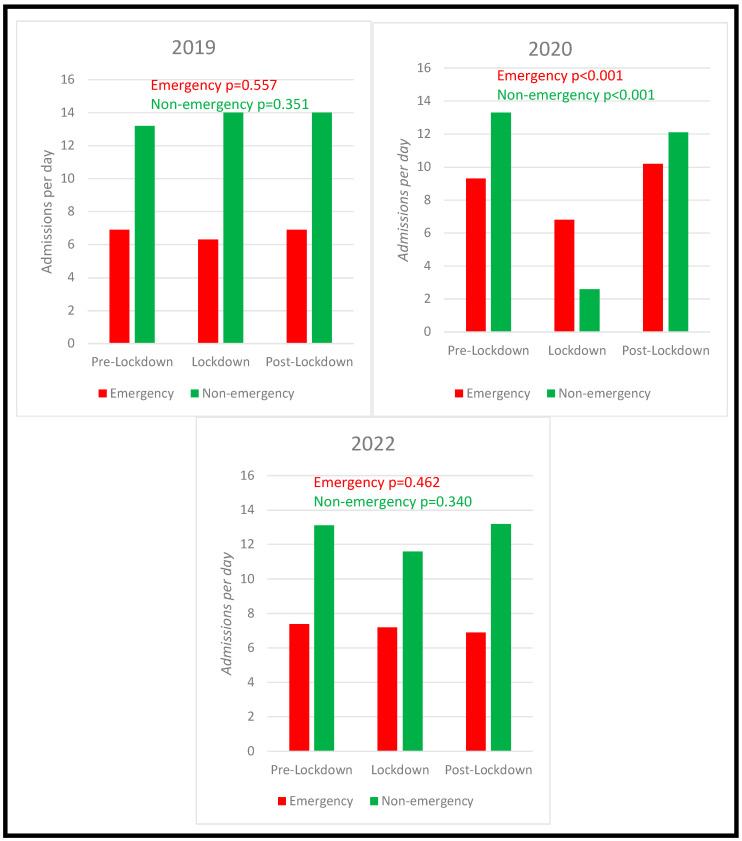
Methods: Consecutive cardiac patients admitted to our tertiary heart center between 1 January and 30 June 2020 were included. The observation period of 6 months was analyzed in total and divided into three defined time periods: the pre-lockdown (1 January-19 March), lockdown (20 March-19 April), and post-lockdown (20 April-30 June) period. These were compared to the reference periods 2019 and 2022 using daily admission rates and incidence rate ratios (IRR).
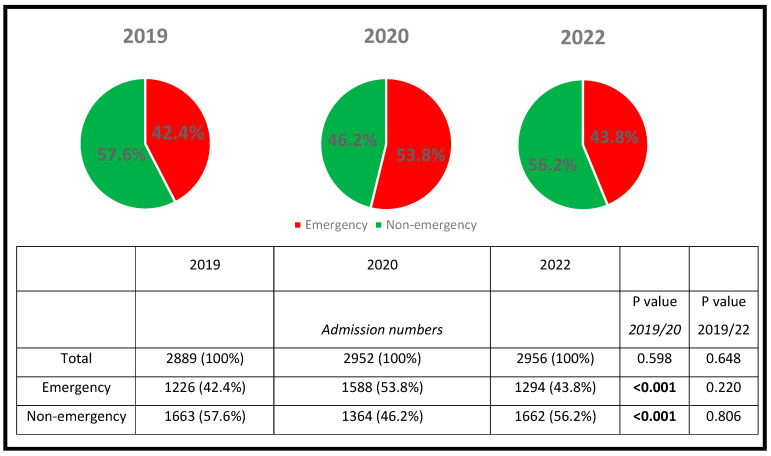
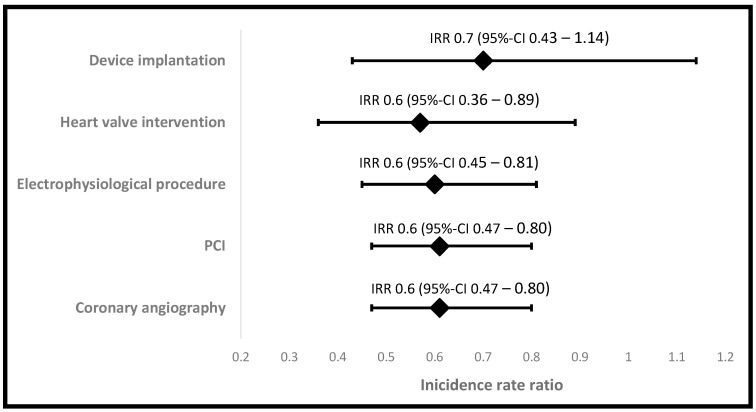
Results: Over the observation period from 1 January to 30 June, cardiac admissions (including non-emergency and emergency) were comparable between 2019, 2020, and 2022 (n = 2889, n = 2952, n = 2956; p = 0.845). However, when compared to the reference period 2019, non-emergency admissions decreased in 2020 (1364 vs. 1663; p = 0.02), while emergency admissions significantly increased (1588 vs. 1226; p < 0.001). Further analysis of the lockdown period revealed that non-emergency admissions dropped by 82% (IRR 0.18; 95%-CI 0.14-0.24; p < 0.001) and 42% fewer invasive cardiac interventions were performed (p < 0.001), whereas the post-lockdown period showed a 52% increase of emergency admissions (IRR 1.47; 95%-CI 1.31-1.65; p < 0.001) compared to 2019.
Conclusions: We demonstrate a drastic surge of emergency cardiac admissions post-COVID-19 related lockdown suggesting that patients who did not keep their non-emergency appointment had to be admitted as an emergency later on.
Keywords: COVID-19; admission; cardiac event; deferral; emergency; lockdown; lockdown strategies; non-emergency.
Conflict of interest statement
The authors declare no conflict of interest.
Figures
References
-
- Shah S.A., Brophy S., Kennedy J., Fisher L., Walker A., Mackenna B., Curtis H., Inglesby P., Davy S., Bacon S., et al. Impact of first UK COVID-19 lockdown on hospital admissions: Interrupted time series study of 32 million people. EClinicalMedicine. 2022;49:101462. doi: 10.1016/j.eclinm.2022.101462. - DOI - PMC - PubMed
-
- Rattka M., Winsauer C., Stuhler L., Thiessen K., Baumhardt M., Stephan T., Rottbauer W., Imhof A. Outcomes of patients with ST-segment myocardial infarction admitted during the COVID-19 pandemic: A prospective, observational study from a tertiary care center in Germany. Herz. 2021;47:258–264. doi: 10.1007/s00059-021-05058-7. - DOI - PMC - PubMed
-
- Kapsner L.A., Kampf M.O., Seuchter S.A., Gruendner J., Gulden C., Mate S., Mang J.M., Schüttler C., Deppenwiese N., Krause L., et al. Reduced Rate of Inpatient Hospital Admissions in 18 German University Hospitals During the COVID-19 Lockdown. Front. Public Health. 2021;8:594117. doi: 10.3389/fpubh.2020.594117. - DOI - PMC - PubMed
-
- Li Z., Lin L., Wu H., Yan L., Wang H., Yang H., Li H. Global, Regional, and National Death, and Disability-Adjusted Life-Years (DALYs) for Cardiovascular Disease in 2017 and Trends and Risk Analysis From 1990 to 2017 Using the Global Burden of Disease Study and Implications for Prevention. Front. Public Health. 2021;9:559751. doi: 10.3389/fpubh.2021.559751. - DOI - PMC - PubMed
MeSH terms
LinkOut - more resources
Full Text Sources
Medical
Miscellaneous
