


Effects of Different Types of Human Disturbance on Total and Nitrogen-Transforming Bacteria in Haihe River
- PMID: 36556446
- PMCID: PMC9781767
- DOI: 10.3390/life12122081
Effects of Different Types of Human Disturbance on Total and Nitrogen-Transforming Bacteria in Haihe River
Abstract
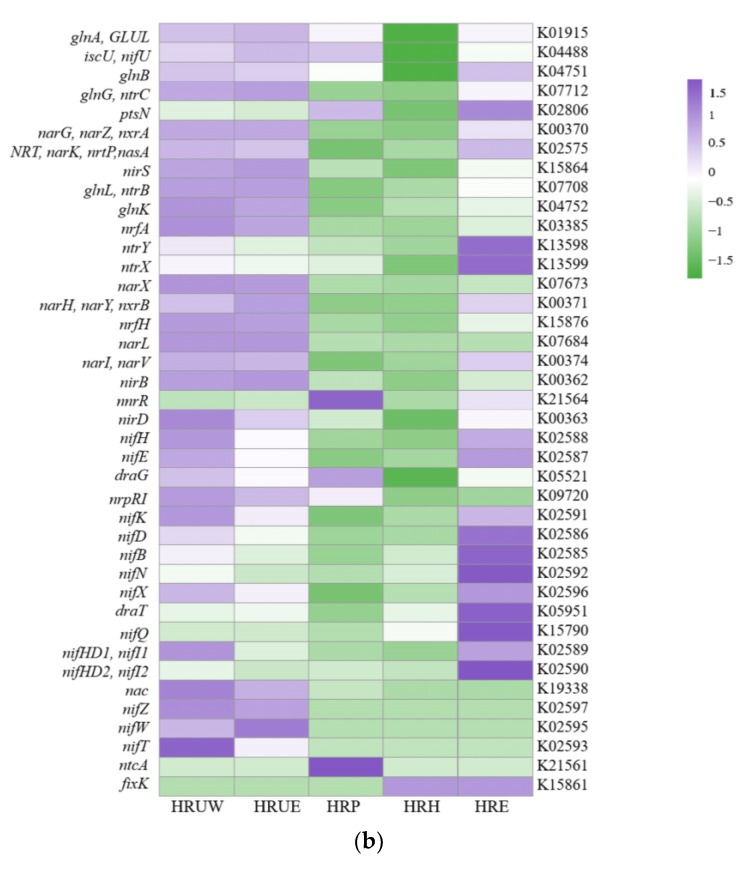
Haihe River is the largest water system in North China and is injected into the Bohai Sea in Tianjin City. In this study, different types of human disturbance (urban sewage, industrial pollution, ship disturbance) were selected from the upper reaches of Haihe river Tianjin section down to the estuary that connected with Bohai Sea for evaluation. By metagenomic sequencing, the effects of different types of disturbances on bacteria communities in Haihe sediments were studied, with a special focus on the function of nitrogen-cycling bacteria that were further analyzed through KEGG comparison. By analyzing the physical and chemical characteristics of sediments, results showed that human disturbance caused a large amount of nitrogen input into Haihe River, and different types of human disturbance led to distinct spatial heterogeneity in different sections of Haihe River. The bacteria community was dominated by Proteobacteria, followed by Chloroflexi, Bacteroidetes, Actinobacteria and Acidobacteria. The relative abundance of each phylum varied at different sites as a response to different types of human disturbances. In nitrogen cycling, microorganisms including nitrogen fixation and removal were detected at each site, which indicated the active potential for nitrogen transformation in Haihe River. In addition, a large number of metabolic pathways relating to human diseases were also revealed in urban and pollution sites by function potential, which provided an important basis for the indicative role of urban river ecosystem for public health security. In summary, by evaluating both the ecological role and function potential of bacteria in Haihe River under different types of human disturbance, the knowledge of microorganisms for healthy and disturbed river ecosystems has been broadened, which is also informative for further river management and bioremediation.
Keywords: Haihe River; function potential; human disturbance; microbial diversity; nitrogen cycle.
Conflict of interest statement
The authors declare no conflict of interest.
Figures


References
-
- Cai W., Li Y., Shen Y., Wang C., Wang P.F., Wang L.F., Niu L.H., Zhang W.L. Vertical distribution and assemblages of microbial communities and their potential effects on sulfur metabolism in a black-odor urban river. J. Environ. Manage. 2019;235:368–376. doi: 10.1016/j.jenvman.2019.01.078. - DOI - PubMed
-
- Dodds W.K. Eutrophication and trophic state in rivers and streams. Limnol. Oceanogr. 2006;51:671–680. doi: 10.4319/lo.2006.51.1_part_2.0671. - DOI
-
- Zhang X., Gu Q., Long X.E., Li Z.L., Liu D.X., Ye D.H., He C.Q., Liu X.Y., Vaananen K., Chen X.P. Anthropogenic activities drive the microbial community and its function in urban river sediment. J. Soils Sediments. 2016;16:716–725. doi: 10.1007/s11368-015-1246-8. - DOI
Grants and funding
LinkOut - more resources
Full Text Sources
