. 2022 Dec 13;12(12):1255.
doi: 10.3390/metabo12121255.

Antibacterial and Antibiofilm Activity of Carvacrol against Oral Pathogenic Bacteria

Affiliations

Antibacterial and Antibiofilm Activity of Carvacrol against Oral Pathogenic Bacteria

Irene Fernández-Babiano et al. Metabolites. .

Abstract

Faced with the current situation of high rates of microbial resistance, together with the scarcity of new antibiotics, it is necessary to search for and identify new antimicrobials, preferably natural, to alleviate this situation. The aim of this work was to evaluate the antibacterial activity of carvacrol (CAR), a phenolic compound of essential oils, against pathogenic microorganisms causing oral infections, such as Streptococcus mutans and S. sanguinis, never evaluated before. The minimum inhibitory and the minimum bactericidal concentration were 93.4 μg/mL and 373.6 μg/mL, respectively, for the two strains. The growth kinetics under different concentrations of CAR, as well as the bactericidal power were determined. The subinhibitory concentrations delayed and decreased bacterial growth. Its efficacy on mature biofilms was also tested. Finally, the possible hemolytic effect of CAR, not observable at the bactericidal concentrations under study, was evaluated. Findings obtained point to CAR as an excellent alternative agent to safely prevent periodontal diseases. In addition, it is important to highlight the use of an experimental methodology that includes dual-species biofilm and subinhibitory concentration models to determine optimal CAR treatment concentrations. Thus, CAR could be used preventively in mouthwashes or biomaterials, or in treatments to avoid existing antibiotic resistance.

Keywords: Streptococcus; antibacterial activity; biofilm; carvacrol; oral diseases.


Conflict of interest statement

The authors declare no conflict of interest.

Figures
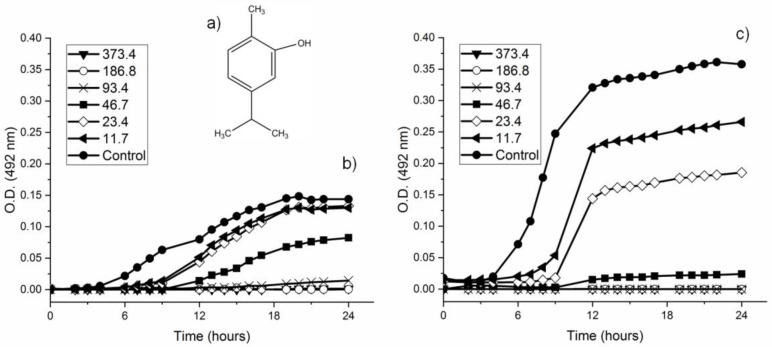
Figure 1
Figure 1
Chemical structure of CAR (a); growth curves of S. mutans (b) and S. sanguinis (c) against different concentrations of CAR (µg/mL) and Control (no treatment).
Figure 2
Figure 2
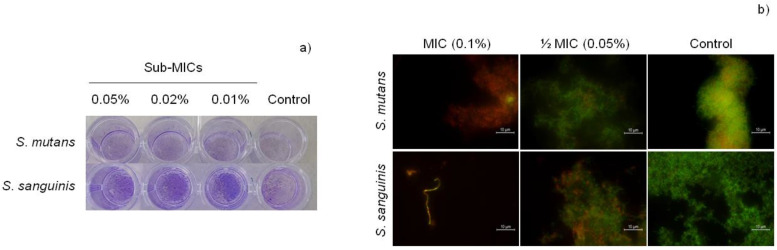
Biofilm remaining after treatment of CAR against S. mutans and S. sanguinis by violet crystal stain assay (a); Live/Dead staining of biofilm cells after treatment with CAR (b).
Figure 3
Figure 3
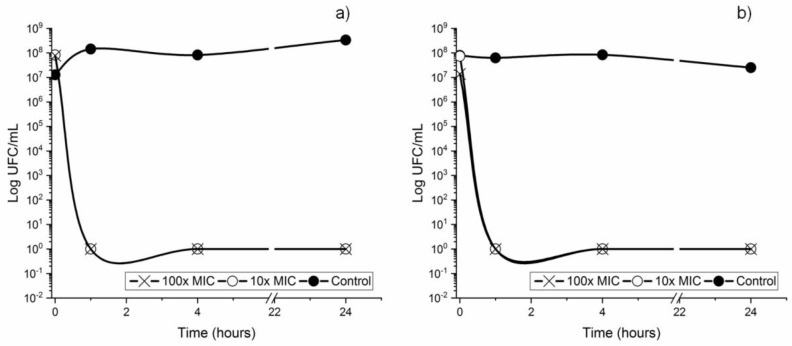
Time-kill curves for a standardized culture of S. mutans (a) and S. sanguinis (b) subjected to 10, 100 times their MIC and Control (no treatment) at different times.
Figure 4
Figure 4
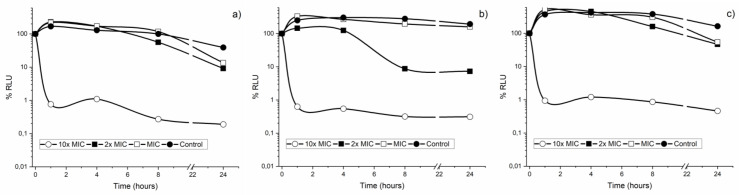
Variation of metabolic activity of the S. mutans (a), S. sanguinis (b) and mixture of both strains (c) included in mature biofilm under various concentrations of CAR and Control (no treatment) at different times.
Figure 5
Figure 5
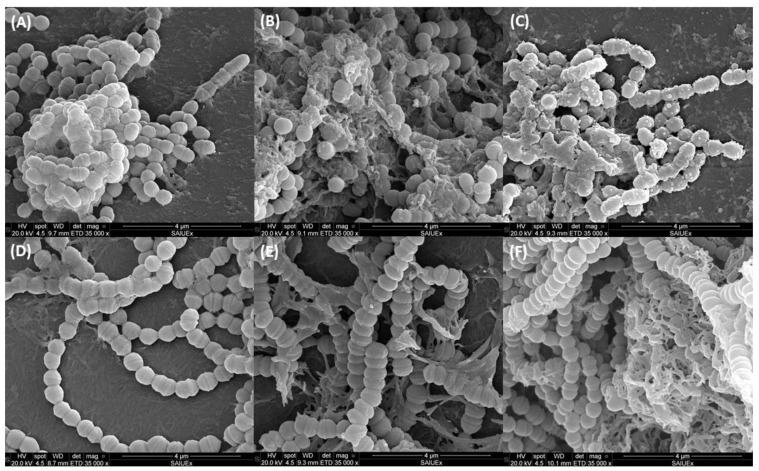
Image obtained by scanning electron microscopy of the biofilm generated by S. mutans (above) and S. sanguinis (below) at two different concentrations of CAR ((A,D): Control; (B,E): 1.5 mg/mL (1.5%), (C,F): 11.95 mg/mL(12.5%)).
Figure 6
Figure 6
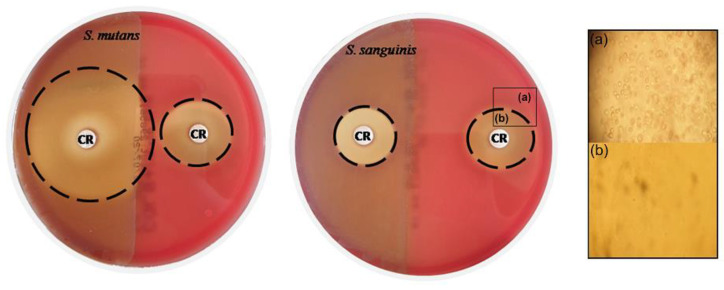
Hemolytic effect of CAR on blood agar plates. The left halves of both plates were inoculated with S. mutans (left) and S. sanguinis (right). (a) Healthy and (b) Hemolyzed red blood cells observed by optical microscopy. Disks contained CAR at 95.6 mg/mL.
Figure 7
Figure 7
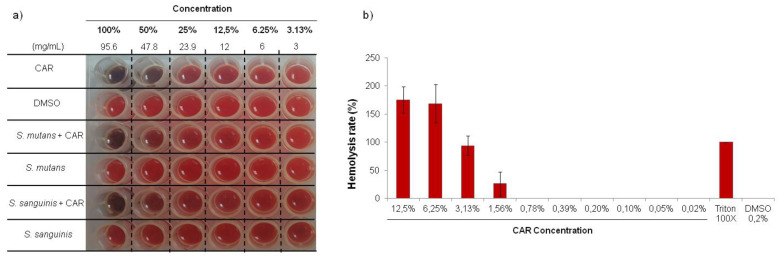
Hemolytic effect of different concentrations of CAR and solvent (DMSO) in the presence and absence of the strains studied in microtiter plate (a); Hemolysis rate (b).

References

    1. Bacali C., Vulturar R., Buduru S., Cozma A., Fodor A., Chis A., Lucaciu O., Damian L., Moldovan M.L. Oral Microbiome: Getting to Know and Befriend Neighbors, a Biological Approach. Biomedicines. 2022;10:671. doi: 10.3390/biomedicines10030671. - DOI - PMC - PubMed
    1. Di Stefano M., Polizzi A., Santonocito S., Romano A., Lombardi T., Isola G. Impact of Oral Microbiome in Periodontal Health and Periodontitis: A Critical Review on Prevention and Treatment. Int. J. Mol. Sci. 2022;23:5142. doi: 10.3390/ijms23095142. - DOI - PMC - PubMed
    1. Diaz P.I., Valm A.M. Microbial Interactions in Oral Communities Mediate Emergent Biofilm Properties. J. Dent. Res. 2020;99:18–25. doi: 10.1177/0022034519880157. - DOI - PMC - PubMed
    1. Welch J.L.M., Rossetti B.J., Rieken C.W., Dewhirst F.E., Borisy G.G. Biogeography of a human oral microbiome at the micron scale. Proc. Natl. Acad. Sci. USA. 2016;113:E791–E800. doi: 10.1073/pnas.1522149113. - DOI - PMC - PubMed
    1. Scharnow A.M., Solinski A.E., Wuest W.M. Targeting S. mutans biofilms: A perspective on preventing dental caries. Medchemcomm. 2019;10:1057–1067. doi: 10.1039/C9MD00015A. - DOI - PMC - PubMed

LinkOut - more resources