


Prediction of Dispersion Rate of Airborne Nanoparticles in a Gas-Liquid Dual-Microchannel Separated by a Porous Membrane: A Numerical Study
- PMID: 36557519
- PMCID: PMC9785617
- DOI: 10.3390/mi13122220
Prediction of Dispersion Rate of Airborne Nanoparticles in a Gas-Liquid Dual-Microchannel Separated by a Porous Membrane: A Numerical Study
Abstract
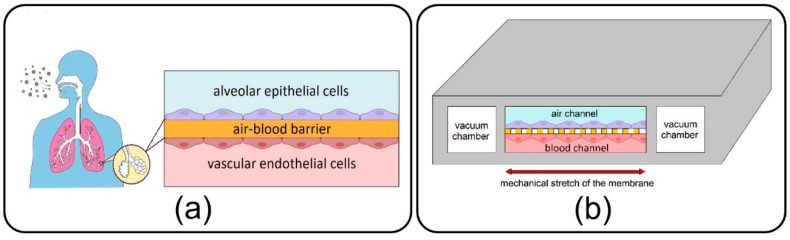
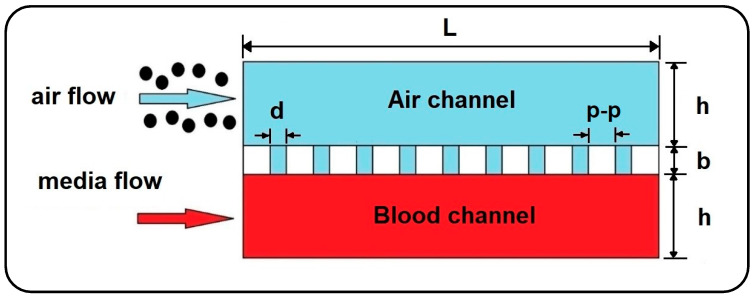
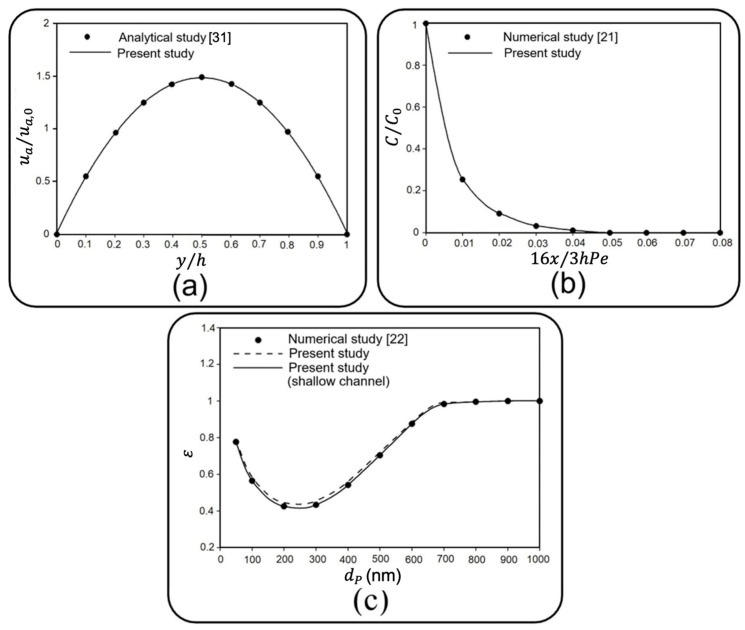
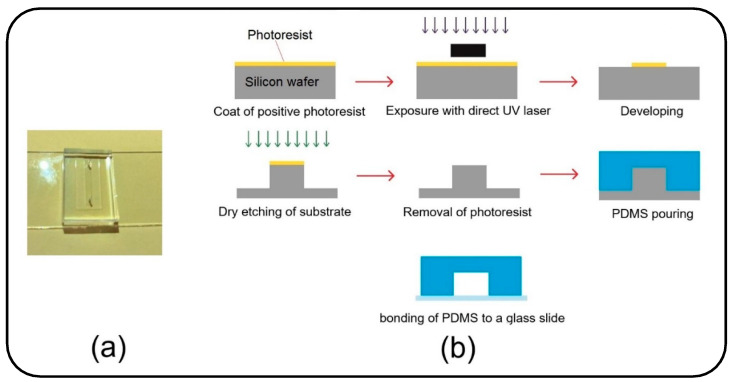
Recently, there has been increasing attention toward inhaled nanoparticles (NPs) to develop inhalation therapies for diseases associated with the pulmonary system and investigate the toxic effects of hazardous environmental particles on human lung health. Taking advantage of microfluidic technology for cell culture applications, lung-on-a-chip devices with great potential in replicating the lung air-blood barrier (ABB) have opened new research insights in preclinical pathology and therapeutic studies associated with aerosol NPs. However, the air interface in such devices has been largely disregarded, leaving a gap in understanding the NPs' dynamics in lung-on-a-chip devices. Here, we develop a numerical parametric study to provide insights into the dynamic behavior of the airborne NPs in a gas-liquid dual-channel lung-on-a-chip device with a porous membrane separating the channels. We develop a finite element multi-physics model to investigate particle tracing in both air and medium phases to replicate the in vivo conditions. Our model considers the impact of fluid flow and geometrical properties on the distribution, deposition, and translocation of NPs with diameters ranging from 10 nm to 900 nm. Our findings suggest that, compared to the aqueous solution of NPs, the aerosol injection of NPs offers more efficient deposition on the substrate of the air channel and higher translocation to the media channel. Comparative studies against accessible data, as well as an experimental study, verify the accuracy of the present numerical analysis. We propose a strategy to optimize the affecting parameters to control the injection and delivery of aerosol particles into the lung-on-chip device depending on the objectives of biomedical investigations and provide optimized values for some specific cases. Therefore, our study can assist scientists and researchers in complementing their experimental investigation in future preclinical studies on pulmonary pathology associated with inhaled hazardous and toxic environmental particles, as well as therapeutic studies for developing inhalation drug delivery.
Keywords: gas–liquid dual-channel chip; lung-on-a-chip; nanoparticle; numerical simulation; porous membrane.
Conflict of interest statement
The authors declare no conflict of interest.
Figures
References
-
- Amararathna M., Goralski K., Hoskin D.W., Rupasinghe H.P.V. Pulmonary Nano-Drug Delivery Systems for Lung Cancer: Current Knowledge and Prospects. J. Lung Health Dis. 2019;3:11–28. doi: 10.29245/2689-999X/2019/2.1148. - DOI
LinkOut - more resources
Full Text Sources
Miscellaneous
