


Theileria terrestris nov. sp.: A Novel Theileria in Lowland Tapirs (Tapirus terrestris) from Two Different Biomes in Brazil
- PMID: 36557572
- PMCID: PMC9784709
- DOI: 10.3390/microorganisms10122319
Theileria terrestris nov. sp.: A Novel Theileria in Lowland Tapirs (Tapirus terrestris) from Two Different Biomes in Brazil
Abstract
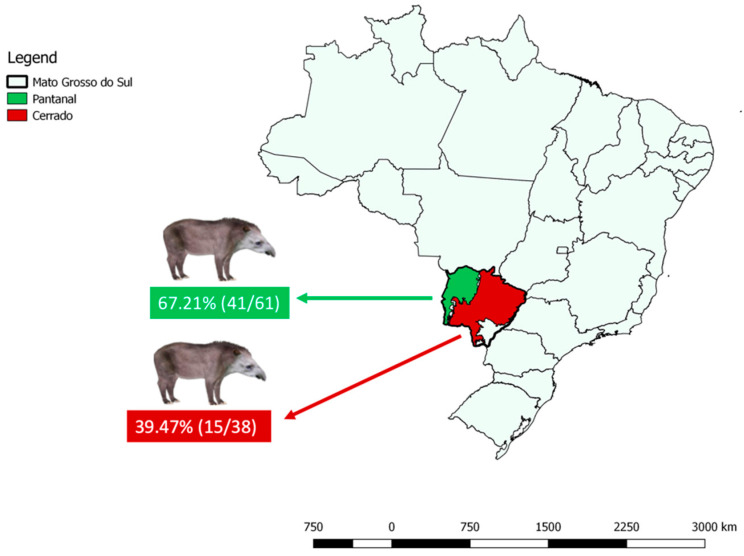
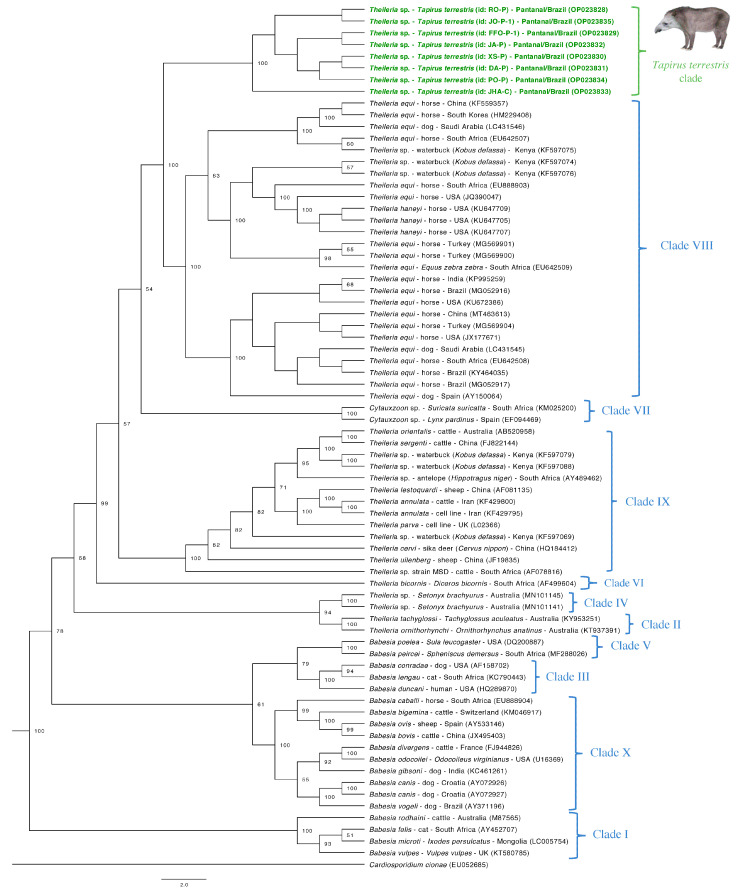
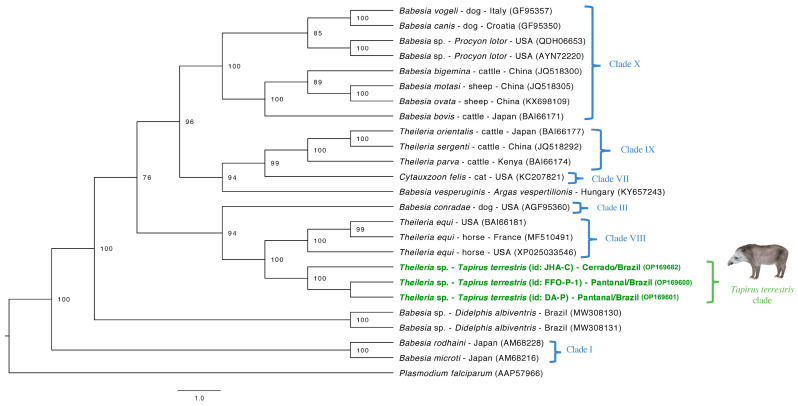
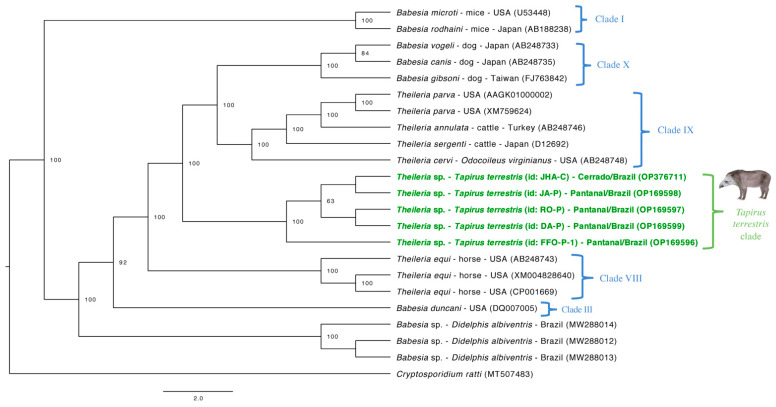
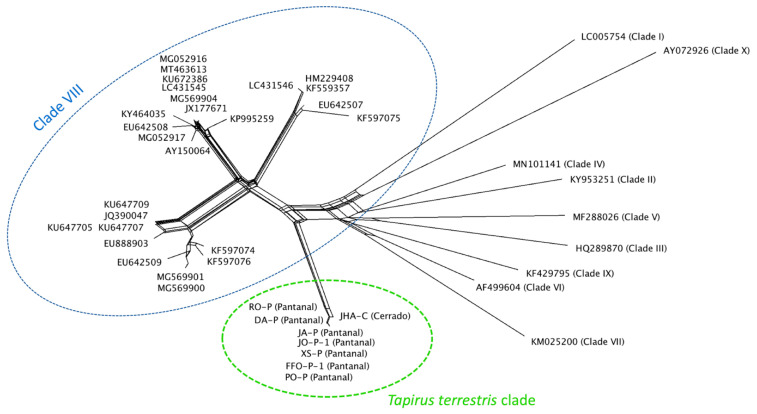
The low-land tapir (Tapirus terrestris) is the largest wild terrestrial mammal found in Brazil. Although T. terrestris has been already reported as a host of hemoparasites, the occurrence and genetic identity of Piroplasmida agents in this species is still cloudy. Although it is reported that Theileria equi, an endemic equid-infective agent in Brazil, is occurring in lowland tapirs, these reports are probably misconceived diagnoses since they are solely based on small fragments of 18S rRNA that may not achieve accurate topologies on phylogenetic analyses. The present study aimed to detect and investigate the identity of Theileria spp. in tapirs from Pantanal and Cerrado biomes. Blood-DNA samples from tapirs were screened for a partial (~800 bp) 18S rRNA gene fragment from Piroplasmida and 64 (64/122; 52.46% CI: 43.66-61.11%) presented bands of expected size. Samples were submitted to different protocols for molecular characterization, including near-full length 18S rRNA gene (~1500 bp), and the ema-1 gene from T. equi. Eight sequences were obtained for extended fragments (1182-1473 bp) from the 18S rRNA gene. Moreover, three sequences from partial cox-1 and five from partial hsp70 gene were obtained. None of the samples presented amplifications for the ema-1 gene. Phylogenetic and distance analyses from the 18S rRNA sequences obtained demonstrated a clear separation from tapirs' Theileria spp. and T. equi. Phylogenetic analyses of cox-1 and hsp70 sequences obtained herein also showed a unique clade formed by tapir's Theileria spp. Theileria terrestris sp. nov. is positioned apart from all other Theileria species in 18S rRNA, cox-1, and hps70 phylogenetic analyses. This novel proposed species represents a new Piroplasmida clade, yet to be characterized regarding biological features, vectors involved in the transmission cycles, additional vertebrate hosts, and pathogenicity.
Keywords: Cerrado; Pantanal; Piroplasmida; tapirs; theileriosis; wildlife.
Conflict of interest statement
The authors declare no conflict of interest.
Figures
References
-
- Schnittger L., Ganzinelli S., Bhoora R., Omondi D., Nijhof A.M., Florin-Christensen M. The Piroplasm Babesia, Cytauxzoon, and Theileria in farm and companion animals: Species compilation, molecular phylogeny, and evolutionary inshights. Parasitol. Res. 2022;121:1207–1245. doi: 10.1007/s00436-022-07424-8. - DOI - PubMed
-
- Acosta I.C.L., Costa A.P., Nunes P.H., Gondim M.F.N., Gatti A., Rossi J.L., Jr., Gennari S.M., Marcili A. Morphological and molecular characterization and phylogenetic relationship of a new species of trypanosome in Tapirus terrestris (lowland tapir), Trypanosoma terrestris sp. nov., from Atlantic Rainforest of southeastern Brazil. Parasit. Vectors. 2013;6:349. doi: 10.1186/1756-3305-6-349. - DOI - PMC - PubMed
-
- Mongruel A.C.B., Medici E.P., Canena A.D.C., Calchi A.C., Machado R.Z., André M.R. Expanding the Universe of Hemoplasmas: Multi-Locus Sequencing Reveals Putative Novel Hemoplasmas in Lowland Tapirs (Tapirus terrestris), the Largest Land Mammals in Brazil. Microorganisms. 2022;10:614. doi: 10.3390/microorganisms10030614. - DOI - PMC - PubMed
-
- Gonçalves T.S., Barros F.N.L., Inoue L.S., Farias D.M., Lima J.S., Nobre A.V., Aidar E.S.A., Diniz R.F.R., Gering A.P., Scofield A. Natural Theileria equi infection in captive Tapirus terrestris (Perissodactyla: Tapiridae) in the Brazilian Amazon. Ticks Tick-Borne Dis. 2020;11:101452. doi: 10.1016/j.ttbdis.2020.101452. - DOI - PubMed
Grants and funding
LinkOut - more resources
Full Text Sources
Research Materials
Miscellaneous
