


Improvements to the Rapid Detection of the Marine Pathogenic Bacterium, Vibrio harveyi, Using Loop-Mediated Isothermal Amplification (LAMP) in Combination with SYBR Green
- PMID: 36557599
- PMCID: PMC9786892
- DOI: 10.3390/microorganisms10122346
Improvements to the Rapid Detection of the Marine Pathogenic Bacterium, Vibrio harveyi, Using Loop-Mediated Isothermal Amplification (LAMP) in Combination with SYBR Green
Abstract
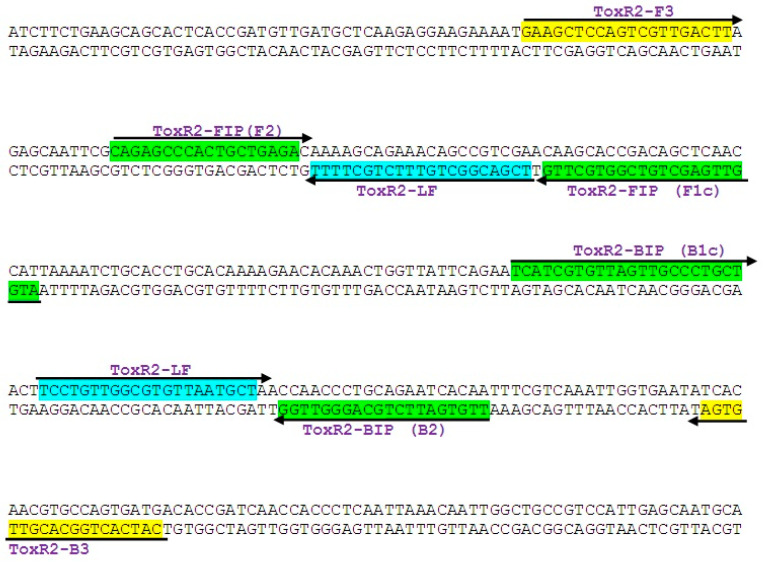
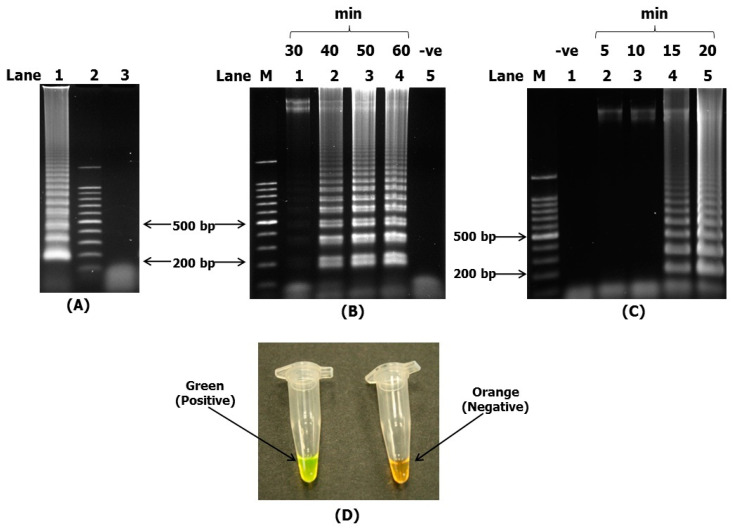
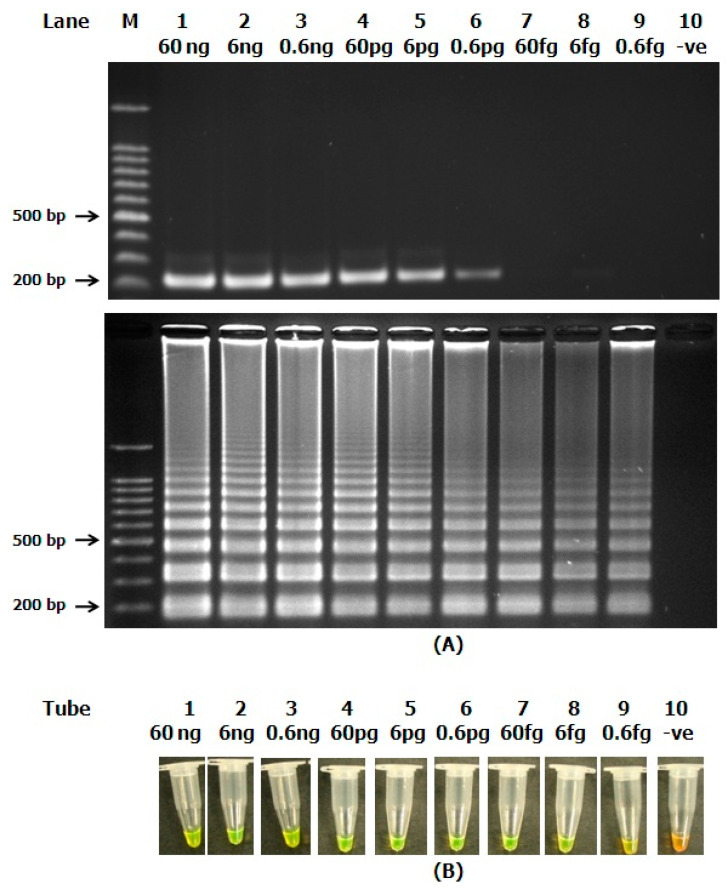
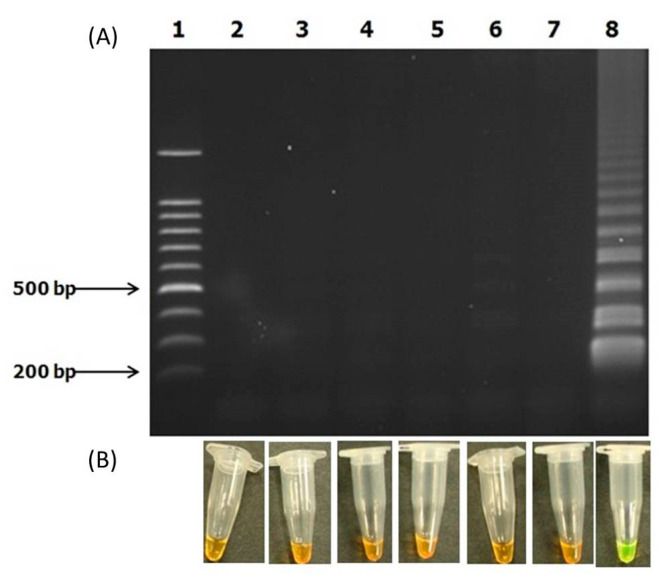
The common methods that are presently used to identify Vibrio harveyi include microscopic examination and biochemical, immunological and PCR-based assays. These methods require technical expertise, and can be time-consuming. A rapid method is required for the high-throughput screening of large number of samples. As such, we have developed a rapid, simple yet sensitive and specific detection method based on the use of the loop-mediated isothermal amplification (LAMP) of DNA. A set of six primers, i.e., two outer, two inner and two loop primers, was designed based on the in silico analysis of a large pool of 39 strains of the toxR gene sequence of V. harveyi. The addition of the loop primers decreased the reaction time of the LAMP by more than half. Furthermore, with the application of SYBR Green, the result can be obtained as quickly as in 10 to 15 min without the need of gel electrophoresis. The specificity of the method primers was then determined by performing LAMP with Vibrio and non-Vibrio samples. LAMP has a greater sensitivity than PCR reaction. The sensitivity of PCR was at 0.6 pg concentration of V. harveyi recombinant plasmid DNA standard, while LAMP was able to detect lower amounts even at 0.6 fg. The development of the LAMP assay will provide a valuable tool for the high-throughput rapid detection of V. harveyi contamination both in laboratories and in the field.
Keywords: LAMP-SYBR green; Vibrio harveyi; loop-mediated isothermal amplification; rapid detection; toxR gene; vibriosis.
Conflict of interest statement
The authors declare that there is no conflict of interest.
Figures
References
-
- Colwell R.R., Chun J. The genus Vibrio and related genera. In: Goldman E., Green L.H., editors. Practical Handbook of Microbiology. 2nd ed. CRC Press; London, UK: 2008. pp. 287–294. - DOI
-
- Yu G., Yu H., Yang Q., Wang J., Fan H., Liu G., Wang L., Bello B.K., Zhao P., Zhang H., et al. Vibri o harveyi infections induce production of proinflammatory cytokines in murine peritoneal macrophages via activation of p38 MAPK and NF-κB pathways, but reversed by PI3K/AKT pathways. Dev. Comp. Immunol. 2022;127:104292. doi: 10.1016/j.dci.2021.104292. - DOI - PubMed
-
- Mohd Yazid S.H., Mohd Daud H., Azmai M.N.A., Mohamad N., Mohd Nor N. Estimating the Economic Loss Due to Vibriosis in Net-Cage Cultured Asian Seabass (Lates calcarifer): Evidence From the East Coast of Peninsular Malaysia. Front. Vet. Sci. 2021;8:644009. doi: 10.3389/fvets.2021.644009. - DOI - PMC - PubMed
-
- Cano-Gomez A., Bourne D.G., Hall M.R., Owens L., Høj L. Molecular identification, typing and tracking of Vibrio harveyi in aquaculture systems: Current methods and future prospects. Aquaculture. 2009;287:1–10. doi: 10.1016/j.aquaculture.2008.10.058. - DOI
Grants and funding
LinkOut - more resources
Full Text Sources
Other Literature Sources
Molecular Biology Databases
Research Materials
