


Monilinia fructigena Suppressing and Plant Growth Promoting Endophytic Pseudomonas spp. Bacteria Isolated from Plum
- PMID: 36557655
- PMCID: PMC9781308
- DOI: 10.3390/microorganisms10122402
Monilinia fructigena Suppressing and Plant Growth Promoting Endophytic Pseudomonas spp. Bacteria Isolated from Plum
Abstract
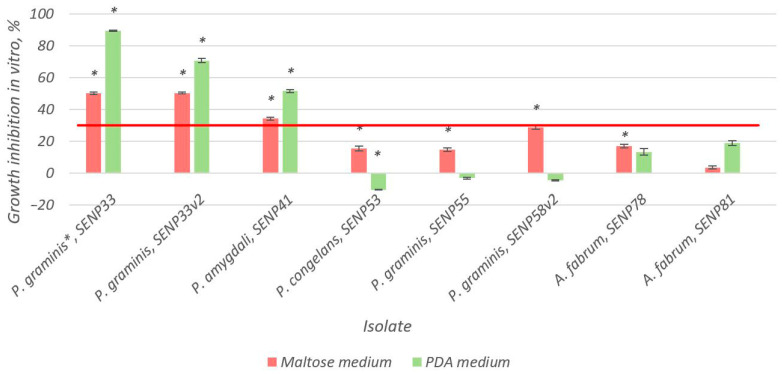
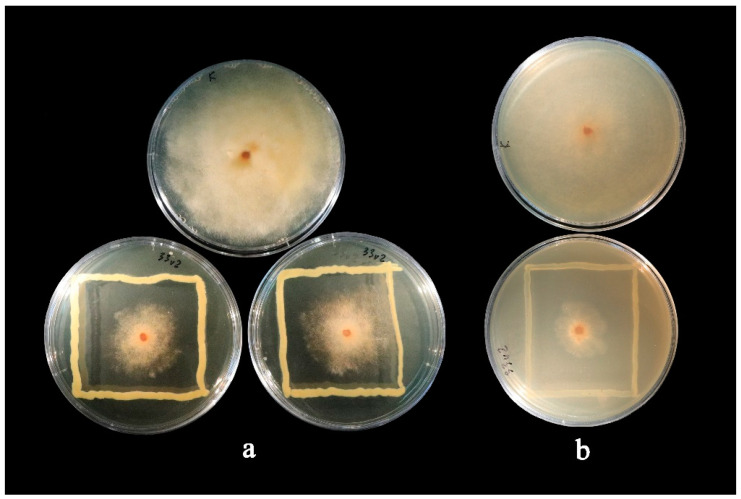
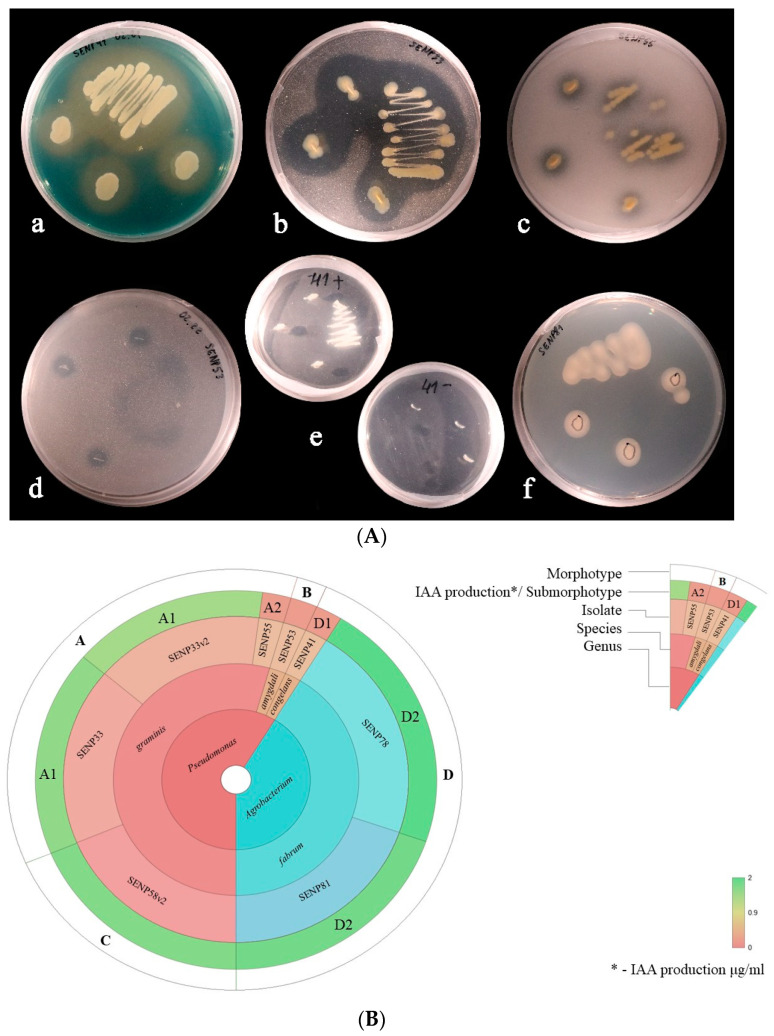
Brown rot caused by Monilinia spp. fungi causes substantial losses in stone and pome fruit production. Reports suggest that up to 90% of the harvest could be lost. This constitutes an important worldwide issue in the food chain that cannot be solved by the use of chemical fungicides alone. Biocontrol agents (BCAs) based on microorganisms are considered a potential alternative to chemical fungicides. We hypothesized that endophytic bacteria from Prunus domestica could exhibit antagonistic properties towards Monilinia fructigena, one of the main causative agents of brown rot. Among the bacteria isolated from vegetative buds, eight isolates showed antagonistic activity against M. fructigena, including three Pseudomonas spp. isolates that demonstrated 34% to 90% inhibition of the pathogen's growth when cultivated on two different media in vitro. As the stimulation of plant growth could contribute to the disease-suppressing activity of the potential BCAs, plant growth promoting traits (PGPTs) were assessed for bacterial isolates with M. fructigena-suppressing activity. While all isolates were capable of producing siderophores and indole-3-acetic acid (IAA), fixating nitrogen, mineralizing organic phosphate, and solubilizing inorganic phosphate and potassium, only the Pseudomonas spp. isolates showed 1-aminocyclopropane-1-carboxylic acid (ACC) deaminase activity. Overall, our study paves the way for the development of an eco-friendly strategy for managing M. fructigena pathogens by using BCAs including Pseudomonas spp. bacteria, which could also serve as growth stimulators.
Keywords: Monilinia fructigena; bacterial control agents; plant growth promoting traits.
Conflict of interest statement
The authors declare no conflict of interest.
Figures
References
-
- Lahlali R., Aksissou W., Lyousfi N., Ezrari S., Blenzar A., Tahiri A., Ennahli S., Hrustić J., MacLean D., Amiri S. Biocontrol activity and putative mechanism of Bacillus amyloliquefaciens (SF14 and SP10), Alcaligenes faecalis ACBC1, and Pantoea agglomerans ACBP1 against brown rot disease of fruit. Microb. Pathog. 2020;139:103914. doi: 10.1016/j.micpath.2019.103914. - DOI - PubMed
-
- Zhang J., Liu J., Xie J., Deng L., Yao S., Zeng K. Biocontrol efficacy of Pichia membranaefaciens and Kloeckera apiculata against Monilinia fructicola and their ability to induce phenylpropanoid pathway in plum fruit. Biol. Control. 2019;129:83–91. doi: 10.1016/j.biocontrol.2018.09.018. - DOI
-
- Mari M., Martini C., Guidarelli M., Neri F. Postharvest biocontrol of Monilinia laxa, Monilinia fructicola and Monilinia fructigena on stone fruit by two Aureobasidium pullulans strains. Biol. Control. 2012;60:132–140. doi: 10.1016/j.biocontrol.2011.10.013. - DOI
LinkOut - more resources
Full Text Sources
Research Materials
Miscellaneous
