Review
. 2022 Dec 12;27(24):8810.
doi: 10.3390/molecules27248810.

Natural Polyphenols for Treatment of Colorectal Cancer

Affiliations
Review

Natural Polyphenols for Treatment of Colorectal Cancer

Yiwen Zhang et al. Molecules. .

Abstract

Colorectal cancer (CRC) is a prevalent and serious gastrointestinal malignancy with high mortality and morbidity. Chemoprevention refers to a newly emerged strategy that uses drugs with chemopreventive properties to promote antioxidation, regulate cancer cell cycle, suppress proliferation, and induce cellular apoptosis, so as to improve cancer treatment outcomes. Natural polyphenols are currently recognized as a class of chemopreventive agents that have shown remarkable anticarcinogenic properties. Numerous in vitro and in vivo studies have elucidated the anti-CRC mechanisms of natural polyphenols, such as regulation of various molecular and signaling pathways. Natural polyphenols are also reportedly capable of modulating the gut microbiota and cancer stem cells (CSCs) to suppress tumor formation and progression. Combined use of different natural polyphenols is recommended due to their low bioavailability and instability, and combination treatment can exert synergistical effects, reduce side effects, and avoid drug resistance in CRC treatment. In summary, the application of polyphenols in the chemoprevention and treatment of CRC is promising. Further clinical evaluation of their effectiveness is warranted and anticipated.

Keywords: chemoprevention; colorectal cancer; combination therapy; polyphenol.


Conflict of interest statement

The authors declare no conflict of interest.

Figures
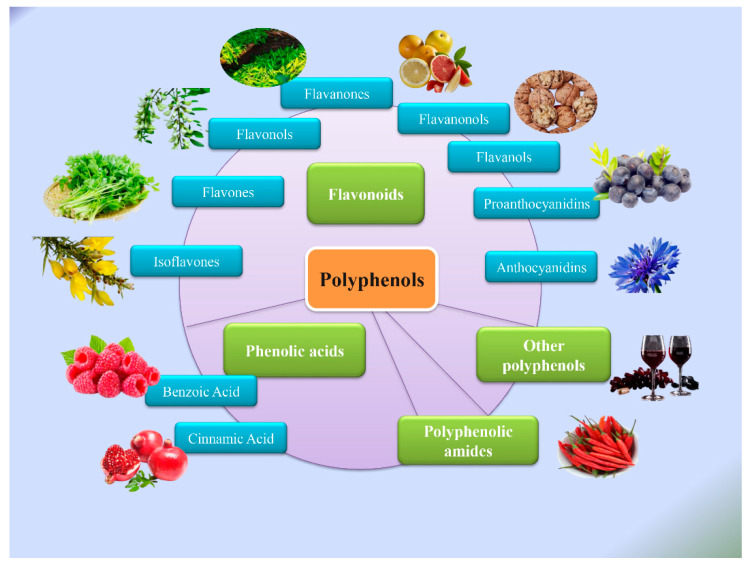
Figure 1
Figure 1
Classification of polyphenols.
Figure 2
Figure 2
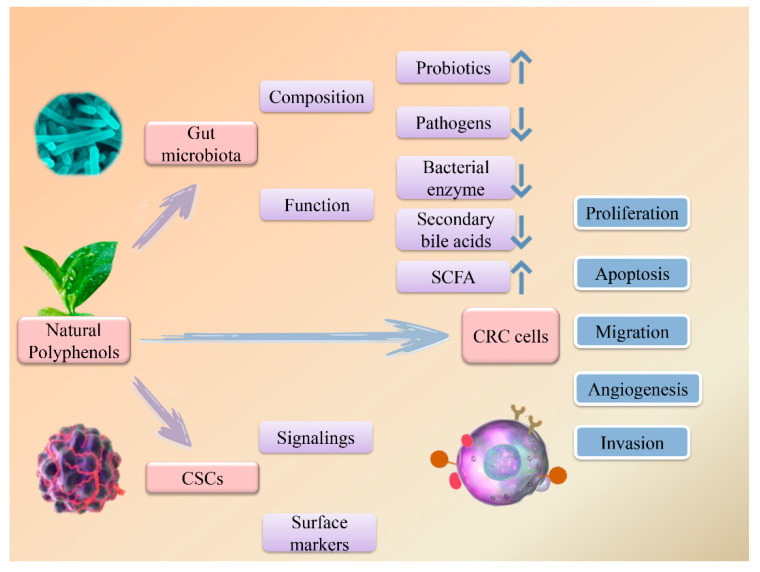
The role of polyphenols in the gut microbiota, cancer stem cells (CSCs), and colorectal cancer cells (CRC).
Figure 3
Figure 3
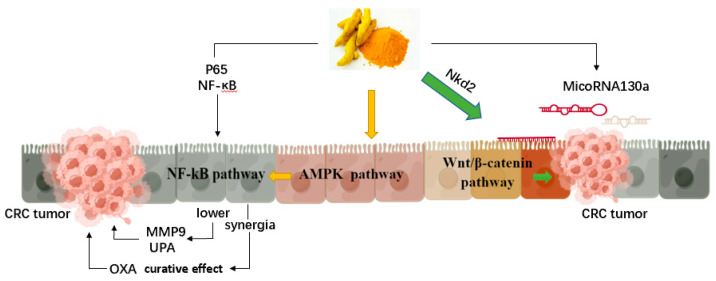
Mechanism of action of curcumin on colorectal cancer cells. Created by Figdraw.
Figure 4
Figure 4
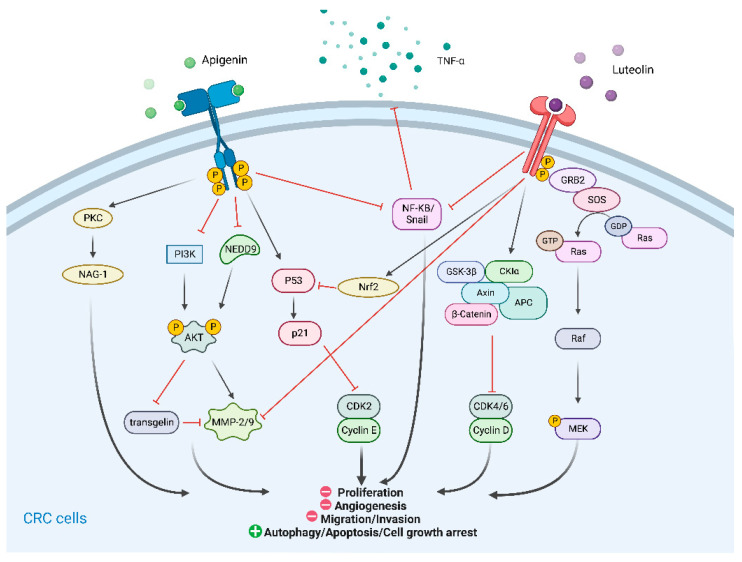
Mechanism of apigenin and luteolin against colorectal cancer cells. Created by Bio render.
Figure 5
Figure 5
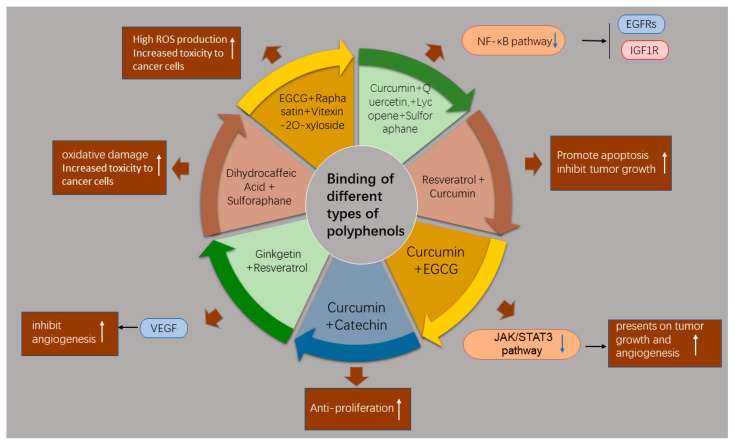
The mechanism diagram of the enhancement of anti-tumor efficacy of combined multi-type polyphenols. White arrows show enhanced efficacy and blue clippings show downregulation.

References

    1. Sung H., Ferlay J., Siegel R.L., Laversanne M., Soerjomataram I., Jemal A., Bray F. Global Cancer Statistics 2020: GLOBOCAN Estimates of Incidence and Mortality Worldwide for 36 Cancers in 185 Countries. CA Cancer J. Clin. 2021;71:209–249. doi: 10.3322/caac.21660. - DOI - PubMed
    1. Li N., Lu B., Luo C., Cai J., Lu M., Zhang Y., Chen H., Dai M. Incidence, mortality, survival, risk factor and screening of colorectal cancer: A comparison among China, Europe, and northern America. Cancer Lett. 2021;522:255–268. doi: 10.1016/j.canlet.2021.09.034. - DOI - PubMed
    1. Anwar S., Shamsi A., Shahbaaz M., Queen A., Khan P., Hasan G.M., Islam A., Alajmi M.F., Hussain A., Ahmad F., et al. Rosmarinic Acid Exhibits Anticancer Effects via MARK4 Inhibition. Sci. Rep. 2020;10:10300. doi: 10.1038/s41598-020-65648-z. - DOI - PMC - PubMed
    1. Zhou Y., Zheng J., Li Y., Xu D.P., Li S., Chen Y.M., Li H.B. Natural Polyphenols for Prevention and Treatment of Cancer. Nutrients. 2016;8:515. doi: 10.3390/nu8080515. - DOI - PMC - PubMed
    1. Tjalsma H., Boleij A., Marchesi J.R., Dutilh B.E. A bacterial driver-passenger model for colorectal cancer: Beyond the usual suspects. Nat. Rev. Microbiol. 2012;10:575–582. doi: 10.1038/nrmicro2819. - DOI - PubMed