


Establishing the Prevalence of Osteomalacia in Arab Adolescents Using Biochemical Markers of Bone Health
- PMID: 36558513
- PMCID: PMC9784134
- DOI: 10.3390/nu14245354
Establishing the Prevalence of Osteomalacia in Arab Adolescents Using Biochemical Markers of Bone Health
Abstract
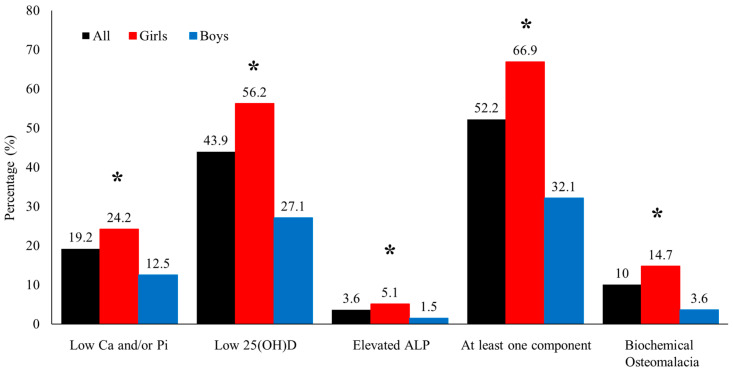
Nutrition-acquired osteomalacia is a bone mineralization disorder associated with dietary calcium and/or solar vitamin D deficiency, risk factors considered common in the Middle Eastern region. Establishing less invasive, cheap, and widely available diagnostic markers for this underdiagnosed entity is essential, in particular for screening in high-risk groups. This study assessed the prevalence of biochemical osteomalacia in Arab adolescents. In this cross-sectional study performed between September 2019 and March 2021, adolescents aged 12−17 years from 60 different secondary and preparatory year schools in Riyadh, Saudi Arabia were included. Anthropometrics and fasting blood samples were collected. Biochemical osteomalacia was defined as any two of the following four serum markers of hypomineralization, namely low 25 hydroxyvitamin D (25OHD < 30 nmol/L), high alkaline phosphatase (ALP), low calcium (Ca), and/or inorganic phosphorous (Pi). A total of 2938 Arab adolescents [1697 girls; mean age (years) 14.8 ± 1.8; 1241 boys; mean age 15.1 ± 1.6] were recruited. Vitamin D deficiency was noted in 56.2% (n = 953) of girls and 27.1% (n = 336) of boys (p < 0.001). The overall prevalence of biochemical osteomalacia was 10.0% (n = 295/2938) and was higher in girls than boys (14.7% vs. 3.6%, p < 0.001). The prevalence of low serum Ca and/or Pi was also higher in girls than in boys (24.2% vs. 12.5%, respectively, p < 0.001), as well as elevated ALP (5.1% vs. 1.5%, p < 0.001). Overall, girls were 4.6 times (95% CI 3.3−6.4) more likely to have biochemical osteomalacia than boys. Screening of apparently healthy Arab adolescents revealed a high prevalence of deranged mineralization markers suggestive of biochemical osteomalacia, which was significantly more common in girls than boys and was likely associated with Arab traditional clothing and diet. The proposed combination of typically altered mineralization markers for the diagnosis of osteomalacia is, at best, suggestive until further comparisons with established diagnostic tools (histological analysis of bone biopsies) are conducted.
Keywords: biochemical osteomalacia; bone markers; children; nutritional rickets; vitamin D deficiency.
Conflict of interest statement
The authors declare no conflict of interest.
Figures
References
-
- Al Saleh Y., Beshyah S.A., Hussein W., Almadani A., Hassoun A., Al Mamari A., Ba-Essa E., Al-Dhafiri E., Hassanein M., Fouda M.A., et al. Diagnosis and management of vitamin D deficiency in the Gulf Cooperative Council (GCC) countries: An expert consensus summary statement from the GCC vitamin D advisory board. Arch. Osteoporos. 2020;15:35. doi: 10.1007/s11657-020-0709-8. - DOI - PubMed
-
- Al-Daghri N.M., Al-Saleh Y., Aljohani N., Sulimani R., Al-Othman A.M., Alfawaz H., Fouda M., Al-Amri F., Shahrani A., Alharbi M., et al. Vitamin D status correction in Saudi Arabia: An experts’ consensus under the auspices of the European Society for Clinical and Economic Aspects of Osteoporosis, Osteoarthritis, and Musculoskeletal Diseases (ESCEO) Arch. Osteoporos. 2017;12:1. doi: 10.1007/s11657-016-0295-y. - DOI - PMC - PubMed
MeSH terms
Substances
LinkOut - more resources
Full Text Sources
Medical
Research Materials
Miscellaneous
