


Astrocytes Reduce Store-Operated Ca2+ Entry in Microglia under the Conditions of an Inflammatory Stimulus and Muscarinic Receptor Blockade
- PMID: 36558972
- PMCID: PMC9783111
- DOI: 10.3390/ph15121521
Astrocytes Reduce Store-Operated Ca2+ Entry in Microglia under the Conditions of an Inflammatory Stimulus and Muscarinic Receptor Blockade
Abstract
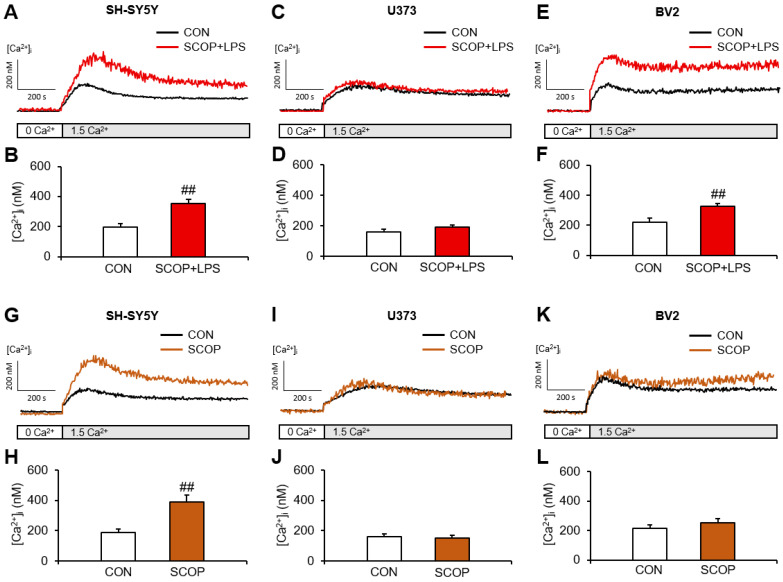
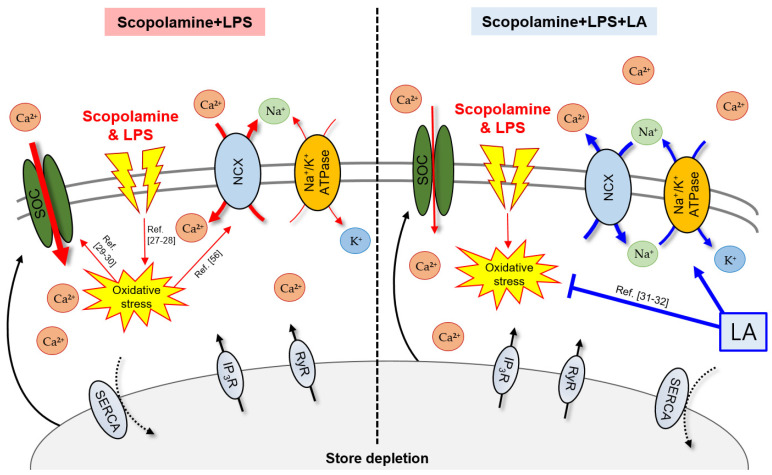
Inflammation and loss of cholinergic transmission are involved in neurodegenerative diseases, but possible interactions between them within neurons, astrocytes, and microglia have not yet been investigated. We aimed to compare store-operated Ca2+ entry (SOCE) in neurons, astrocytes, and microglia following cholinergic dysfunction in combination with (or without) an inflammatory stimulus and to investigate the effects of linalyl acetate (LA) on this process. We used the SH-SY5Y, U373, and BV2 cell lines related to neurons, astrocytes, and microglia, respectively. Scopolamine or lipopolysaccharide (LPS) was used to antagonize the muscarinic receptors or induce inflammatory responses, respectively. The concentration of intracellular Ca2+ was measured using Fura-2 AM. Treatment with scopolamine and LPS significantly increased SOCE in the neuron-like cells and microglia but not in the scopolamine-pretreated astrocytes. LA significantly reduced SOCE in the scopolamine-pretreated neuron-like cells and microglia exposed to LPS, which was partially inhibited by the Na+-K+ ATPase inhibitor ouabain and the Na+/Ca2+ exchanger (NCX) inhibitor Ni2+. Notably, SOCE was significantly reduced in the LPS plus scopolamine-pretreated cells mixed with astrocytes and microglia, with a two-fold increase in the applied number of astrocytes. LA may be useful in protecting neurons and microglia by reducing elevated SOCE that is induced by inflammatory responses and inhibiting the muscarinic receptors via Na+-K+ ATPase and the forward mode of NCX. Astrocytes may protect microglia by reducing increased SOCE under the conditions of inflammation and a muscarinic receptor blockade.
Keywords: astrocytes; linalyl acetate; lipopolysaccharide; microglia; scopolamine; store-operated Ca2+ entry.
Conflict of interest statement
The authors declare no conflict of interest.
Figures


References
-
- AlFadly E.D., Elzahhar P.A., Tramarin A., Elkazaz S., Shaltout H., Abu-Serie M.M., Janockova J., Soukup O., Ghareeb D.A., El-Yazbi A.F. Tackling neuroinflammation and cholinergic deficit in Alzheimer’s disease: Multi-target inhibitors of cholinesterases, cyclooxygenase-2 and 15-lipoxygenase. Eur. J. Med. Chem. 2019;167:161–186. doi: 10.1016/j.ejmech.2019.02.012. - DOI - PubMed
Grants and funding
LinkOut - more resources
Full Text Sources
Miscellaneous
