Review
. 2022 Nov 28;14(12):2632.
doi: 10.3390/pharmaceutics14122632.

Progress on Thin Film Freezing Technology for Dry Powder Inhalation Formulations

Affiliations
Review

Progress on Thin Film Freezing Technology for Dry Powder Inhalation Formulations

Sagar R Pardeshi et al. Pharmaceutics. .

Abstract

The surface drying process is an important technology in the pharmaceutical, biomedical, and food industries. The final stage of formulation development (i.e., the drying process) faces several challenges, and overall mastering depends on the end step. The advent of new emerging technologies paved the way for commercialization. Thin film freezing (TFF) is a new emerging freeze-drying technique available for various treatment modalities in drug delivery. TFF has now been used for the commercialization of pharmaceuticals, food, and biopharmaceutical products. The present review highlights the fundamentals of TFF along with modulated techniques used for drying pharmaceuticals and biopharmaceuticals. Furthermore, we have covered various therapeutic applications of TFF technology in the development of nanoformulations, dry powder for inhalations and vaccines. TFF holds promise in delivering therapeutics for lung diseases such as fungal infection, bacterial infection, lung dysfunction, and pneumonia.

Keywords: dry fine powder; inhalation; novel drug delivery; poorly soluble drug; pulmonary; thin film freezing.


Conflict of interest statement

The company had no role in the design of the study; in the collection, analyses, or interpretation of data; in the writing of the manuscript, and in the decision to publish the results. The authors declare no conflict of interest.

Figures
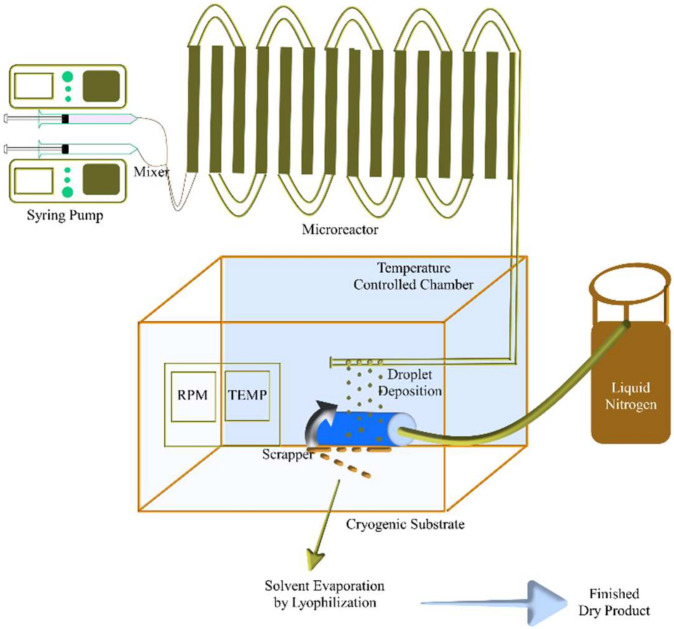
Figure 1
Figure 1
Model setup of the TFF system.
Figure 2
Figure 2
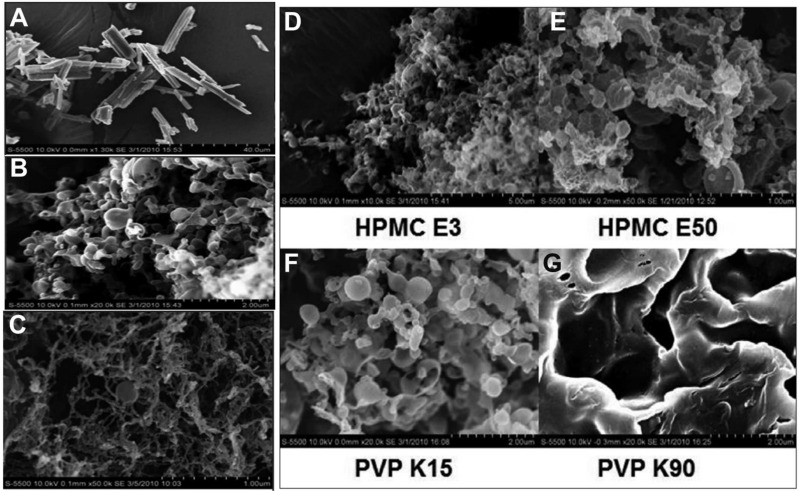
SEM images of (A) pure itraconazole (ITZ); (B) template emulsion-based ITZ powder; (C) cosolvent-processed TFF powder; and template emulsion compositions containing (D) HPMC E3; (E) HPMC E50; (F) PVP K15; and (G) PVP K90. Reproduced from Lang et al. [40] with kind permission of copyright holder, Elsevier.
Figure 3
Figure 3
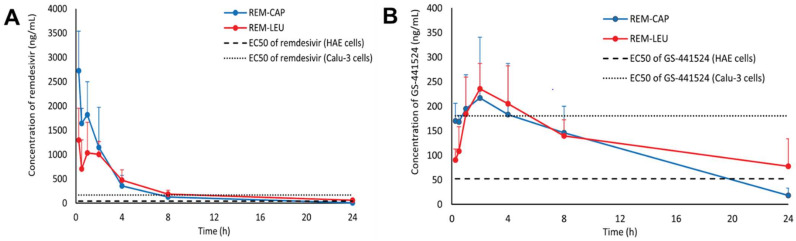
Plasma concentration–time profiles of REM-CAP (remdesivir-Captisol®; 80/20 w/w) and REM-LEU (remdesivir-leucine; 80/20 w/w) after a single inhalation administration in hamsters; (A) remdesivir; (B) GS-441524. The dashed line and dotted line represent the EC50 of remdesivir and GS-441524 in human epithelial cells (HAE) and a continuous human lung epithelial cell line (Calu-3), respectively. Reproduced from Sahakijpijarn et al. [46] with kind permission of copyright holder, Elsevier.
Figure 4
Figure 4
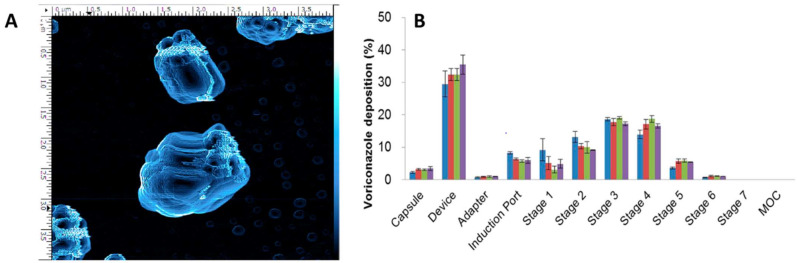
(A) AFM topography image of aerosolized TFF-VCZ-MAN 95:5 by DP4 insufflator; (B) Aerodynamic particle size distribution profile of TFFVCZ-MAN 95:5 by time sheared: (blue) at 0 min; (red) at 15 min; (green) at 30 min; (purple) at 60 min (n = 3; mean ± SD). Reproduced from Moon et al. [27] with kind permission of copyright holder, American Chemical Society.
Figure 5
Figure 5
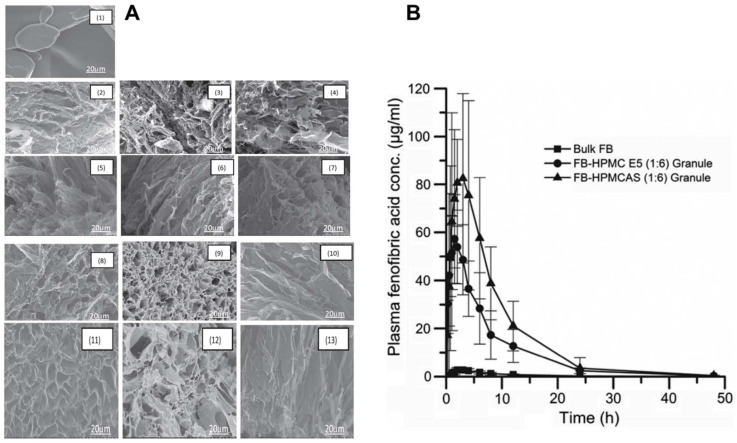
(A) SEM micrographs of bulk FB and FB solid dispersions prepared by the TFF process. (1) Bulk FB; (2) FB-Soluplus (1:4); (3) FB-Soluplus (1:6); (4) FB-Soluplus (1:8); (5) FBHPMC E5 (1:4); (6) FB-HPMC E5 = 1:6; (7) FB-HPMC E5 = 1:8; (8) FB-HPMCAS (1:4); (9) FB-HPMCAS (1:6); (10) FB-HPMCAS (1:8); (11) FB-HP55 (1:4); (12) FB-HP55 (1:6); and (13) FB- HP55 (1:8); and (B) Average plasma-drug concentration of fenofibric acid following single-dose oral administration of different formulations to Wistar rats (data presented are mean ± SD, n = 6, dose is 27 mg/kg). Reproduced from Zhang et al. [3] with kind permission of copyright holder, Elsevier.
Figure 6
Figure 6
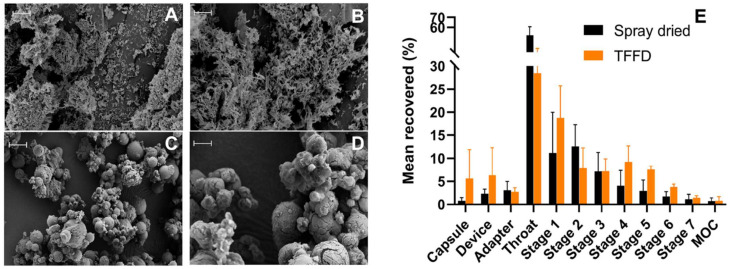
Representative SEM images of dry powders of SLNs prepared by thin-film freeze-drying (A,B) or spray drying (C,D). In (A,C), the scale bar indicates 10 µm, and in (B,D), the scale bar indicates 2 µm; (B) deposition patterns of dry powders of SLNs prepared by spray drying or thin film freeze-drying in NGI (MOC, micro-orifice collector). Data are the mean ± S.D. (n = 3). Reproduced from Wang et al. [42] with kind permission of copyright holder, Elsevier.
Figure 7
Figure 7
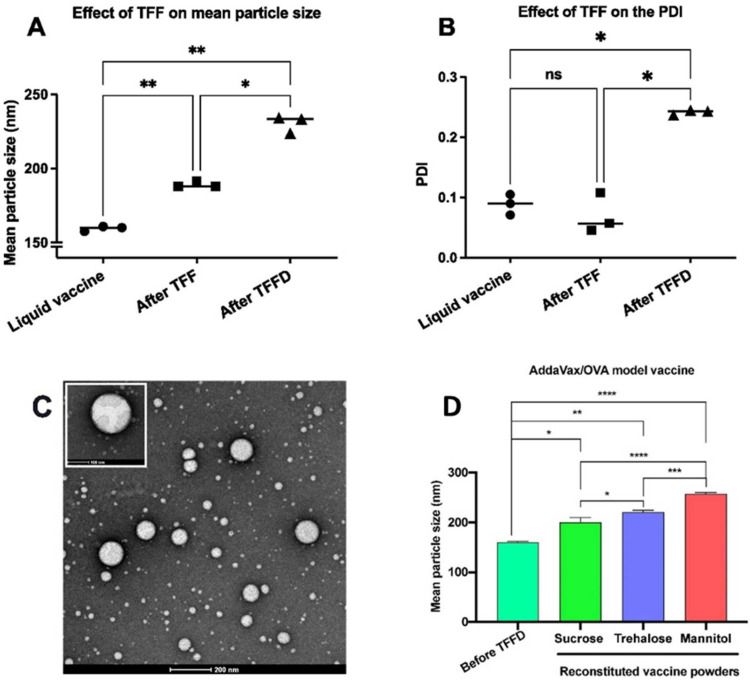
Effect of the freezing and drying steps of TFFD on (A) the mean particle size; and (B) PDI of AddaVax/OVA vaccine; (C) representative TEM image of AddaVax/OVA vaccine reconstituted from a thin-film freeze-dried powder (the scale bar is 200 nm). * p < 0.05, ** p < 0.01, ns: non-significant (p > 0.05); (D) effect of stabilizing agent and its concentration on the mean particle size of AddaVax/OVA model vaccine. The efficiency of sucrose, trehalose, and mannitol * p < 0.05, ** p < 0.01, *** p < 0.001, **** p < 0.0001, ns: non-significant (p > 0.05). Reprinted with permission from [55].

References

    1. Overhoff K.A., Johnston K.P., Tam J., Engstrom J., Williams R.O., III Use of Thin Film Freezing to Enable Drug Delivery: A Review. J. Drug Deliv. Sci. Technol. 2009;19:89–98. doi: 10.1016/S1773-2247(09)50016-0. - DOI
    1. Overhoff K.A., Engstrom J.D., Chen B., Scherzer B.D., Milner T.E., Johnston K.P., Williams R.O., III Novel Ultra-Rapid Freezing Particle Engineering Process for Enhancement of Dissolution Rates of Poorly Water-Soluble Drugs. Eur. J. Pharm. Biopharm. 2007;65:57–67. doi: 10.1016/j.ejpb.2006.07.012. - DOI - PubMed
    1. Zhang M., Li H., Lang B., O’Donnell K., Zhang H., Wang Z., Dong Y., Wu C., Williams R.O., III Formulation and Delivery of Improved Amorphous Fenofibrate Solid Dispersions Prepared by Thin Film Freezing. Eur. J. Pharm. Biopharm. 2012;82:534–544. doi: 10.1016/j.ejpb.2012.06.016. - DOI - PubMed
    1. Hufnagel S., Sahakijpijarn S., Moon C., Cui Z., Williams R.O., III The Development of Thin-Film Freezing and Its Application to Improve Delivery of Biologics as Dry Powder Aerosols. KONA Powder Part. J. 2022;39:2022010. doi: 10.14356/kona.2022010. - DOI
    1. Jiang J., Peng H.-H., Yang Z., Ma X., Sahakijpijarn S., Moon C., Ouyang D., Williams R.O., III The Applications of Machine Learning (ML) in Designing Dry Powder for Inhalation by Using Thin-Film-Freezing Technology. Int. J. Pharm. 2022;626:122179. doi: 10.1016/j.ijpharm.2022.122179. - DOI - PubMed

LinkOut - more resources