. 2022 Dec 14;14(12):2794.
doi: 10.3390/pharmaceutics14122794.

Rapid and Specific Action of Methylene Blue against Plasmodium Transmission Stages

Affiliations

Rapid and Specific Action of Methylene Blue against Plasmodium Transmission Stages

Nathanaël Saison et al. Pharmaceutics. .

Abstract

Methylene blue (MB) is the oldest synthetic anti-infective. Its high potency against asexual and sexual stages of malaria parasites is well documented. This study aimed to investigate possible additional activities of MB in interfering with parasite transmission and determine target stages in Anopheles vectors and humans. MB's transmission-blocking activity was first evaluated by an ex vivo direct membrane feeding assay (DMFA) using Plasmodium falciparum field isolates. To investigate anti-mosquito stage activity, Plasmodium berghei-infected Anopheles stephensi mosquitoes were fed a second blood meal on mice that had been treated with methylene blue, 3, 6- and 15-days after the initial infectious blood meal. Anti-sporozoite and liver stage activities were evaluated in vitro and in vivo via sporozoite invasion and liver stage development assays, respectively. MB exhibited a robust inhibition of P. falciparum transmission in An. gambiae, even when added shortly before the DMFA but only a moderate effect against P. berghei oocyst development. Exposure of mature P. berghei and P. falciparum sporozoites to MB blocked hepatocyte invasion, yet P. berghei liver stage development was unaffected by MB. Our results indicate previously underappreciated rapid specific activities of methylene blue against Plasmodium transmission stages, preventing the establishment of both mosquito midgut and liver infections as the first essential steps in both hosts.

Keywords: Anopheles gambiae; Anopheles stephensi; Gabon; Plasmodium berghei; Plasmodium falciparum; Plasmodium yoelii; in vivo and ex vivo experiments; methylene blue; transmission.


Conflict of interest statement

The authors declare that they have no conflict of interest.

Figures
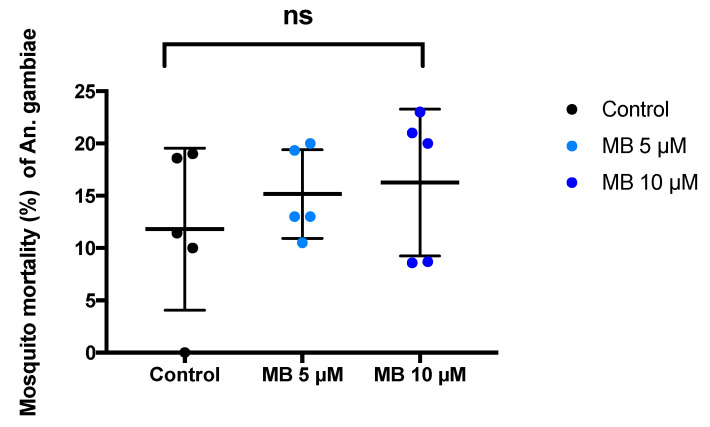
Figure A1
Figure A1
Mosquito mortality rate post-feeding is presented as mean and standard deviation. Data from five independent experiments are presented. The black lines represent the mean and standard deviation. p = 0.48 for comparisons of MB 5 µM vs. control; p = 0.23 for comparisons of MB 10 µM vs. control.
Figure A2
Figure A2
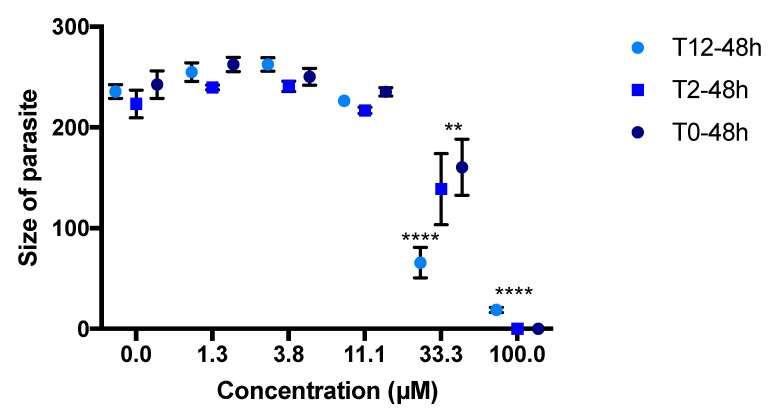
MB shows weak inhibition of liver stage development in vitro. MB activity against P. berghei liver stages was investigated at concentrations ranging from 1.25 to 100 µM. MB was added simultaneously to the hepatocyte invasion (0 h) or 2 h and 12 h pi. Activity is presented as the size of schizonts counted (blue bars = EEF size). Data are means and SDs of triplicate measurements from one representative experiment. The black lines represent the mean and standard deviation. ** p < 0.01; **** p = 0.0001 when compared to control by t-test.
Figure A3
Figure A3
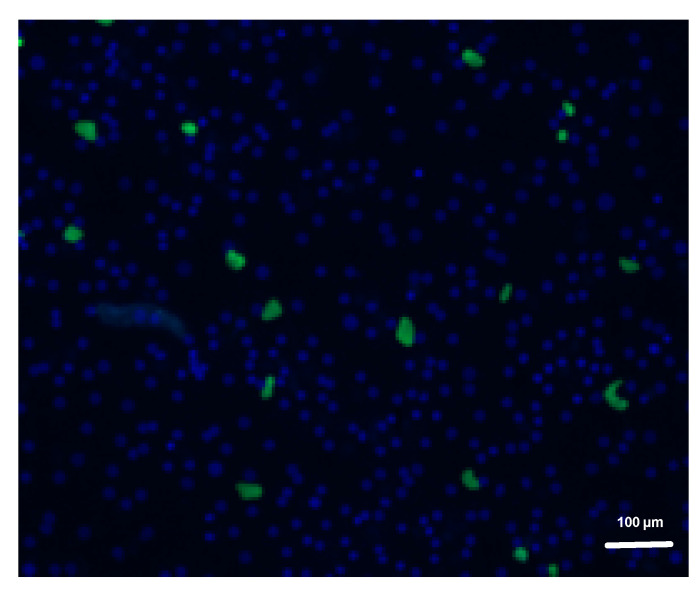
Representative image of P. berghei liver stage parasites in simian hepatocytes after two post-sporozoite infections visualized with DAPI (blue), GFP expression and immunofluorescent detection (green). Scale bars indicate 100 µm.
Figure 1
Figure 1
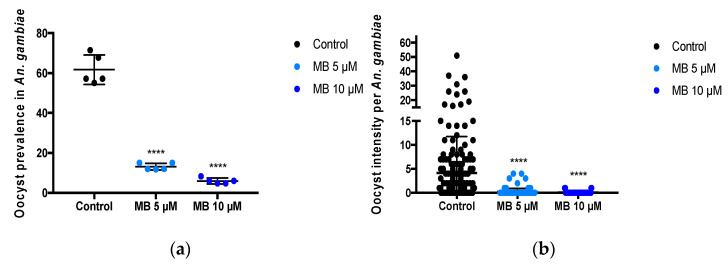
MB inhibits P. falciparum transmission in An. gambiae. (a) Prevalence of the infection is presented as the percentage of infected mosquitoes as measured by the presence of oocysts. (b) The infection intensity is presented as the number of oocysts per single midgut (black dots). The black lines represent the mean and standard deviation. Data from 5 independent experiments are presented in A–B, corresponding to five different isolates. **** p = 0.0001 when compared to control by t-test.
Figure 2
Figure 2
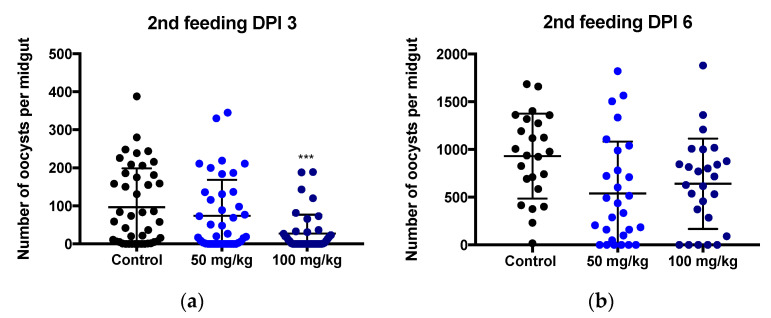
Exposure to MB during Plasmodium mosquito stage development shows a moderate impact on oocyst numbers. Preliminary P. berghei-infected mosquitoes were divided into three groups that received secondary blood meals on anesthetized mice treated with 0 (control, black dot), 50 (light blue dot) and 100 (dark blue dot) mg/kg MB 3 days (a) and 6 days (b) pi. The infection intensity is presented as the number of oocysts per midgut (black dots). The black lines represent the mean and standard deviation. Data are represented from two independent experiments. *** p = 0.005 when compared to the control by t-test.
Figure 3
Figure 3
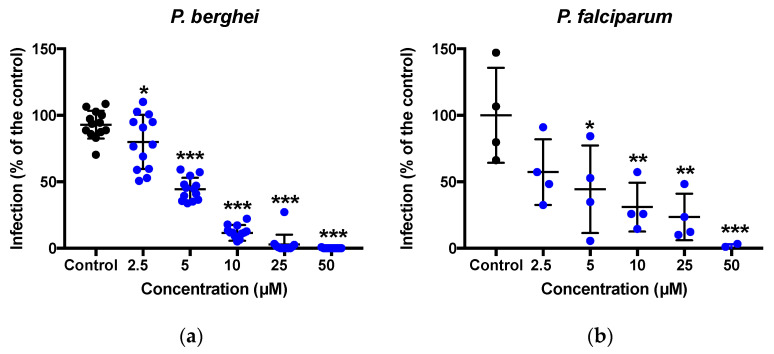
Exposure of freshly isolated sporozoites to MB inhibits hepatocyte invasion. (a) MB displayed an inhibition (IC50 = 4.46 µM) of P. berghei hepatocyte invasion after 1 h pre-incubation. Data are presented from four independent experiments. (b) MB displayed a potent inhibition (IC50 = 4.7 µM) of P. falciparum hepatocyte invasion after 1 h pre-incubation. In vitro sporozoite activity (infection scale, blue bars = EEFs). Data are presented from one representative experiment. The black lines represent the mean and standard deviation. * p < 0.05; ** p < 0.01; *** p < 0.001 when compared to control by t-test. Control, black dot; MB, blue dot.
Figure 4
Figure 4
MB shows weak inhibition of liver stage infection in vitro. (a) MB activity against P. berghei liver stages was investigated at concentrations ranging from 1.25 to 100 µM. MB was added simultaneously to the hepatocyte invasion (0 h), 2 h or 12 h pi. Activity is presented as the number of schizonts counted (blue bars = EEFs). (b) Toxicity to host cells is presented as the number of hepatocyte nuclei. Data are presented from one representative experiment. The black lines represent the mean and standard deviation. * p < 0.05; ** p < 0.01; *** p < 0.001; **** p = 0.0001 when compared to control by t-test.
Figure 5
Figure 5
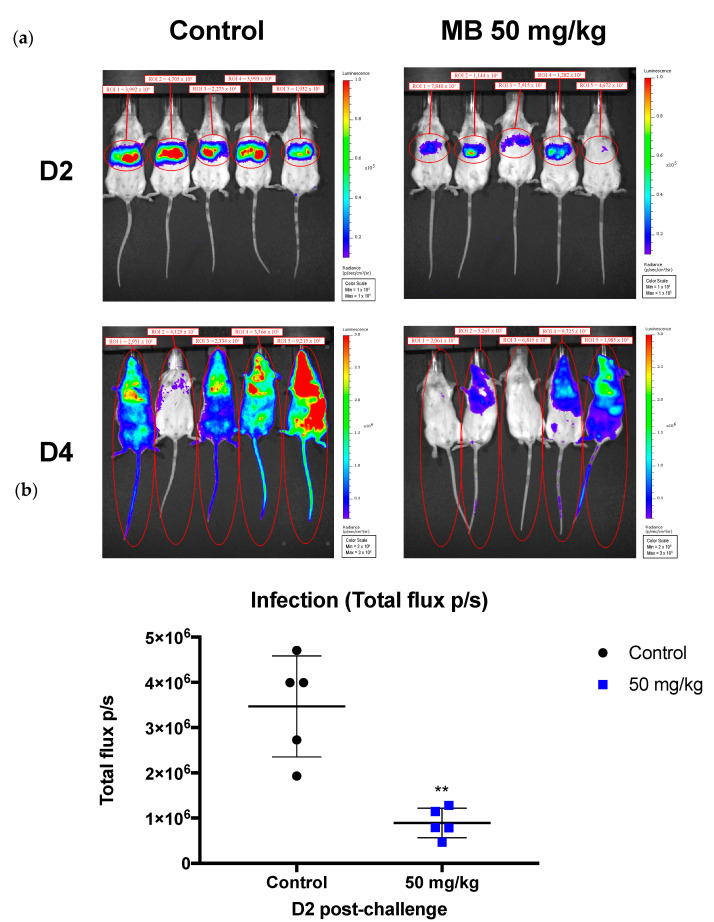
MB delayed and reduced the P. yoelii sporozoite infection in mice. Mice were first treated for 30 min with MB (50 mg/kg) and were then challenged by retro-orbital injection of 5.000 sporozoites of P. yoelii. (a) In vivo images (IVIS) of luminescence reported at D2 and D4 post-P.yoelii-infection. Rainbow images show the relative levels of luminescence ranging from low (blue) to medium (green) to high (yellow/red). (b) Mean luminescence levels (photons/s) for each group at 42 h post-challenge. The black lines represent the mean and standard deviation. ** p = 001 when compared to control by t-test.
Figure 6
Figure 6
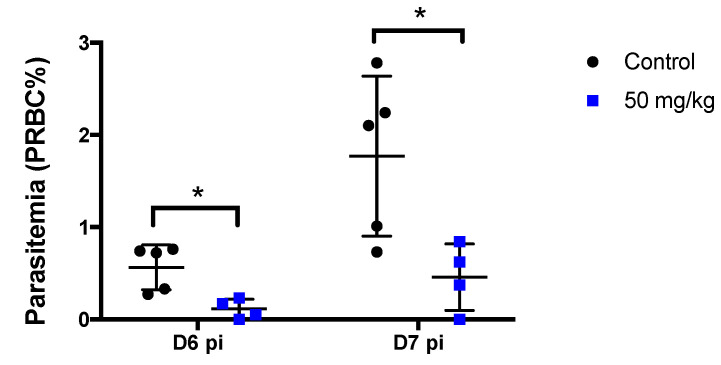
Single treatment of MB before challenge by mosquito bite reduces subsequent blood-stage parasitemia. Mice were first treated with MB (50 mg/kg) 30 min before the mosquito challenge and were then challenged by the bite of P. berghei-infected mosquitoes. Blood stage parasitemia of P. berghei was monitored in mice by studying Giemsa-stained blood smears on day 6 and day 7 after the infection by mosquito bite. Data are presented from one representative experiment. The black lines represent the mean and standard deviation. Asterisks (*) indicate significant (p < 0.05) differences between each treatment group and control.

References

    1. World Health Organization . World Malaria Report 2021. World Health Organization; Geneva, Switzerland: 2021.
    1. Uwimana A., Legrand E., Stokes B.H., Ndikumana J.M., Warsame M., Umulisa N., Ngamije D., Munyaneza T., Mazarati J.B., Munguti K., et al. Emergence and clonal expansion of in vitro artemisinin-resistant Plasmodium falciparum kelch13 R561H mutant parasites in Rwanda. Nat. Med. 2020;26:1602–1608. doi: 10.1038/s41591-020-1005-2. - DOI - PMC - PubMed
    1. Balikagala B., Fukuda N., Ikeda M., Katuro O.T., Tachibana S.I., Yamauchi M., Opio W., Emoto S., Anywar D.A., Kimura E., et al. Evidence of Artemisinin-Resistant Malaria in Africa. N. Engl. J. Med. 2021;385:1163–1171. doi: 10.1056/NEJMoa2101746. - DOI - PubMed
    1. Maiga F.O., Wele M., Toure S.M., Keita M., Tangara C.O., Refeld R.R., Thiero O., Kayentao K., Diakite M., Dara A., et al. Artemisinin-based combination therapy for uncomplicated Plasmodium falciparum malaria in Mali: A systematic review and meta-analysis. Malar. J. 2021;20:356. doi: 10.1186/s12936-021-03890-0. - DOI - PMC - PubMed
    1. Toure O.A., Assi S.B., Kiki-Barro P.M.C., Yavo W., Abba T., Tiacoh L.N., Konate A.A., Angora E.K., Bedia V.A., Menan H., et al. Efficacy and safety of artesuante-amodiaquine and artemether lumefantrine, the first line malaria treatment in six sentinel’s sites of Cote d’Ivoire, West Africa. Ann. Parasitol. 2020;66:561–571. doi: 10.17420/ap6604.299. - DOI - PubMed

LinkOut - more resources