


Treatment-Resistant Bipolar Depression: Therapeutic Trends, Challenges and Future Directions
- PMID: 36561896
- PMCID: PMC9767030
- DOI: 10.2147/NDT.S273503
Treatment-Resistant Bipolar Depression: Therapeutic Trends, Challenges and Future Directions
Abstract
Introduction: Bipolar disorder (BD) is a chronic mental illness impacting 1-2% of the population worldwide and causing high rates of functional impairment. Patients with BD spend most of their time in depressive episodes and up to one-third of patients do not respond to adequate doses of medications. Although no consensus exists for definition of treatment-resistant bipolar depression (TRBD), failure of symptoms improvement despite an adequate trial of two therapeutic agents is a common theme of TRBD. In this paper, we review the evidence base of therapeutic interventions, challenges, and potential future directions for TRBD.
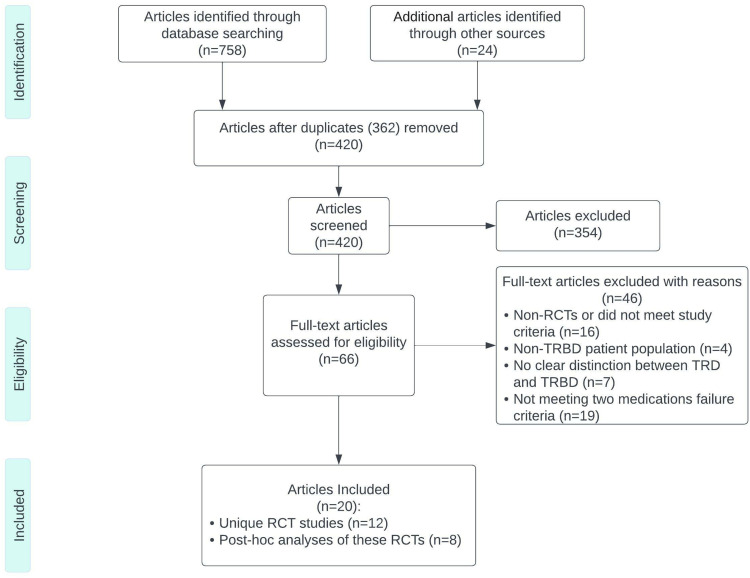
Methods: We conducted a literature search for randomized controlled trials on PubMed for the treatment of TRBD and ongoing trials for the treatment of TRBD/bipolar depression on clinicaltrials.gov.
Results: Several therapeutic agents have been investigated for TRBD. Adjunctive pramipexole and modafinil have data supporting short-term efficacy in TRBD, along with limited data for racemic intravenous ketamine. Celecoxib augmentation of escitalopram and treatment with metformin in patients with insulin resistance showed promising results. Right unilateral electroconvulsive therapy displayed statistically significant response rate and improvement, but not remission compared to pharmacotherapy. Trials for transcranial magnetic stimulation (TMS) have failed to show a significant difference from sham treatment in TRBD.
Future trends: Pharmacological treatments with novel mechanisms of actions like brexpiprazole and vortioxetine are being investigated following successes in unipolar depression. Modified TMS protocols such as accelerated TMS are under investigation. Innovative approaches like psychedelic-assisted psychotherapy, interleukin-2, fecal microbiota transplantation and multipotent stromal cells are being studied.
Conclusion: Evidence on current treatment modalities for TRBD is limited with low efficacy. More research is needed for successful treatment of TRBD. Effective therapies and innovative approaches to treatment are being investigated and could show promise.
Keywords: TRBD; bipolar disorder; ketamine; treatment-refractory depression.
© 2022 Elsayed et al.
Conflict of interest statement
B Singh has received research grant support from Mayo Clinic. Other authors have nothing to declare.
Figures
References
Publication types
LinkOut - more resources
Full Text Sources
