


CRISPR activation and interference as investigative tools in the cardiovascular system
- PMID: 36563996
- PMCID: PMC10265131
- DOI: 10.1016/j.biocel.2022.106348
CRISPR activation and interference as investigative tools in the cardiovascular system
Abstract
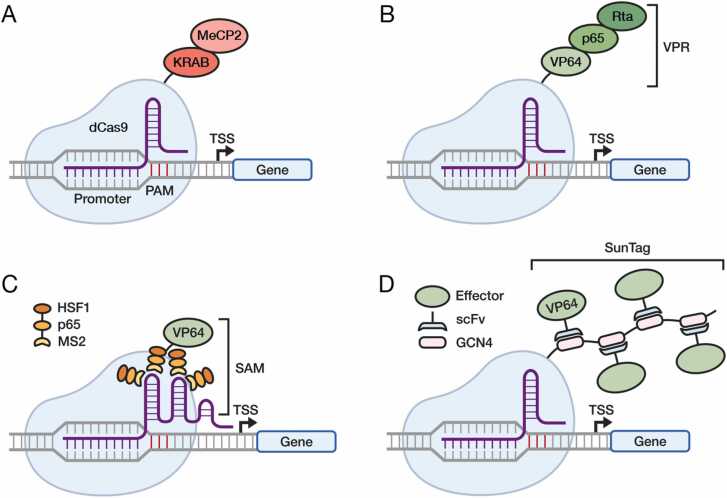
CRISPR activation and interference (CRISPRa/i) technology offers the unprecedented possibility of achieving regulated gene expression both in vitro and in vivo. The DNA pairing specificity of a nuclease dead Cas9 (dCas9) is exploited to precisely target a transcriptional activator or repressor in proximity to a gene promoter. This permits both the study of phenotypes arising from gene modulation for investigative purposes, and the development of potential therapeutics. As with virtually all other organ systems, the cardiovascular system can deeply benefit from a broader utilisation of CRISPRa/i. However, application of this technology is still in its infancy. Significant areas for improvement include the identification of novel and more effective transcriptional regulators that can be docked to dCas9, and the development of more efficient methods for their delivery and expression in vivo.
Keywords: CRISPR; Cardiovascular; DCas9; Transcriptional regulation.
Copyright © 2022 The Authors. Published by Elsevier Ltd.. All rights reserved.
Figures
References
-
- Black J.B., Adler A.F., Wang H.G., D'Ippolito A.M., Hutchinson H.A., Reddy T.E., Pitt G.S., Leong K.W., Gersbach C.A. Targeted epigenetic remodeling of endogenous loci by CRISPR/Cas9-based transcriptional activators directly converts fibroblasts to neuronal cells. Cell Stem Cell. 2016;19(3):406–414. - PMC - PubMed
-
- Charlesworth C.T., Deshpande P.S., Dever D.P., Camarena J., Lemgart V.T., Cromer M.K., Vakulskas C.A., Collingwood M.A., Zhang L., Bode N.M., Behlke M.A., Dejene B., Cieniewicz B., Romano R., Lesch B.J., Gomez-Ospina N., Mantri S., Pavel-Dinu M., Weinberg K.I., Porteus M.H. Identification of preexisting adaptive immunity to Cas9 proteins in humans. Nat. Med. 2019;25(2):249–254. - PMC - PubMed
-
- Chavez A., Scheiman J., Vora S., Pruitt B.W., Tuttle M., E P.R.I., Lin S., Kiani S., Guzman C.D., Wiegand D.J., Ter-Ovanesyan D., Braff J.L., Davidsohn N., Housden B.E., Perrimon N., Weiss R., Aach J., Collins J.J., Church G.M. Highly efficient Cas9-mediated transcriptional programming. Nat. Methods. 2015;12(4):326–328. - PMC - PubMed
Publication types
MeSH terms
Substances
Grants and funding
LinkOut - more resources
Full Text Sources
Research Materials
