. 2022 Dec 23;14(1):49.
doi: 10.1186/s13099-022-00525-w.

Dietary and lifestyle associations with microbiome diversity

Affiliations

Dietary and lifestyle associations with microbiome diversity

Katherine M Watson et al. Gut Pathog. .

Abstract

Background: Microbial dysbiosis has been closely linked with colorectal cancer development. However, data is limited regarding the relationship of the mucosal microbiome, adenomatous polyps and dietary habits. Understanding these associations may elucidate pathways for risk stratification according to diet.

Results: Patients undergoing screening colonoscopy were included in our prospective, single center study and divided into adenoma or no adenoma cohorts. Oral, fecal, and mucosal samples were obtained. Microbial DNA was extracted, and amplicon libraries generated using primers for the 16S rRNA gene V4 region. Patient and dietary information was collected. Of 104 participants, 44% presented with polyps, which were predominantly tubular adenomas (87%). Adenoma formation and multiple patient dietary and lifestyle characteristics were associated with mucosal microbiome diversity. Lifestyle factors included age, body mass index, adenoma number, and dietary consumption of red meats, processed meats, vegetables, fruit, grain, fermented foods and alcohol.

Conclusion: In this study we showed associations between dietary habits, adenoma formation and the mucosal microbiome. These early findings suggest that ongoing research into diet modification may help reduce adenoma formation and subsequently the development of CRC.


Conflict of interest statement

None of the authors have any competing interests to disclose.

Figures
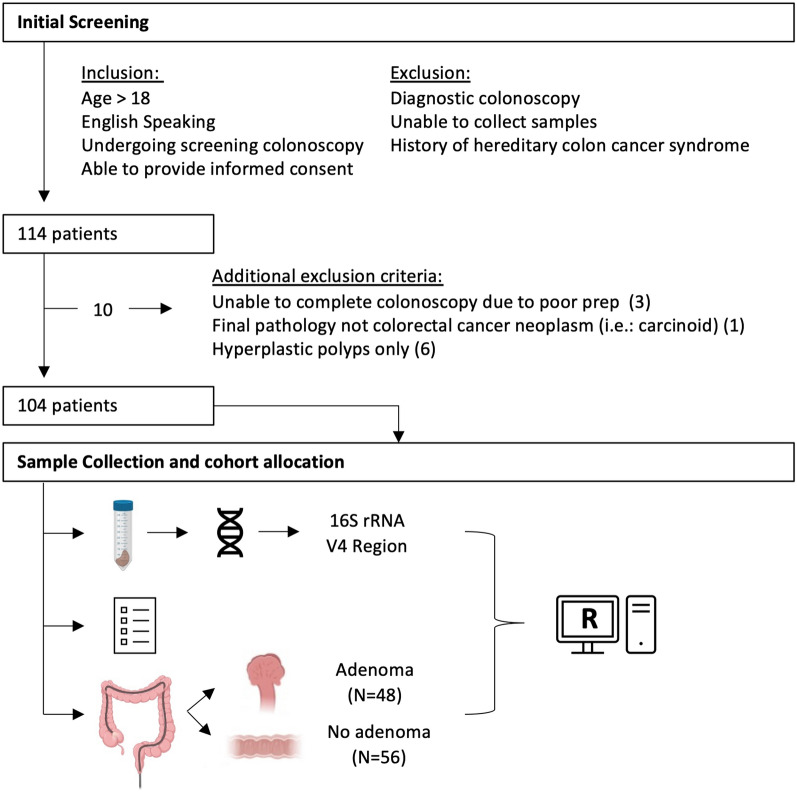
Fig. 1
Fig. 1
Study Flow Diagram. Patients undergoing screening colonoscopy were screed for inclusion in the study. Of the 114 patients enrolled, 10 were excluded. Samples and data from the remaining 104 patients were used for data analysis. Stool samples were collected prior to bowel preparation using the Zymo Research DNA/RNA Shield Collection Tube and Tube. Samples were processed using the DNeasy PowerSoil Pro isolation kit. Sequencing was performed on an Illumina MiSeq instrument by amplification of the V4 region of the 16S rRNA. Questionnaires were obtained including patient medical history, dietary information and habits. Data was analyzed using R statistical software. To determine how other host metadata parameters influenced microbiome diversity, we performed a constrained ordination analysis. A stepwise model construction procedure for constrained ordination was then used to select a reduced model with P-value permutation
Fig. 2
Fig. 2
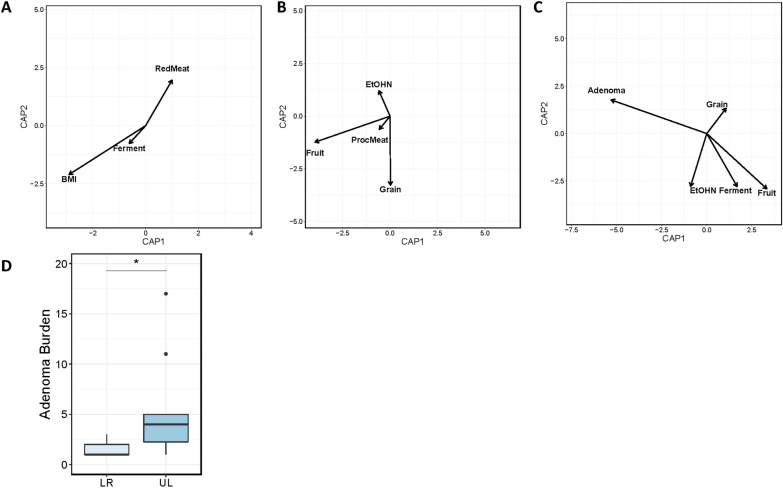
Patient lifestyle is associated with microbiome diversity. Constrained ordinations of A oral, B fecal, C mucosal diversity overlaid with vectors (arrows) representing the direction and magnitude of the correlation of between parameter and the primary axes of microbiome diversity variation. Factors shown include body mass index (BMI); fermented food (Ferment), red meat (RedMeat), fruit, grain, and alcoholic beverage (EtOHN) consumption; and adenoma number (Adenoma). D A boxplot of adenoma number per patient in patients with adenomas in the lower right (LR) and upper left (UL) quadrants of the mucosal microbial diversity ordination. An * denotes p < 0.05

References

    1. Park SY, Boushey CJ, Wilkens LR, Haiman CA, Le Marchand L. High-quality diets associate with reduced risk of colorectal cancer: analyses of diet quality indexes in the multiethnic cohort. Gastroenterology. 2017;153(2):386–394. doi: 10.1053/j.gastro.2017.04.004. - DOI - PMC - PubMed
    1. Nigro ND, Bull AW. Prospects for the prevention of colorectal cancer. Dis Colon Rectum. 1987;30(10):751–4. doi: 10.1007/BF02554620. - DOI - PubMed
    1. Dekker E, Tanis PJ, Vleugels JLA, Kasi PM, Wallace MB. Colorectal cancer. Lancet. 2019;394(10207):1467–80. doi: 10.1016/S0140-6736(19)32319-0. - DOI - PubMed
    1. Faith JJ, Guruge JL, Charbonneau M, Subramanian S, Seedorf H, Goodman AL, et al. The long-term stability of the human gut microbiota. Science. 2013 doi: 10.1126/science.1237439. - DOI - PMC - PubMed
    1. Nelson H, Chia N. Gut Microbiome and Colon Cancer: A Plausible Explanation for Dietary Contributions to Cancer. J Am Coll Surg. 2019 doi: 10.1016/j.jamcollsurg.2019.05.003. - DOI - PubMed

LinkOut - more resources