. 2023 Jan 3;12(1):e8066.
doi: 10.1161/JAHA.122.027715. Epub 2022 Dec 24.

Ross Procedure Versus Mechanical Versus Bioprosthetic Aortic Valve Replacement: A Network Meta-Analysis

Affiliations

Ross Procedure Versus Mechanical Versus Bioprosthetic Aortic Valve Replacement: A Network Meta-Analysis

Yujiro Yokoyama et al. J Am Heart Assoc. .

Abstract

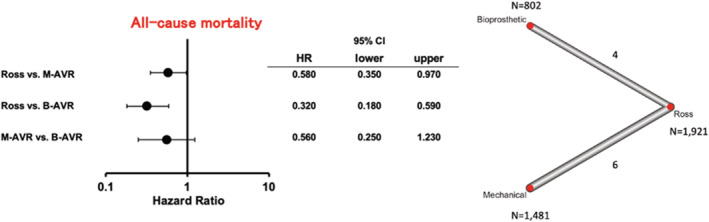
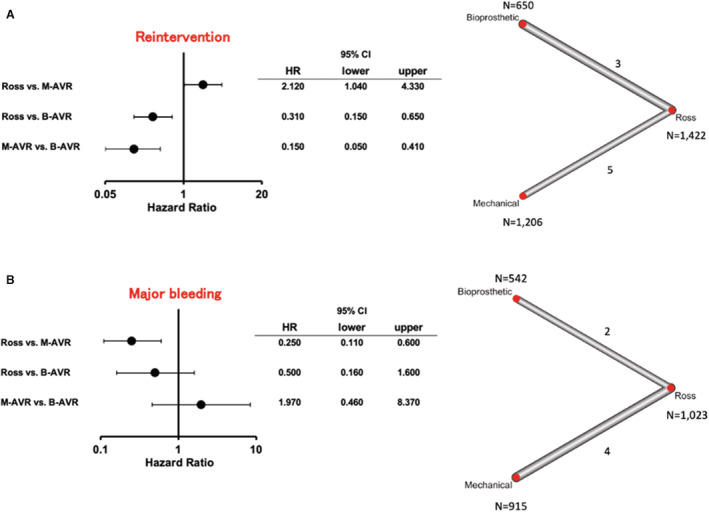
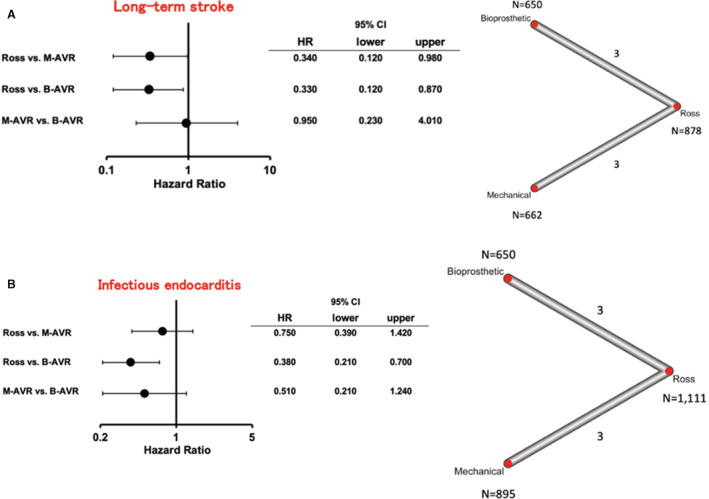
Background The Ross operation appears to restore normal survival in young and middle-aged adults with aortic valve disease. However, there are limited data comparing it with conventional aortic valve replacement. Herein, we compared outcomes of the Ross procedure with mechanical and bioprosthetic aortic valve replacement (M-AVR and B-AVR, respectively). Methods and Results MEDLINE and EMBASE were searched through March 2022 to identify randomized controlled trials and propensity score-matched studies that investigated outcomes of patients aged ≥16 years undergoing the Ross procedure, M-AVR, or B-AVR. The systematic literature search identified 2 randomized controlled trials and 8 propensity score-matched studies involving a total of 4812 patients (Ross: n=1991; M-AVR: n=2019; and B-AVR: n=802). All-cause mortality was significantly lower in the Ross procedure group compared with M-AVR (hazard ratio [HR] [95% CI], 0.58 [0.35-0.97]; P=0.035) and B-AVR (HR [95% CI], 0.32 [0.18-0.59]; P<0.001) groups. The reintervention rate was lower after the Ross procedure and M-AVR compared with B-AVR, whereas it was higher after the Ross procedure compared with M-AVR. Major bleeding rate was lower after the Ross procedure compared with M-AVR. Long-term stroke rate was lower following the Ross procedure compared with M-AVR and B-AVR. The rate of endocarditis was also lower after the Ross procedure compared with B-AVR. Conclusions Improved long-term outcomes of the Ross procedure are demonstrated compared with conventional M-AVR and B-AVR options. These results highlight a need to enhance the recognition of the Ross procedure and revisit current guidelines on the optimal valve substitute for young and middle-aged patients.

Keywords: Ross procedure; aortic valve substitute; bioprosthetic aortic valve replacement; mechanical aortic valve replacement; surgical aortic valve replacement.


Figures
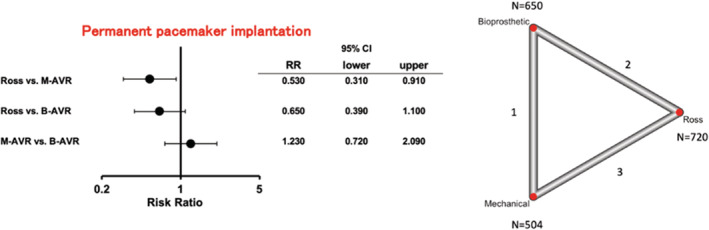
Figure 1
Figure 1. Forest plots of rates of permanent pacemaker implantation among treatment strategies (random‐effects model).
The horizontal lines represent the values within the 95% CI of the underlying effects. The vertical line indicates an incident risk ratio (RR) of 1. B‐AVR indicates bioprosthetic aortic valve replacement; and M‐AVR, mechanical aortic valve replacement.
Figure 2
Figure 2. Forest plots of long‐term all‐cause mortality among treatment strategies (random‐effects model).
The horizontal lines represent the values within the 95% CI of the underlying effects. The vertical line indicates an incident hazard ratio (HR) of 1. B‐AVR indicates bioprosthetic aortic valve replacement; and M‐AVR, mechanical aortic valve replacement.
Figure 3
Figure 3. Forest plots of rates of long‐term reintervention (A) and long‐term major bleeding (B) among treatment strategies (random‐effects model).
The horizontal lines represent the values within the 95% CI of the underlying effects. The vertical line indicates an incident hazard ratio (HR) of 1. B‐AVR indicates bioprosthetic aortic valve replacement; and M‐AVR, mechanical aortic valve replacement.
Figure 4
Figure 4. Forest plots of rates of long‐term stroke (A) and infectious endocarditis (B) among treatment strategies (random‐effects model).
The horizontal lines represent the values within the 95% CI of the underlying effects. The vertical line indicates an incident hazard ratio (HR) of 1. B‐AVR indicates bioprosthetic aortic valve replacement; and M‐AVR, mechanical aortic valve replacement.

References

    1. Leon MB, Smith CR, Mack MJ, Makkar RR, Svensson LG, Kodali SK, Thourani VH, Tuzcu EM, Miller DC, Herrmann HC, et al. Transcatheter or surgical aortic‐valve replacement in intermediate‐risk patients. N Engl J Med. 2016;374:1609–1620. doi: 10.1056/NEJMoa1514616 - DOI - PubMed
    1. Reardon MJ, Van Mieghem NM, Popma JJ, Kleiman NS, Søndergaard L, Mumtaz M, Adams DH, Deeb GM, Maini B, Gada H, et al. Surgical or transcatheter aortic‐valve replacement in intermediate‐risk patients. N Engl J Med. 2017;376:1321–1331. doi: 10.1056/NEJMoa1700456 - DOI - PubMed
    1. Mack MJ, Leon MB, Thourani VH, Makkar R, Kodali SK, Russo M, Kapadia SR, Malaisrie SC, Cohen DJ, Pibarot P, et al. Transcatheter aortic‐valve replacement with a balloon‐expandable valve in low‐risk patients. N Engl J Med. 2019;380:1695–1705. doi: 10.1056/NEJMoa1814052 - DOI - PubMed
    1. Popma JJ, Deeb GM, Yakubov SJ, Mumtaz M, Gada H, O'Hair D, Bajwa T, Heiser JC, Merhi W, Kleiman NS, et al. Transcatheter aortic‐valve replacement with a self‐expanding valve in low‐risk patients. N Engl J Med. 2019;380:1706–1715. doi: 10.1056/NEJMoa1816885 - DOI - PubMed
    1. Forrest JK, Ramlawi B, Deeb GM, Zahr F, Song HK, Kleiman NS, Chetcuti SJ, Michelena HI, Mangi AA, Skiles JA, et al. Transcatheter aortic valve replacement in low‐risk patients with bicuspid aortic valve stenosis. JAMA Cardiol. 2021;6:50–57. doi: 10.1001/jamacardio.2020.4738 - DOI - PMC - PubMed

Publication types

LinkOut - more resources