


A review of protocols for brain organoids and applications for disease modeling
- PMID: 36566384
- PMCID: PMC9803834
- DOI: 10.1016/j.xpro.2022.101860
A review of protocols for brain organoids and applications for disease modeling
Abstract
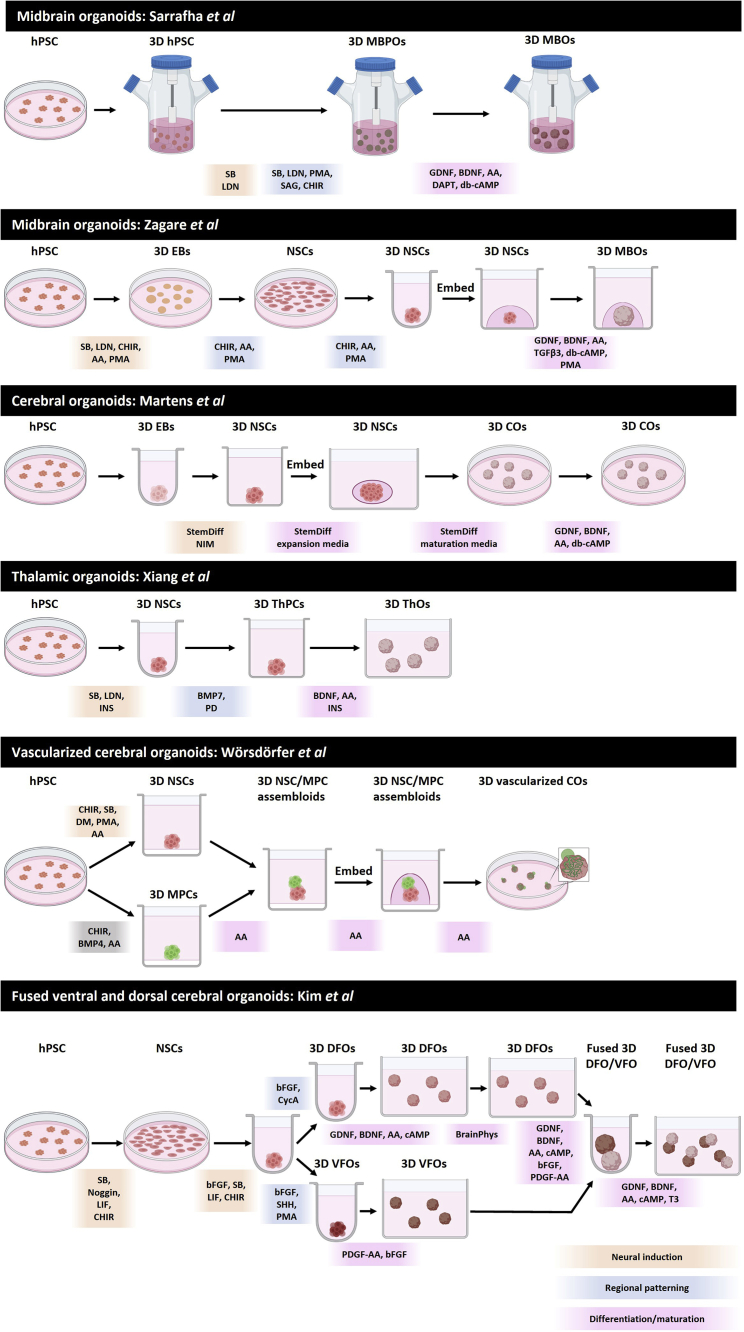
Recent breakthroughs in human stem cell technologies have enabled the generation of 3D brain organoid platforms for modeling human neurodevelopment and disease. Here, we review advances in brain organoid development, approaches for generating whole-brain or cerebral organoids and region-specific brain organoids, and their applications in disease modeling. We present a comprehensive overview of various brain organoid generation protocols, including culture steps, media, timelines, and technical considerations associated with each protocol, and highlight the advantages and disadvantages of each protocol. We also discuss the current limitations as well as increasing sophistication of brain organoid technology, and future directions for the field. These insights provide a valuable assessment of multiple commonly used brain organoid models and main considerations for investigators who are considering implementing brain organoid technologies in their laboratories.
Keywords: cell culture; organoids; stem cells.
Copyright © 2022 The Authors. Published by Elsevier Inc. All rights reserved.
Conflict of interest statement
Declaration of interests The authors declare that they have no known competing financial interests or personal relationships that could have appeared to influence the work reported in this paper.
Figures
References
-
- Kadoshima T., Sakaguchi H., Nakano T., Soen M., Ando S., Eiraku M., Sasai Y. Self-organization of axial polarity, inside-out layer pattern, and species-specific progenitor dynamics in human ES cell-derived neocortex. Proc. Natl. Acad. Sci. USA. 2013;110:20284–20289. doi: 10.1073/pnas.1315710110. - DOI - PMC - PubMed
Publication types
MeSH terms
LinkOut - more resources
Full Text Sources
Other Literature Sources
