. 2022 May 6;12(9):5022-5035.
doi: 10.1021/acscatal.2c00336. Epub 2022 Apr 13.

Distal Mutations Shape Substrate-Binding Sites during Evolution of a Metallo-Oxidase into a Laccase

Affiliations

Distal Mutations Shape Substrate-Binding Sites during Evolution of a Metallo-Oxidase into a Laccase

Vânia Brissos et al. ACS Catal. .

Abstract

Laccases are in increasing demand as innovative solutions in the biorefinery fields. Here, we combine mutagenesis with structural, kinetic, and in silico analyses to characterize the molecular features that cause the evolution of a hyperthermostable metallo-oxidase from the multicopper oxidase family into a laccase (k cat 273 s-1 for a bulky aromatic substrate). We show that six mutations scattered across the enzyme collectively modulate dynamics to improve the binding and catalysis of a bulky aromatic substrate. The replacement of residues during the early stages of evolution is a stepping stone for altering the shape and size of substrate-binding sites. Binding sites are then fine-tuned through high-order epistasis interactions by inserting distal mutations during later stages of evolution. Allosterically coupled, long-range dynamic networks favor catalytically competent conformational states that are more suitable for recognizing and stabilizing the aromatic substrate. This work provides mechanistic insight into enzymatic and evolutionary molecular mechanisms and spots the importance of iterative experimental and computational analyses to understand local-to-global changes.


Conflict of interest statement

The authors declare no competing financial interest.

Figures

Figure 1
Figure 1
Overall structure and the T1 Cu site environment in 2F4 and wild type. (a) Cartoon representation of the transparent secondary structure of the superimposed wild type (blue) and 2F4 (orange). 2F4 mutations S55, S58, T199, L441, T449, and G471 are displayed as orange spheres and their homologous wild-type side chains as blue spheres. Yellow spheres represent 2F4 copper sites. Cartoon representation of the main-chain 2F4 (b) and wild-type (c) structures with thickness proportional to ⟨a.d.p.⟩ values, color-coded from blue (20 Å2) to red (130 Å2). The distance between residues 449 and 224 (black dashed line and black arrow) in 2F4 (d) and wild type (e). These residues are shown as sticks and transparent spheres with carbon, oxygen, and sulfur atoms colored orange (blue in the wild type), red, and yellow, respectively. M353 and G354 of 2F4 and M355 of McoA are part of the Met-loop region. (f) Zoomed view of regions 220–226 and 401–407 near T1 Cu in the wild-type (blue) and 2F4 variant (orange). The mutation M449T in 2F4 could have led to a structural displacement of the two loops. The residues 224 and 449 are shown as sticks with carbon, oxygen, and sulfur atoms in orange (blue in the wild type), red, and yellow, respectively. The T1 Cu histidine ligands H451 and H514 are shown as red sticks.
Figure 2
Figure 2
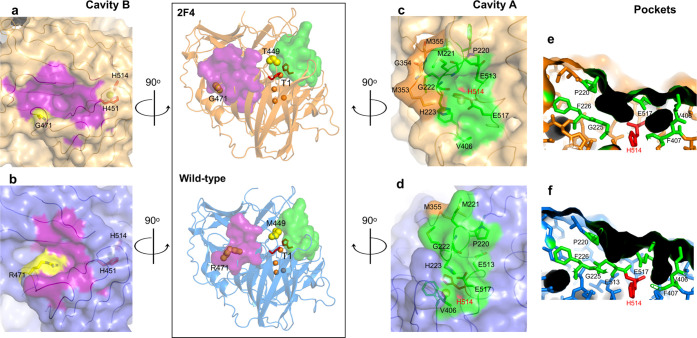
T1 Cu cavities A and B of 2F4 (top) and wild type (bottom). The T1 Cu histidine ligands (H451 and H514) are presented as red sticks. The copper atoms are shown as orange spheres. The mutations M449T and R471G are shown as yellow spheres. Cavities A and B, colored in green and purple, respectively, are shown as ASA. Cavity A shows two small pockets that allow the T1 Cu ligand H514 to access solvent media in 2F4 (c) and wild type (d). Residues part of the Met-rich region with visible electron density (353–355 in 2F4 and 355 in the wild type) are colored in pale orange. (e) and (f) are cutaway views of (c) and (d), respectively, showing pockets in 2F4 and wild type. Cavity B (purple) is located approximately at 180° rotation (in the y-axis) apart from cavity A and offers a higher depth in 2F4 (a) relative to wild type (b). The mutated residue 471 is colored yellow.
Figure 3
Figure 3
Preferential closed Met-loop in the evolved variant 2F4. (a) Logarithmic-scale representation of scattering intensity, I(s), as a function of the momentum transfer, s, measured for 2F4 (empty black circles). Solid lines are back-calculated curves derived from subensembles of 2F4 with Met-loop in the open state (red) or refined from the ensemble optimization method (EOM) fit of the SAXS data (green). Residuals of absolute values are at the bottom with the same color code. Systematic deviations, away from zero, indicate a poor fit by assuming only open Met-loop structures (χ2 = 18.92). The agreement improves by reducing the relative open population, searching best agreement (χ2 = 1.24) near 100% of closed models. (b) Plot shows how SAXS discrepancy, χ2, varies with the relative population of “closed” (green ribbon) and “open” (red ribbon) states. The best agreement is observed for an ensemble with ∼100% of the closed state, with structures partially preventing access to T1 Cu. For clarity, only five Met-loop structures are represented. (c) Root-mean-square fluctuations (RMSF) for 2F4 (orange) vs wild-type McoA (blue) residues over 3.6 μs of simulation. RMSF profiles show that the Met-loop in both variants displays differential mobility, with an apparent reduction in Met-loop flexibility at the T1 Cu interface for 2F4. Loops in McoA/2F4 are shaded in gray. (d, e) Met-loop sampling over the T1 Cu. Wild type and 2F4 are in blue and orange transparent ribbon, and the relative position of the loop tip is displayed as spheres in shades of red. The sphere radius is proportional to the probability of occurrence probability. Cavity A and B are in green and purple surface representation, respectively. The coopers are shown in yellow. (f) Kinetic parameters kcat/Km for the oxidation of ABTS in variants with the Met-rich loop were partially deleted: 2F4 (orange) and wild type (blue). The partial truncation of Met-rich 29-residue loop yielded variants with loops having 19 (loop 19), 13 (loop 13), 7 (loop 7), and 5 (loop 5) residues. Each value averages more than six measurements with standard deviations (bars).
Figure 4
Figure 4
Docking of ABTS to cavity A and cavity B of wild type and 2F4. An ensemble of 1198 and 400 protein structures taken from the MD simulations was used for long-loop (a, b) and truncated-loop (loop 5) (c, d) enzymes, respectively. Histograms show the number of docking solutions as a function of the ABTS distance (Å) to the T1 Cu. Blue and orange colors are used for wild type and 2F4 data, respectively. For long-loop enzymes and cavity A (a), ABTS can get significantly closer to the T1 Cu in 2F4 than the wild type. Also, ABTS binding to cavity B (b) gives slightly shorter ABTS to T1 Cu distances in 2F4. For loop-truncated 2F4, the emergence of a catalytically competent binding site in cavity B is observed (with ABTS to T1 Cu distances of 6.0–7.0 Å). ABTS binding at cavity A is preferred for the truncated wild type, although at slightly longer distances.
Figure 5
Figure 5
Comparison of kinetic parameters for ABTS oxidation of variants with single mutations M449T, I441L, R471G, I199T, P58S, and F55S in the wild-type background (a–c) and mutations T449M, L441I, G471R, T199I, S58P, and S55F in the 2F4 variant background (d–f), and insertion of mutations M449T, I441L, R471G, I199T, P58S, and F55S in the evolutionary trajectory (g–i).
Figure 6
Figure 6
Protein residue network (PRN) analysis was performed on the MD trajectories of wild type and 2F4 (a) and of loop-truncated wild-type and 2F4 variants (b) to identify possible sources for the change in catalysis produced by distant mutations. The method was used to determine communication pathways between mutated residues and flexible loops close to cavity A and those forming the catalytically productive cavity B in 2F4. Residue–residue network optima paths that decrease and increase the most between 2F4 and wild type are given. (a) Some pathways, between mutated residues 471 and 449 and cavity B residues, which are delimiting the cavity, show a decrease in the path length, indicating an increased correlation between these residue pairs in 2F4 to wild type. However, significantly longer communication pathways (i.e., less correlated dynamics, right panel) are observed upon mutation between residue 58 and most of the Met-rich loop. Interestingly, residues 353 and 354, located at the end of the loop, present significantly longer paths than other mutated residues (55, 441, and 449). (b) In loop-truncated 2F4, pathways involving residues 55 and 58 (also 449 and 441) are the ones that have decreased the most. Pathways involving 471 and 449 are the ones that show the most increase in the path length. The Met-rich loop (residues 327–355) is in gray, residues 220–226 are in light green, residues 400–407 in dark green, cavity B residues are in purple, and light purple if the residues belong both to cavity B and to the truncated five-residue loop (starting at 327), which delimits cavity B and separates it from cavity A. (c, d) Comparison between loop-truncated wild type and 2F4 lead to the identification of much shorter, direct, and focused pathways in 2F4 between residues 55 and 58 (shown in yellow spheres) and residues forming cavity B (shown in magenta). Amino acids involved in these communication pathways are represented for (c) wild type (pathways shown in blue) and (d) 2F4 (pathways shown in orange).

References

    1. Cannatelli M. D.; Ragauskas A. J. Two Decades of Laccases: Advancing Sustainability in the Chemical Industry. Chem. Rec. 2017, 17, 122–140. 10.1002/tcr.201600033. - DOI - PubMed
    1. Mate D. M.; Alcalde M. Laccase: A Multi-Purpose Biocatalyst at the Forefront of Biotechnology. Microb. Biotechnol. 2017, 10, 1457–1467. 10.1111/1751-7915.12422. - DOI - PMC - PubMed
    1. Sousa A. C.; Martins L. O.; Robalo M. P. Laccases: Versatile Biocatalysts for the Synthesis of Heterocyclic Cores. Molecules 2021, 26, 371910.3390/molecules26123719. - DOI - PMC - PubMed
    1. Sun Z.; Fridrich B.; De Santi A.; Elangovan S.; Barta K. Bright Side of Lignin Depolymerization: Toward New Platform Chemicals. Chem. Rev. 2018, 118, 614–678. 10.1021/acs.chemrev.7b00588. - DOI - PMC - PubMed
    1. Kosman D. J. Multicopper Oxidases: A Workshop on Copper Coordination Chemistry, Electron Transfer, and Metallophysiology. J. Biol. Inorg. Chem. 2010, 15, 15–28. 10.1007/s00775-009-0590-9. - DOI - PubMed