


Optimizing cCOG, a Web-based tool, to detect dementia with Lewy Bodies
- PMID: 36569383
- PMCID: PMC9773307
- DOI: 10.1002/dad2.12379
Optimizing cCOG, a Web-based tool, to detect dementia with Lewy Bodies
Abstract
Introduction: Distinguishing dementia with Lewy bodies (DLB) from Alzheimer's disease (AD) is challenging due to overlapping presentations. We adapted a Web-based test tool, cCOG, by adding a visuospatial task and a brief clinical survey and assessed its ability to differentiate between DLB and AD.
Methods: We included 110 patients (n = 30 DLB, n = 32 AD dementia, and n = 48 controls with subjective cognitive decline (SCD)). Full cCOG comprises six cognitive subtasks and a survey addressing self-reported DLB core and autonomic features. First, we compared cCOG cognitive tasks to traditional neuropsychological tasks for all diagnostic groups and clinical questions to validated assessments of clinical features in DLB only. Then, we studied the performance of cCOG cognitive tasks and clinical questions, separately and combined, in differentiating diagnostic groups.
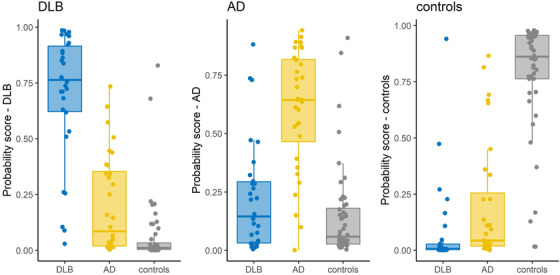
Results: cCOG cognitive tasks and clinical survey had moderate to strong correlations to standard neuropsychological testing (.61≤ r s ≤ .77) and to validated assessments of clinical features (.41≤ r s ≤ .65), except for fluctuations and REM-sleep behavior disorder (RBD) (r s = .32 and r s = .10). Full cCOG, including both cognitive tasks and brief survey had a diagnostic accuracy (acc) of 0.82 [95% CI 0.73-0.89], with good discrimination of DLB versus AD (acc 0.87 [0.76-0.95]) and DLB versus controls (acc 0.94 [0.86-0.98]).
Conclusion: We illustrated that cCOG aids in distinguishing DLB and AD patients by using remote assessment of cognition and clinical features. Our findings pave the way to a funneled, harmonized diagnostic process among memory clinics and, eventually, a more timely and accurate diagnosis of DLB and AD.
Keywords: Alzheimer's disease; Lewy body dementia; Web‐based cognitive testing; dementia; diagnostics; digital assessment; neurodegenerative disorders; neuropsychology.
© 2022 The Authors. Alzheimer's & Dementia: Diagnosis, Assessment & Disease Monitoring published by Wiley Periodicals, LLC on behalf of Alzheimer's Association.
Conflict of interest statement
H.R.M. performs contract research for Combinostics; all funding is paid to her institution. W.F. performs contract research for Biogen. Research programs of W.F. have been funded by ZonMW, NWO, EU‐FP7, EU‐JPND, Alzheimer Nederland, CardioVascular Onderzoek Nederland, Health∼Holland, Topsector Life Sciences & Health, stichting Dioraphte, Gieskes‐Strijbis fonds, stichting Equilibrio, Pasman stichting, stichting Alzheimer & Neuropsychiatrie Foundation, Philips, Biogen MA Inc, Novartis‐NL, Life‐MI, AVID, Roche BV, Fujifilm, Combinostics. W.F. holds the Pasman chair. W.F. is a recipient of ABOARD, which is a public‐private partnership receiving funding from ZonMW (#73305095007) and Health∼Holland, Topsector Life Sciences & Health (PPP‐allowance; #LSHM20106). W.F. has performed contract research for Biogen MA Inc, and Boehringer Ingelheim. W.F. has been an invited speaker at Boehringer Ingelheim, Biogen MA Inc, Danone, Eisai, WebMD Neurology (Medscape), Springer Healthcare. W.F. is consultant to Oxford Health Policy Forum CIC, Roche, and Biogen MA Inc. W.F. participated in advisory boards of Biogen MA Inc and Roche. All funding is paid to her institution. W.F. was associate editor of Alzheimer, Research & Therapy in 2020/2021. W.F. is associate editor at Brain. Jyrki Lötjönen reports that Combinostics owns the following IPR related to the article: 1. J. Koikkalainen and J. Lötjönen. A method for inferring the state of a system, US 7,840,510 B2. 2. J. Lötjönen, J. Koikkalainen, and J. Mattila. State Inference in a heterogeneous system, US 10,372,786 B2. Lötjönen is shareholder in Combinostics. All other authors report no conflicts of interest. Author disclosures are available in the supporting information.
Figures
References
-
- Hogan DB, Fiest KM, Roberts JI, et al. The prevalence and incidence of Dementia with Lewy Bodies: a Systematic Review. Can J Neurol Sci. 2016;43 Suppl 1:S83‐S95. - PubMed
LinkOut - more resources
Full Text Sources