. 2023 Apr;10(2):387-404.
doi: 10.1007/s40744-022-00525-x. Epub 2022 Dec 26.

Serious Infection Rates Among Patients with Select Autoimmune Conditions: A Claims-Based Retrospective Cohort Study from Taiwan and the USA

Affiliations

Serious Infection Rates Among Patients with Select Autoimmune Conditions: A Claims-Based Retrospective Cohort Study from Taiwan and the USA

Wen-Nan Huang et al. Rheumatol Ther. 2023 Apr.

Abstract

Introduction: Serious infections are an important concern for patients with autoimmune conditions. We sought to estimate serious infection rates among patients with select autoimmune conditions relative to the general population in Taiwan and the USA.

Methods: This retrospective cohort study estimated setting-specific standardized serious infection incidence rates and ratios among patients with systemic lupus erythematosus, including extra-renal lupus and lupus nephritis, rheumatoid arthritis and primary membranous nephropathy, compared with the general population using insurance claims for hospitalizations between 2000 and 2013. Multivariable Cox proportional hazard models were used to estimate adjusted hazard ratios for serious infections, adjusting for age, sex, index year, prior serious infection, comorbidities and medications.

Results: In Taiwan, serious infection rates were 22.7, 28.7, 70.6, 43.4 and 215.3 per 1000 person-years among the general population and among cohorts of patients with primary membranous nephropathy, rheumatoid arthritis, extra-renal lupus and lupus nephritis, respectively. In the USA, serious infection rates were 2.6, 9.0, 15.6, 21.0 and 63.3 per 1000 person-years among the general population and among cohorts of patients with primary membranous nephropathy, rheumatoid arthritis, extra-renal lupus and lupus nephritis, respectively. Patients had significantly higher serious infection rates than the general population in both settings, largely driven by bacterial, respiratory, urinary tract and opportunistic infections. Patients with lupus nephritis had the highest burden of serious infections relative to the general population, with 7- to 25-fold higher adjusted hazard ratios in Taiwan and the USA, respectively.

Conclusion: This study identified a significant excess serious infection burden among patients with targeted autoimmune conditions compared with the general populations in Taiwan and the USA.

Keywords: Autoimmune; Incidence; Lupus; Primary membranous nephropathy; Rheumatoid arthritis; Serious infection.


Figures

Fig. 1
Fig. 1
Patient cohorts in study population of Taiwan. AI autoimmune, ERL extra-renal lupus, HIV/AIDS human immunodeficiency virus/acquired immunodeficiency syndrome, ICD-9 International Classification of Diseases, Ninth Revision, ipt inpatient, LN lupus nephritis, NHIRD National Health Insurance Research Database, opt outpatient, pMN primary membranous nephropathy, RA rheumatoid arthritis, SLE systemic lupus erythematosus
Fig. 2
Fig. 2
Patient cohorts in study population of USA. Note that the general population cohort in the USA is based on a 1% random sample of IBM® MarketScan® Commercial Claims and Encounters Database. CCAE IBM® MarketScan® Commercial Claims and Encounters Database, MDCR MarketScan Medicare Supplemental and Coordination of Benefits Database, MN membranous nephropathy; for other abbreviations, see Fig. 1 caption
Fig. 3
Fig. 3
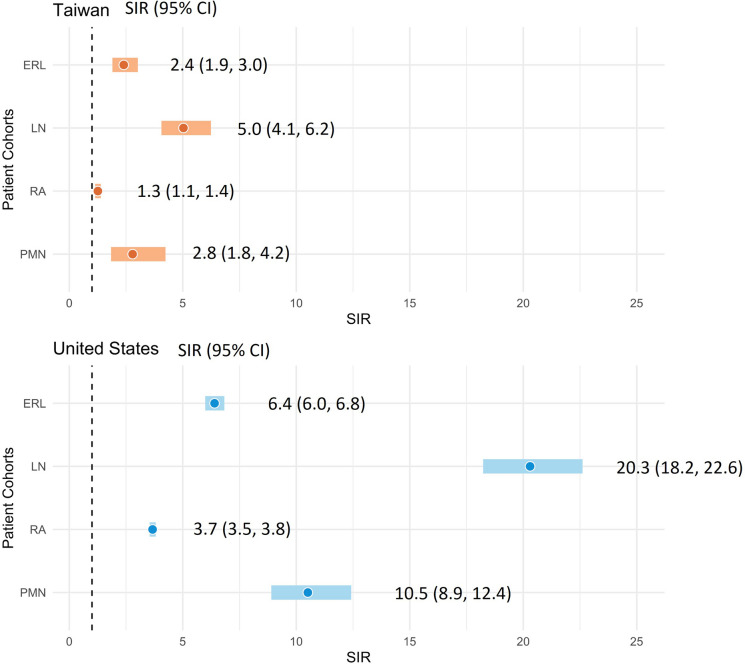
Within-setting comparisons of serious infection rates for autoimmune patients versus the general population. Adjusted SIRs and 95% CIs of serious infection rates for autoimmune patients (extra-renal lupus, lupus nephritis, RA and pMN) were compared with the general population by setting. CI Confidence interval, SI serious infection, SIR standardized incidence ratio
Fig. 4
Fig. 4
Estimated SIRs of patients from Taiwan with SLE and RA in the OMGSD and CID. Adjusted SIRs and 95% CIs of serious infection rates for patients with SLE and RA compared with the general population by database (OMGSD and CID) in Taiwan. CID Catastrophic Illness Database, OMGSD One Million General Sample Database

References

    1. George MD, Baker JF, Winthrop K, et al. Risk for serious infection with low-dose glucocorticoids in patients with rheumatoid arthritis: a cohort study. Ann Intern Med. 2020;173(11):870–8. doi: 10.7326/M20-1594. - DOI - PMC - PubMed
    1. Jung JY, Yoon D, Choi Y, Kim HA, Suh CH. Associated clinical factors for serious infections in patients with systemic lupus erythematosus. Sci Rep. 2019;9(1):9704. doi: 10.1038/s41598-019-46039-5. - DOI - PMC - PubMed
    1. Singh JA, Cameron C, Noorbaloochi S, et al. Risk of serious infection in biological treatment of patients with rheumatoid arthritis: a systematic review and meta-analysis. Lancet. 2015;386(9990):258–265. doi: 10.1016/S0140-6736(14)61704-9. - DOI - PMC - PubMed
    1. Singh JA, Hossain A, Kotb A, Wells G. Risk of serious infections with immunosuppressive drugs and glucocorticoids for lupus nephritis: a systematic review and network meta-analysis. BMC Med. 2016;14(1):137. doi: 10.1186/s12916-016-0673-8. - DOI - PMC - PubMed
    1. Sathish JG, Sethu S, Bielsky MC, et al. Challenges and approaches for the development of safer immunomodulatory biologics. Nat Rev Drug Discov. 2013;12(4):306–324. doi: 10.1038/nrd3974. - DOI - PMC - PubMed

LinkOut - more resources