


The Effects of Tinnitus and Tinnitus Annoyance on Need for Recovery After Work: Results of the Netherlands Longitudinal Study on Hearing
- PMID: 36573900
- PMCID: PMC10262992
- DOI: 10.1097/AUD.0000000000001323
The Effects of Tinnitus and Tinnitus Annoyance on Need for Recovery After Work: Results of the Netherlands Longitudinal Study on Hearing
Abstract
Objectives: The first aim of this study was to examine the relationship between having tinnitus and the need for recovery after work (NFR). The second aim was to investigate whether the level of tinnitus annoyance is associated with NFR.
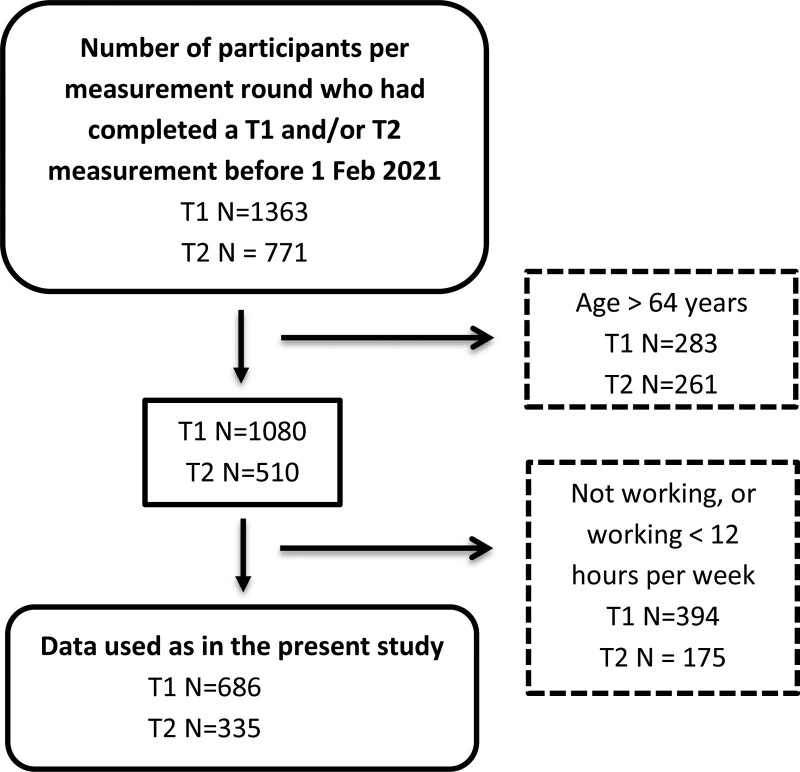
Design: Data from the 5- and 10-year follow-up measurement rounds of the Netherlands Longitudinal Study on Hearing (NL-SH) were used in a cross-sectional analyses. The NL-SH is a web-based prospective cohort study and includes participants aged 18 to 70 years at baseline. For this study, we included only participants who worked at least 12 hours/week and were under the age of 65 years. Participants completed questionnaires on demographic, socioeconomic, psychosocial, hearing-related, and work-related characteristics. In addition, participants answered questions about hearing ability and tinnitus and performed an online digit-triplet speech recognition in noise test to measure the speech reception threshold (SRT) in noise. Participants were asked if (1) they suffer from tinnitus and (2) to rate tinnitus annoyance on a 0-100 numeric rating scale. A linear mixed model was used (1) to estimate the overall (i.e., cross-sectional) association between having tinnitus and NFR and (2) to estimate the overall association between the level of tinnitus annoyance and NFR. The models were checked for effect modification and confounding of factors known to be associated with either tinnitus or NFR and available in the NL-SH.
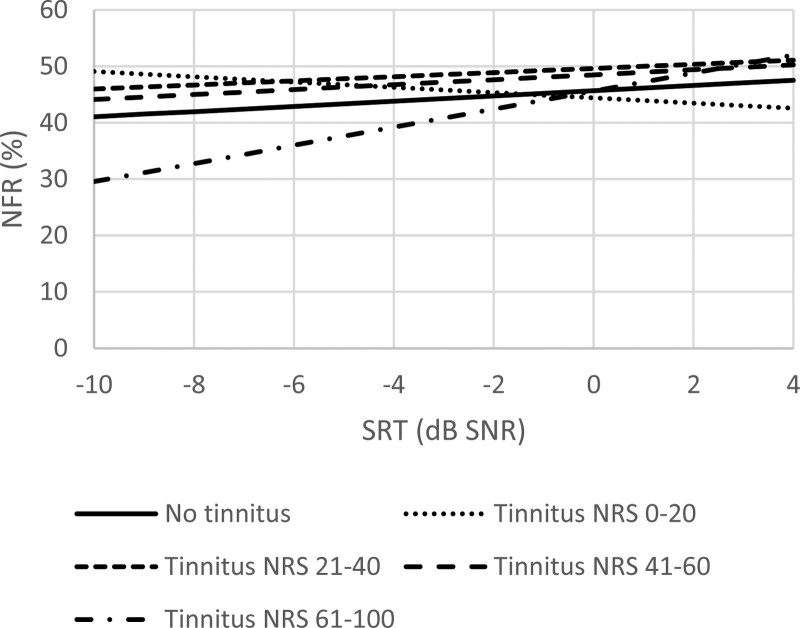
Results: The study sample comprised 770 unique participants in total; 686 and 335 participants at 5- and 10-year follow-up, respectively. Distress, somatization, and self-reported hearing disability appeared to be confounding factors in the analysis of having tinnitus and NFR. After adjusting for these factors, participants with tinnitus had a 2.5% higher NFR (95% confidence interval: -0.9 to 5.9; p = 0.15). In the analysis of tinnitus annoyance and NFR, SRT was an effect modifier. Distress, somatization, depression, and self-reported hearing disability were confounders. After adjustment for effect modification and confounding, tinnitus annoyance was not significantly associated with NFR ( p = 0.79 for tinnitus annoyance).
Conclusions: This study showed that having tinnitus was not associated with a higher NFR. Also, higher levels of tinnitus annoyance were not associated with a higher NFR. NFR was associated with the psychological factors distress, somatization, and depression, which are known to be intricately related to tinnitus. A longitudinal study design is recommended as it can assess the sequence of events, which might help disentangle the association between tinnitus, NFR, and psychological factors.
Copyright © 2022 The Authors. Ear & Hearing is published on behalf of the American Auditory Society, by Wolters Kluwer Health, Inc.
Conflict of interest statement
The authors have no conflicts of interest to declare.
Figures
References
-
- Baguley D., McFerran D., Hall D. (2013). Tinnitus. Lancet, 382, 1600–1607. - PubMed
-
- Boeschen Hospers J. M., Smits N., Smits C., Stam M., Terwee C. B., Kramer S. E. (2016). Reevaluation of the Amsterdam inventory for auditory disability and handicap using item response theory. J Speech Lang Hear Res, 59, 373–383. - PubMed
-
- Broersen J. P. J., Fortuin R. J., Dijkstra L., van Veldhoven M., Prins J. (2004). Monitor Arboconvenanten: Kengetallen en grenswaarden. TBV – Tijdschrift voor Bedrijfs- en Verzekeringsgeneeskunde, 12, 104–108.
-
- Bültmann U., Kant I., Kasl S. V., Beurskens A. J. H. M., van den Brandt P. A. (2002). Fatigue and psychological distress in the working population: Psychometrics, prevalence, and correlates. J Psychosom Res, 52, 445–452. - PubMed
-
- de Croon E. M., Sluiter J. K., Frings-Dresen M. H. (2003). Need for recovery after work predicts sickness absence: A 2-year prospective cohort study in truck drivers. J Psychosom Res, 55, 331–339. - PubMed
MeSH terms
LinkOut - more resources
Full Text Sources
Medical
