Review
. 2023 May;41(5):459-476.
doi: 10.1007/s11604-022-01376-w. Epub 2022 Dec 28.

FDG-PET findings associated with various medical procedures and treatments

Affiliations
Review

FDG-PET findings associated with various medical procedures and treatments

Chio Okuyama et al. Jpn J Radiol. 2023 May.

Abstract

[18F]-fluorodeoxyglucose (FDG) positron emission tomography (PET) is a well-established modality with high sensitivity for the diagnosis and staging of oncologic patients. FDG is taken up by the glucose transporter of the cell membrane and becomes trapped within the cell. In addition to malignant neoplasms, active inflammatory lesions and some kinds of benign tumors also accumulate FDG. Moreover, the degree of uptake into normal organs and tissues depends on various physiological conditions, which is affected by various medical procedures, treatments, and drugs. To avoid misleading interpretations, it is important to recognize possible situations of unexpected abnormal accumulation that mimic tumor lesions. In this review, we present various FDG findings associated with surgical or medical procedures and treatments. Some findings reflect the expected physiological reaction to treatment, and some show inflammation due to prior procedures. Occasionally, FDG-PET visualizes other disorders that are unrelated to the malignancy, which may be associated with the adverse effects of certain drugs that the patient is taking. Careful review of medical records and detailed interviews of patients are thus necessary.

Keywords: Adverse effect; FDG–PET; Medical procedures; Physiological effect; Physiological reaction.


Conflict of interest statement

The authors declare that they have no conflict of interest.

Figures

Fig. 1
Fig. 1
Diffuse increased accumulation in the muscles of a patient who had consumed a meal 2 h before FDG injection. An insulin injection before FDG administration causes a similar image
Fig. 2
Fig. 2
Increased bowel FDG distribution in a patient using metformin
Fig. 3
Fig. 3
FDG accumulation along the abdominal aortic graft wall (arrow) is seen, without any particular findings indicating active inflammation, 3 years after operation
Fig. 4
Fig. 4
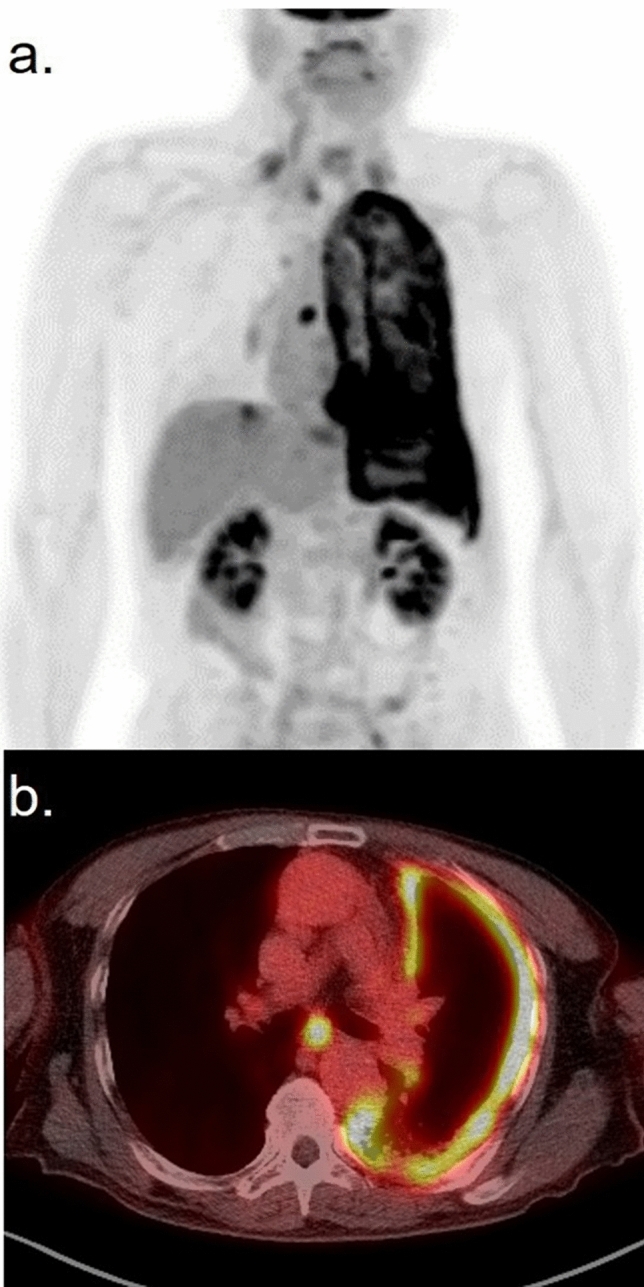
Intense FDG accumulation spreading inside the left pleura 1 month after pleurodesis with OK-432 after bruising the chest for pleuritis carcinomatosis. a MIP, b axial fusion image)
Fig. 5
Fig. 5
Axial images of a case of radiation pneumonitis that occurred in a patient with esophageal cancer. a FDG–PET/CT before treatment, b image of the irradiation field with two radiation direction (1. 40 Gy (upper) and 2. 20 Gy (lower)), c FDG–PET/CT 11 months after radiotherapy
Fig. 6
Fig. 6
Images of a patient with testicular cancer who had undergone radiotherapy for a metastatic bone tumor at his L1 spine 2 months previously [17]. The FDG–PET/CT showed a localized hot spot in the lateral segment of the left lobe of the liver (a). Although the contrast-enhanced CT performed 10 days previously showed no abnormality (b), the MRI performed 7 days later showed a well-bordered square low signal area indicating radiation-induced hepatitis (c). (Partly cited from reference #17)
Fig. 7
Fig. 7
Serial changes in physiological FDG uptake in a pediatric patient with lymphoma: a before treatment (arrow shows the primary spot), b 1 month after the end of chemotherapy, and c 1 year after treatment. The image b shows diffusely increased uptake in the bone marrow. One year after chemotherapy, rebound uptake is seen in the thymus and tonsils, both of which seem to be enlarged. The bone marrow uptake has returned to its initial levels
Fig. 8
Fig. 8
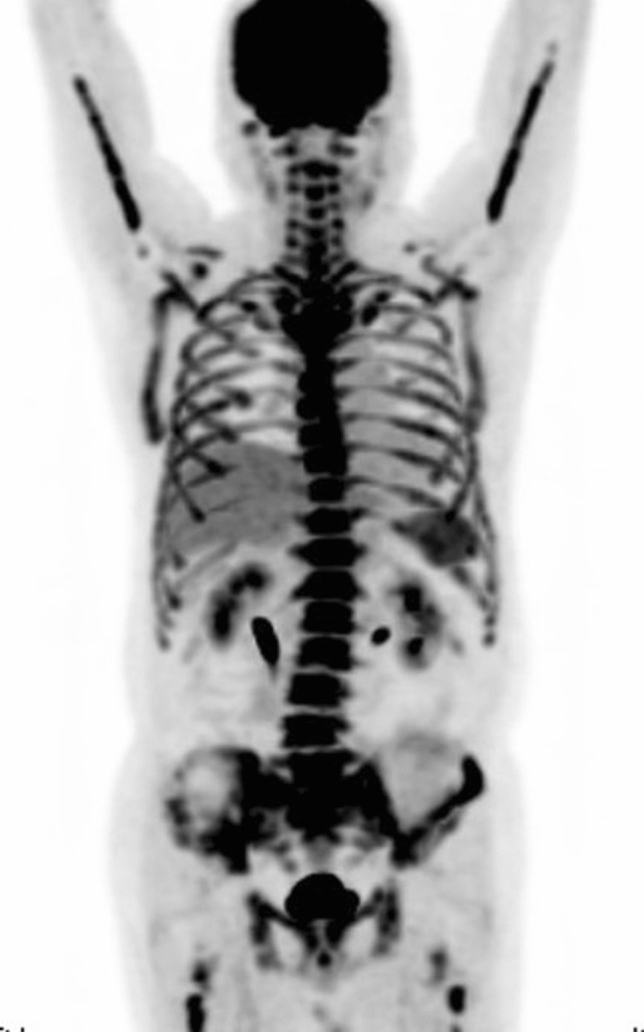
Marked increased uptake in the hematopoietic bone marrow and spleen in a patient with lymphoma, who received pegfilgrastim 7 days before the FDG–PET examination
Fig. 9
Fig. 9
Two patients with high uptake in the left axillary and supraclavicular lymph nodes and spleen after vaccination: a 5 days after the second COVID-19 vaccination on the left deltoid muscle, b 6 days after subcutaneous influenza vaccination on the left arm in a woman with inflammatory breast cancer of the right breast
Fig. 10
Fig. 10
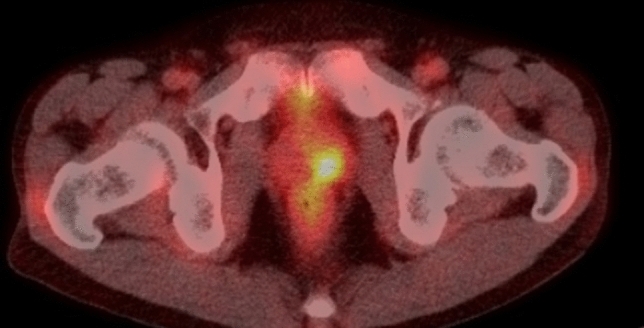
Local granuloma in the prostate in a patient who received intravesical BCG administration for bladder cancer
Fig. 11
Fig. 11
Ectopic granuloma at the abdominal aortic wall and disseminated granuloma in the lungs, liver, bone marrow, kidneys are visualized on the FDG–PET (a) [23]. The patient has a history of transurethral resection of bladder tumor and 8 times intravesical BCG injection for his bladder cancer. The axial PET/CT fusion image (b) shows intense accumulation on wall of the dilated left common iliac artery. Five days after the PET/CT examination, this patient developed an acute abdomen with impending rupture of this aneurysm (c)
Fig. 12
Fig. 12
Patient with multiple lymphadenopathies that were diagnosed as Oii-LPD with positive EBV. He had been treated with MTX for rheumatoid arthritis. In this patient, most of the lymphadenopathies disappeared after MTX discontinuation
Fig. 13
Fig. 13
Patient with EBVMCU who had been receiving MTX for rheumatoid arthritis for 2 years. a Contrast-enhanced CT, b FDG–PET/CT fusion image
Fig. 14
Fig. 14
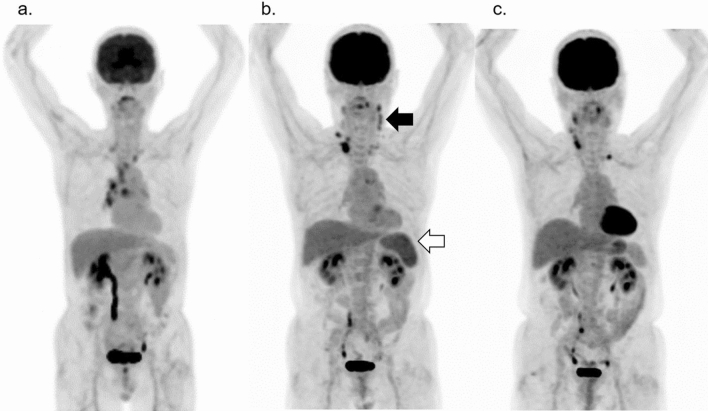
Patient with lung cancer with lymph nodes metastases (a). Six months after achievement of a complete response, lymph nodes metastases developed in the right lower neck and bilateral supraclavicular regions. The second PET scan (b), which was performed 3 weeks after starting anti-PD-L1, visualized another lymph node in the left neck (closed arrow) and increased uptake in the enlarged spleen (open arrow). The increased splenic uptake and lymphadenopathy in the left neck that had disappeared on the third PET scan (c) are considered immunotherapy-related findings
Fig. 15
Fig. 15
Patient with lung cancer with bone metastasis who developed medication-related osteonecrosis of the jaw due to bisphosphonate. The first PET scan (a) revealed metastatic lesions in the mediastinum, right adrenal gland, and a lumbar vertebra. The second PET scan detected the abnormality as an intense accumulation in the mandibular bone (b, c) earlier than the CT (d)
Fig. 16
Fig. 16
Patient with post-operative-state tongue cancer. An intense FDG accumulation seen in the center of the reconstructed tongue (a) without any abnormality on the contrast enhanced CT (b) or clinical inspection. The interview revealed that he had underwent rehabilitation for postoperatively impaired oral muscular function before the PET examination
Fig. 17
Fig. 17
Increased FDG uptake in both adrenal glands with normal configuration in a case who developed vasovagal reflex at the FDG injection. a Fusion image, b CT
Fig. 18
Fig. 18
Patient with retrosternal-reconstructed esophageal cancer. A hot spot at the left axillary lymph node as a result of tracer extravasation in the ipsilateral arm is visualized. a MIP image, b axial section of the fusion image. The CT shows a normal lymph node configuration (c)
Fig. 19
Fig. 19
Transient hot clot in the right lung, which was considered to be a microembolism due to tracer extravasation, without abnormality on CT in the corresponding site a MIP, b axial images of fusion image (left), PET (middle) and CT (right)). The hot clot rapidly disappeared on the delayed scan that was performed 30 min later c MIP image, d axial image)

References

    1. Boellaard R, Delgado-Bolton R, Oyen WJ, Giammarile F, Tatsch K, Eschner W, et al. FDG PET/CT: EANM procedure guidelines for tumour imaging: version 2.0. Eur J Nucl Med Mol Imaging. 2015;42(2):328–354. doi: 10.1007/s00259-014-2961-x. - DOI - PMC - PubMed
    1. Kreissl MC, Stout DB, Wong KP, Wu HM, Caglayan E, Ladno W, et al. Influence of dietary state and insulin on myocardial, skeletal muscle and brain [F]-fluorodeoxyglucose kinetics in mice. EJNMMI Res. 2011;1:8. doi: 10.1186/2191-219X-1-8. - DOI - PMC - PubMed
    1. Gontier E, Fourme E, Wartski M, Blondet C, Bonardel G, Le Stanc E, et al. High and typical 18F-FDG bowel uptake in patients treated with metformin. Eur J Nucl Med Mol Imaging. 2008;35(1):95–99. doi: 10.1007/s00259-007-0563-6. - DOI - PubMed
    1. Hamidizadeh R, Eftekhari A, Wiley EA, Wilson D, Alden T, Benard F. Metformin discontinuation prior to FDG PET/CT: a randomized controlled study to compare 24- and 48-hour bowel activity. Radiology. 2018;289(2):418–425. doi: 10.1148/radiol.2018180078. - DOI - PubMed
    1. Lee SH, Jin S, Lee HS, Ryu JS, Lee JJ. Metformin discontinuation less than 72 h is suboptimal for F-18 FDG PET/CT interpretation of the bowel. Ann Nucl Med. 2016;30(9):629–636. doi: 10.1007/s12149-016-1106-7. - DOI - PubMed

Substances

LinkOut - more resources