


Gambling associated risk-taking decision in cerebellar ataxia
- PMID: 36577359
- PMCID: PMC9905314
- DOI: 10.1016/j.parkreldis.2022.105252
Gambling associated risk-taking decision in cerebellar ataxia
Abstract
Introduction: People with cerebellar ataxia (CA) can develop impulsive and compulsive behaviors that significantly affect their and their family's quality of life. To further assess the decision-making process associated with these behaviors, we used the Iowa Gambling Task (IGT) to study people with CA.
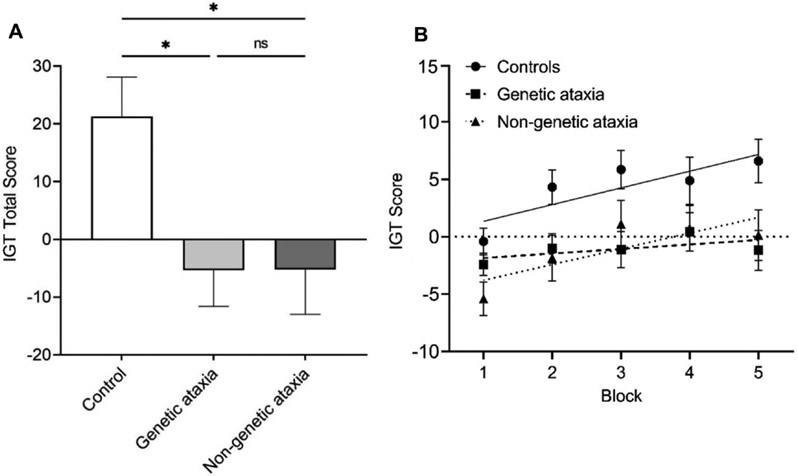
Methods: Sixty individuals with CA and thirty age-matched controls were enrolled in the study to complete the IGT. No participants had a prior or comorbid neurologic or psychiatric disorder associated with impulsivity. IGT performance in each of the five 20-trial blocks was compared between groups and the progression of participants' performance was assessed with simple linear regression models. Subgroup analyses were performed with genetic and non-genetic CA cases.
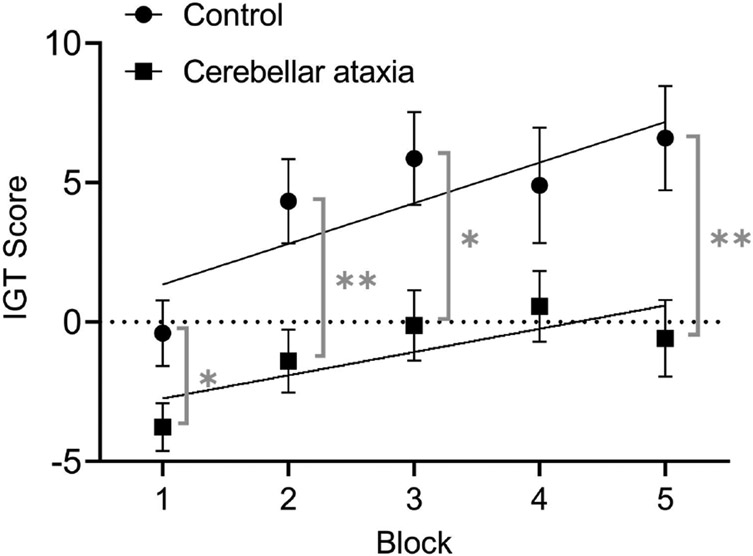
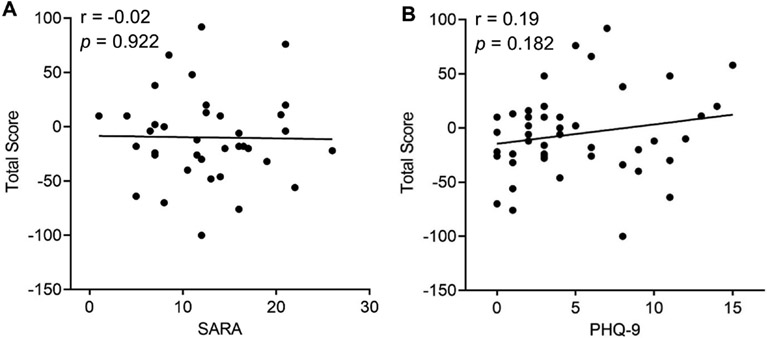
Results: CA cases obtained significantly lower IGT total scores than controls (-5.30 ± 37.53 vs. 21.30 ± 37.37, p = 0.004). In addition, those with CA made riskier decisions throughout the task compared to controls. Although both CA and controls learned to make decisions with more favorable outcomes over the course of completing the IGT, CA participants never matched the controls' performance. IGT performance did not correlate with ataxia severity or depressive symptoms.
Conclusion: The IGT may capture a unique behavioral symptom of CA. Future studies may help elucidate the mechanisms underlying impaired decision-making in CA and further the understanding of a broader spectrum of cerebellar cognitive affective syndrome.
Keywords: Cerebellar ataxia; Cerebellum; Decision making; Gambling; Impulsivity; Risk taking.
Copyright © 2022 Elsevier Ltd. All rights reserved.
Conflict of interest statement
Declaration of competing interest The authors declare that they have no known competing financial interests or personal relationships that could have appeared to influence the work reported in this paper.
Figures
References
-
- West JR, Gelderd JB, The Cerebellum, in: Conn PM (Ed.), Neuroscience in Medicine, Humana Press, Totowa, NJ, 2003: pp. 217–236. 10.1007/978-1-59259-371-2_10. - DOI
-
- Van Overwalle F, Manto M, Cattaneo Z, Clausi S, Ferrari C, Gabrieli JDE, Guell X, Heleven E, Lupo M, Ma Q, Michelutti M, Olivito G, Pu M, Rice LC, Schmahmann JD, Siciliano L, Sokolov AA, Stoodley CJ, van Dun K, Vandervert L, Leggio M, Consensus Paper: Cerebellum and Social Cognition, Cerebellum. 19 (2020) 833–868. 10.1007/s12311-020-01155-1. - DOI - PMC - PubMed
Publication types
MeSH terms
Grants and funding
LinkOut - more resources
Full Text Sources
Medical
