


The Potential of 24-Propylcholestrol as Antibacterial Oral Bacteria of Enterococcus faecalis ATCC 29212 and Inhibitor Biofilms Formation: in vitro and in silico Study
- PMID: 36578792
- PMCID: PMC9792223
- DOI: 10.2147/AABC.S372337
The Potential of 24-Propylcholestrol as Antibacterial Oral Bacteria of Enterococcus faecalis ATCC 29212 and Inhibitor Biofilms Formation: in vitro and in silico Study
Abstract
Introduction: Uncontrolled biofilm can cause several diseases such as dental caries, gingivitis, and periodontitis. Dental caries is a disease caused by the accumulation of plaque-containing pathogenic bacteria, including Enterococcus faecalis. These bacteria infect the root canals of teeth and colonize to form biofilms. Biofilm inhibition is carried out by interfering with cell wall formation metabolism. MurA enzyme has a role in peptidoglycan biosynthesis of cell walls. Enterococcal surface protein (Esp) is the main contributor of E. faecalis to form biofilms. In addition, inhibition of biofilms by interfering with the quorum sensing (QS) system, suppressing gelatinase virulence factors by blocking autoinducers gelatinase biosynthesis-activating pheromone (GBAP).
Purpose: Knowing the potential of Piper betel Linn. compounds as antibacterial in vitro and antibiofilm agents against E. faecalis in silico.
Patients and methods: The compounds were purified by a bioactivity-guided chromatographic method. Antibacterial activity was tested by disc diffusion method, in vitro studies. In silico study, compound P. betel L. was used as the test ligand and compared with positive control fosfomycin, ambuic acid, quercetin, and taxifolin. The proteins used MurA, Esp, GBAP, and gelatinase were docking with the Autodock Vina PyRx 0.8 followed by the PYMOL program and visualized with the Discovery Studio 2020 program.
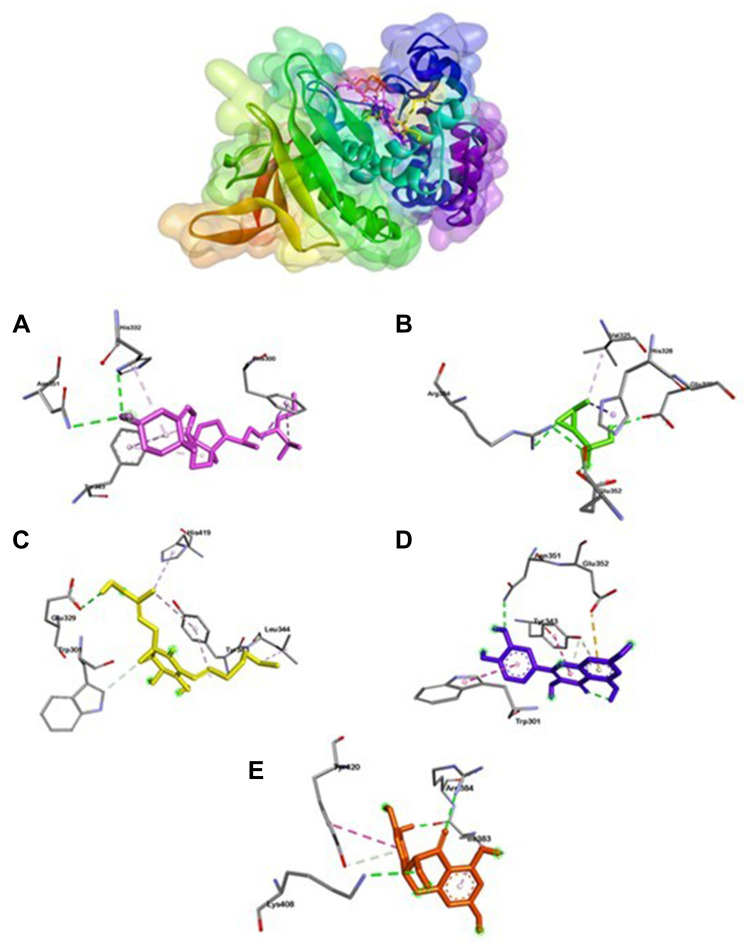
Results: An antibacterial compound was identified 24-propylcholesterol which can inhibit the activity of E. faecalis ATCC 29212 with MIC value of 78.1 µg/mL and MBC value of 156.3 µg/mL. Molecular docking results showed the binding affinity of 24-propylcholesterol with MurA, ESP, GBAP, and gelatinase enzymes was -7.6, -8.7, -5.3, and -7.9 kcal/mol.
Conclusion: 24-propylcholesterol has potential as an antibacterial against E. faecalis and as an antibiofilm through in silico inhibition of QS. However, further research is needed in vitro and in vivo to determine the effectiveness of these compounds as antibacterial and antibiofilm.
Keywords: 24-propylcholesterol; MurA; Piper betel Linn; QS; biofilm.
© 2022 Windaryanti et al.
Conflict of interest statement
The authors report no conflicts of interest in this work.
Figures




References
-
- Perry AD. Plaque control for the periodontal patient. Carranza’s Clin Periodontol. 2012:452–460. doi:10.1016/B978-1-4377-0416-7.00044-5 - DOI
-
- Kurnia D, Hutabarat GS, Windaryanti D, Herlina T, Herdiyati Y, Satari MH. Potential allylpyrocatechol derivatives as antibacterial agent against oral pathogen of S. sanguinis ATCC 10556 and as inhibitor of MurA enzymes: in vitro and in silico study. Drug Des Devel Ther. 2020;14:2977–2985. doi:10.2147/dddt.s255269 - DOI - PMC - PubMed
-
- Najafi S, Ghasempour M, Davoodabadi A, Kazemi S. Effect of arginine, protamine, and aqueous extracts of Green Tea and Aloe Vera against Enterococcus faecalis. J Islam Dent Assoc IRAN. 2019;31(1):8–13. doi:10.30699/jidai.31.1.2 - DOI
-
- Noviyandri PR, Andayani R, Rizky E. Potensi ekstrak alga Merah Gracilaria verrucosa sebagai penghambat perkembangan pembentukan biofilm Enterococcus faecalis pada infeksi saluran akar gigi. J Syiah Kuala Dent Soc. 2018;1(3):6–15.
LinkOut - more resources
Full Text Sources
Molecular Biology Databases
