


Investigation of Demand-Control-Support Model and Effort-Reward Imbalance Model as Predictor of Counterproductive Work Behaviors
- PMID: 36579002
- PMCID: PMC9772460
- DOI: 10.1016/j.shaw.2022.08.005
Investigation of Demand-Control-Support Model and Effort-Reward Imbalance Model as Predictor of Counterproductive Work Behaviors
Abstract
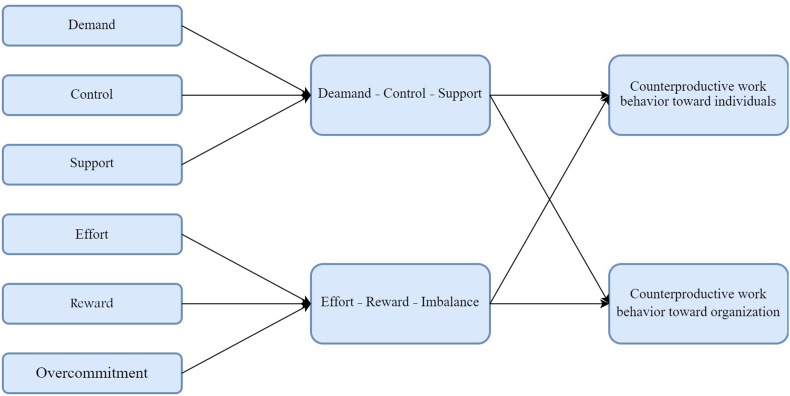
Background: Nowadays, counter-productive work behaviors (CWBs) have turned into a common and costly position for many organizations and especially health centers. Therefore, the study was carried out to examine and compare the demand-control-support (DCS) and effort-reward imbalance (ERI) models as predictors of CWBs.
Methods: The study was cross-sectional. The population was all nurses working in public hospitals in Hamadan, Iran of whom 320 were selected as the sample based on simple random sampling method. The instruments used were Job Content Questionnaire, Effort-Reward Imbalance Questionnaire, and Counterproductivity Work Behavior Questionnaire. Data were analyzed using correlation and regression analysis in SPSS18.
Results: The findings indicated that both ERI and DCS models could predict CWB (p ≤ 0.05); however, the DCS model variables can explain the variance of CWB-I and CWB-O approximately 8% more than the ERI model variables and have more power in predicting these behaviors in the nursing community.
Conclusion: According to the results, job stress is a key factor in the incidence of CWBs among nurses. Considering the importance and impact of each component of ERI and DCS models in the occurrence of CWBs, corrective actions can be taken to reduce their incidence in nurses.
Keywords: Demand–control–support model; Deviant behaviors; Effort–reward imbalance model; Job stress; Organizational intervention.
© 2022 Occupational Safety and Health Research Institute.
Conflict of interest statement
All authors have no conflicts of interest to declare.
References
-
- Sackett P.R. The structure of counterproductive work behaviors: dimensionality and relationships with facets of job performance. Int J Sel Assess. 2002;10(1-2):5–11.
-
- Robinson S.L., O'Leary-Kelly A.M. Monkey see, monkey do: the influence of work groups on the antisocial behavior of employees. Acad Manag J. 1998;41(6):658–672.
-
- pector P.E., Fox S. 2005. The stressor-emotion model of counterproductive work behavior.
-
- Gruys M.L. Minnesota Univ Minneapolis Industrial Relations Center; 1999. The dimensionality of deviant employee behavior in the workplace.
-
- Robinson S.L., Bennett R.J. A typology of deviant workplace behaviors: a multidimensional scaling study. Acad Manag J. 1995;38(2):555–572.
LinkOut - more resources
Full Text Sources
