


Exploring Clinical and Biological Features of Premature Births among Pregnant Women with SARS-CoV-2 Infection during the Pregnancy Period
- PMID: 36579593
- PMCID: PMC9694165
- DOI: 10.3390/jpm12111871
Exploring Clinical and Biological Features of Premature Births among Pregnant Women with SARS-CoV-2 Infection during the Pregnancy Period
Abstract
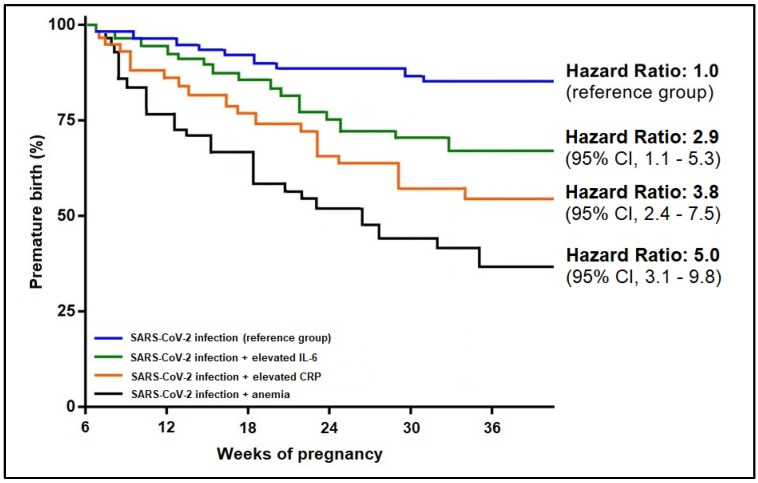
Studies observed that women infected with SARS-CoV-2 during pregnancy had a higher risk of preterm birth. Although it is likely that COVID-19 during the late trimester of pregnancy can trigger premature birth, prematurity remains a concern, and it is vital to study additional clinical and biological patient factors that are highly associated with this negative pregnancy outcome and allow for better management based on the existing predictors. In order to achieve this goal, the current study retrospectively recruited 428 pregnant patients that were separated into three study groups using a 1:2:4 matching ratio and a nearest-neighbor matching method. Sixty-one pregnant patients had a history of COVID-19 during pregnancy and gave birth prematurely; 124 pregnant patient controls had COVID-19 and gave birth full-term, while the second control group of 243 pregnant patients had a premature birth but no history of COVID-19. It was observed that a symptomatic SARS-CoV-2 infection during the third trimester was significantly more likely to be associated with premature birth. Even though the rate of ICU admission was higher in these cases, the mortality rate did not change significantly in the COVID-19 groups. However, SARS-CoV-2 infection alone did not show statistical significance in determining a premature birth (β = 1.09, CI = 0.94−1.15, p-value = 0.067). Maternal anemia was the strongest predictor for prematurity in association with SARS-CoV-2 infection (β = 3.65, CI = 1.46−5.39, p-value < 0.001), followed by elevated CRP (β = 2.11, CI = 1.20−3.06, p-value < 0.001), and respectively IL-6 (β = 1.92, CI = 1.20−2.47, p-value = 0.001. SARS-CoV-2 infection is associated with an increased risk of preterm birth, as shown by our data. If SARS-CoV-2 infection arises during the third trimester, it is recommended that these patients be hospitalized for surveillance of clinical evolution and biological parameters, such as anemia and high inflammatory markers, which have a multiplicative influence on the pregnancy result.
Keywords: COVID-19; SARS-CoV-2; pregnancy infections; premature birth; prematurity.
Conflict of interest statement
The authors declare no conflict of interest.
Figures
References
-
- Uta M., Neamtu R., Bernad E., Mocanu A.G., Gluhovschi A., Popescu A., Dahma G., Dumitru C., Stelea L., Citu C., et al. The Influence of Nutritional Supplementation for Iron Deficiency Anemia on Pregnancies Associated with SARS-CoV-2 Infection. Nutrients. 2022;14:836. doi: 10.3390/nu14040836. - DOI - PMC - PubMed
LinkOut - more resources
Full Text Sources
Research Materials
Miscellaneous
