


Factors Influencing Physician Prognosis: A Scoping Review
- PMID: 36582416
- PMCID: PMC9793048
- DOI: 10.1177/23814683221145158
Factors Influencing Physician Prognosis: A Scoping Review
Abstract
Introduction. Prognosis is an essential component of informed consent for medical decision making. Research shows that physicians display discrepancies in their prognostication, leading to variable, inaccurate, optimistic, or pessimistic prognosis. Factors driving these discrepancies and the supporting evidence have not been reviewed systematically. Methods. We undertook a scoping review to explore the literature on the factors leading to discrepancies in medical prognosis. We searched Medline (Ovid) and Embase (Ovid) databases for peer-reviewed articles from 1970 to 2017. We included articles that discussed prognosis variation or discrepancy and where factors influencing prognosis were evaluated. We extracted data outlining the participants, methodology, and prognosis discrepancy information and measured factors influencing prognosis. Results. Of 4,723 articles, 73 were included in the final analysis. There was significant variability in research methodologies. Most articles showed that physicians were pessimistic regarding patient outcomes, particularly in early trainees and acute care specialties. Accuracy rates were similar across all time periods. Factors influencing prognosis were clustered in 4 categories: patient-related factors (such as age, gender, race, diagnosis), physician-related factors (such as age, race, gender, specialty, training and experience, attitudes and values), clinical situation-related factors (such as physician-patient relationship, patient location, and clinical context), and environmental-related factors (such as country or hospital size). Discussion. Obtaining accurate prognostic information is one of the highest priorities for seriously ill patients. The literature shows trends toward pessimism, especially in early trainees and acute care specialties. While some factors may prove difficult to change, the physician's personality and psychology influence prognosis accuracy and could be tackled using debiasing strategies. Exposure to long-term patient outcomes and a multidisciplinary practice setting are environmental debiasing strategies that may warrant further research.
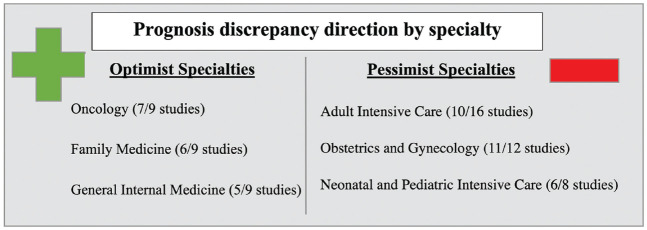
Highlights: Literature on discrepancies in physician's prognostication is heterogeneous and sparse.Literature shows that physicians are mostly pessimistic regarding patient outcomes.Literature shows that a physician's personality and psychology influence prognostic accuracy and could be improved with evidence-based debiasing strategies.Medical specialty strongly influences prognosis, with specialties exposed to acutely ill patients being more pessimistic, whereas specialties following patients longitudinally being more optimistic.Physicians early in their training were more pessimist than more experienced physicians.
Keywords: Attitudes; Bias; Ethics; Physician; prognosis.
© The Author(s) 2022.
Conflict of interest statement
The authors declared no potential conflicts of interest with respect to the research, authorship, and/or publication of this article.
Figures



References
-
- Munro M, Yu VY, Partridge JC, Martinez AM. Antenatal counselling, resuscitation practices and attitudes among Australian neonatologists towards life support in extreme prematurity. Aust N Z J Obstet Gynaecol. 2001;41(3):275–80. - PubMed
-
- Sanders MR, Donohue PK, Oberdorf MA, Rosenkrantz TS, Allen MC. Perceptions of the limit of viability: neonatologists’ attitudes toward extremely preterm infants. J Perinatol. 1995;15:494–502. - PubMed
Publication types
LinkOut - more resources
Full Text Sources
