


Surface Smoothing by Atomic Layer Deposition and Etching for the Fabrication of Nanodevices
- PMID: 36583128
- PMCID: PMC9791650
- DOI: 10.1021/acsanm.2c04025
Surface Smoothing by Atomic Layer Deposition and Etching for the Fabrication of Nanodevices
Abstract
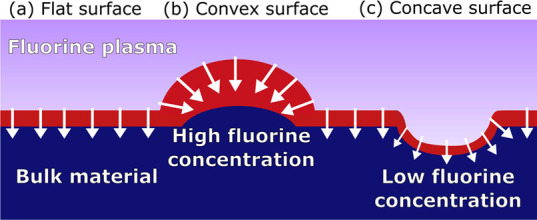
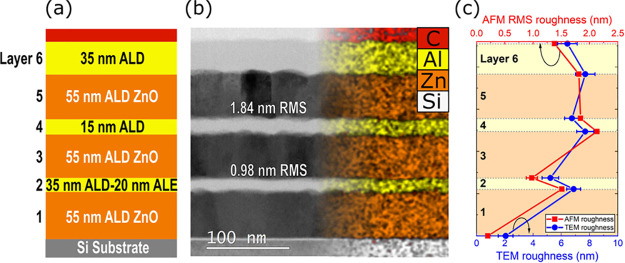
In many nano(opto)electronic devices, the roughness at surfaces and interfaces is of increasing importance, with roughness often contributing toward losses and defects, which can lead to device failure. Consequently, approaches that either limit roughness or smoothen surfaces are required to minimize surface roughness during fabrication. The atomic-scale processing techniques atomic layer deposition (ALD) and atomic layer etching (ALE) have experimentally been shown to smoothen surfaces, with the added benefit of offering uniform and conformal processing and precise thickness control. However, the mechanisms which drive smoothing during ALD and ALE have not been investigated in detail. In this work, smoothing of surfaces by ALD and ALE is studied using finite difference simulations that describe deposition/etching as a front propagating uniformly and perpendicular to the surface at every point. This uniform front propagation model was validated by performing ALD of amorphous Al2O3 using the TMA/O2 plasma. ALE from the TMA/SF6 plasma was also studied and resulted in faster smoothing than predicted by purely considering uniform front propagation. Correspondingly, it was found that for such an ALE process, a second mechanism contributes to the smoothing, hypothesized to be related to curvature-dependent surface fluorination. Individually, the atomic-scale processing techniques enable smoothing; however, ALD and ALE will need to be combined to achieve thin and smooth films, as is demonstrated and discussed in this work for multiple applications.
© 2022 The Authors. Published by American Chemical Society.
Conflict of interest statement
The authors declare no competing financial interest.
Figures




References
-
- Wang X.; Brown A. R.; Cheng B.; Asenov A.. Statistical Variability and Reliability in Nanoscale FinFETs. In Technical Digest - International Electron Devices Meeting, IEDM, 2011; pp 103–106.
-
- Lau W. S.; Yu D. Q.; Wang X.; Wong H.; Xu Y.. Confirmation of the Surface Smoothing Effect of Atomic Layer Deposition and the Physical Mechanism Responsible for Such an Effect. In China Semiconductor Technology International Conference 2016, CSTIC 2016, 2016; pp 3–5.
-
- Zhao Y.-P.; Wang G.-C.; Lu T.-M.; Palasantzas G.; de Hosson J. T. M. Surface-Roughness Effect on Capacitance and Leakage Current of an Insulating Film. Phys. Rev. B 1999, 60, 9157–9164. 10.1103/PhysRevB.60.9157. - DOI
-
- Yeh M. S.; Luo G. L.; Hou F. J.; Sung P. J.; Wang C. J.; Su C. J.; Wu C. T.; Huang Y. C.; Hong T. C.; Chen B. Y.; Chen K. M.; Wu Y. C.; Izawa M.; Miura M.; Morimoto M.; Ishimura H.; Lee Y. J.; Wu W. F.; Yeh W. K. Ge FinFET CMOS Inverters with Improved Channel Surface Roughness by Using In-Situ ALD Digital O3 Treatment. IEEE J. Electron Devices Soc. 2018, 6, 1232–1237. 10.1109/JEDS.2018.2878929. - DOI
-
- Tienda-Luna I. M.; Ruiz F. G.; Godoy A.; Biel B.; Gámiz F. Surface Roughness Scattering Model for Arbitrarily Oriented Silicon Nanowires. J. Appl. Phys. 2011, 110, 08451410.1063/1.3656026. - DOI
LinkOut - more resources
Full Text Sources