


Sex differences in borderline personality disorder: A scoping review
- PMID: 36584029
- PMCID: PMC9803119
- DOI: 10.1371/journal.pone.0279015
Sex differences in borderline personality disorder: A scoping review
Abstract
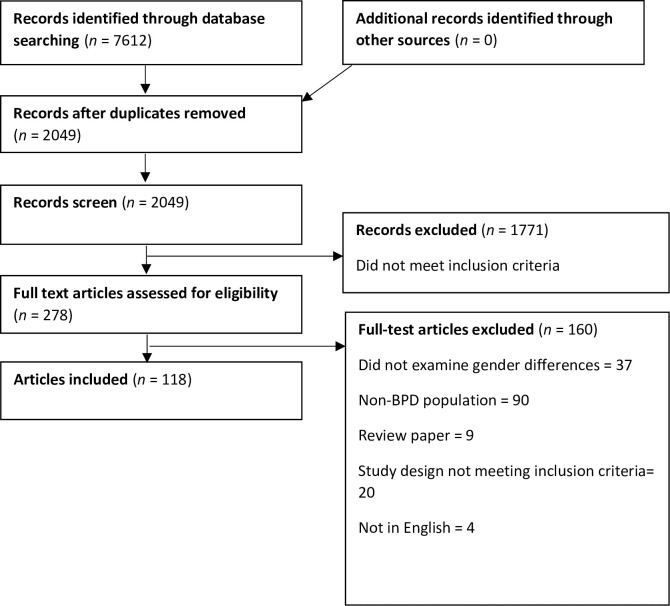
Borderline Personality Disorder (BPD) is often perceived to be a female-predominant disorder in both research and clinical contexts. Although there is growing recognition of possible sex differences, the current literature remains fragmented and inconclusive. This scoping review aimed to synthesize available research evidence on potential sex differences in BPD. PsycINFO, PubMed, Scopus and Web-of-Science were searched from January 1982 to July 2022 surrounding the key concepts of sex and BPD. Data searching and screening processes followed the Joanna Briggs Institute methodology involving two independent reviewers, and a third reviewer if necessary, and identified 118 papers. Data regarding BPD symptoms, comorbid disorders, developmental factors, biological markers, and treatment were extracted. Data was summarized using the vote counting method or narrative synthesis depending on the availability of literature. Males with BPD were more likely to present externalizing symptoms (e.g., aggressiveness) and comorbid disorders (e.g., substance use), while females with BPD were more likely to present internalizing symptoms (e.g., affective instability) and comorbid disorders (e.g., mood and eating disorders). This review also revealed that substantially more research attention has been given to overall sex differences in baseline BPD symptoms and comorbid disorders. In contrast, there is a dearth of sex-related research pertaining to treatment outcomes, developmental factors, and possible biological markers of BPD. The present scoping review synthesized current studies on sex differences in BPD, with males more likely to present with externalizing symptoms in contrast to females. However, how this might change the prognosis of the disorder or lead to modifications of treatment has not been investigated. Most studies were conducted on western populations, mainly North American (55%) or European (33%), and there is a need for future research to also take into consideration genetic, cultural, and environmental concomitants. As the biological construct of 'sex' was employed in the present review, future research could also investigate the social construct 'gender'. Longitudinal research designs are needed to understand any longer-term sex influence on the course of the disorder.
Copyright: © 2022 Qian et al. This is an open access article distributed under the terms of the Creative Commons Attribution License, which permits unrestricted use, distribution, and reproduction in any medium, provided the original author and source are credited.
Conflict of interest statement
The authors have declared that no competing interests exist.
Figures
References
-
- American Psychiatric Association. Diagnostic and statistical manual of mental disorders: DSM-5. 5th ed. Washington, DC: American Psychiatric Publishing; 2013.
-
- Ten Have M, Verheul R, Kaasenbrood A, van Dorsselaer S, Tuithof M, Kleinjan M, et al. Prevalence rates of borderline personality disorder symptoms: A study based on the Netherlands Mental Health Survey and Incidence Study-2. BMC Psychiatry. 2016;16(1):249. doi: 10.1186/s12888-016-0939-x - DOI - PMC - PubMed
Publication types
MeSH terms
LinkOut - more resources
Full Text Sources
Medical
Research Materials
